
Charles R. Goulding and Preeti Sulibhavi analyze how companies like Pulte, Lennar, D.R. Horton, and KB Home are integrating additive manufacturing to cut costs and boost energy efficiency.
Housing affordability is back at the center of national policy discussions. A persistent residential housing shortage, combined with years of elevated interest rates, has left many would-be buyers on the sidelines. Policymakers are looking for ways to unlock demand, and the nation’s largest home builders are preparing for what they expect will be a renewed expansion cycle.
A strong U.S. new home construction market depends on a few fundamentals: manageable interest rates, buyers with sufficient down payments, a reliable construction supply chain, and enough skilled labor to keep projects moving. The current administration has signaled its focus on rate relief and stimulative policies, including proposals that would allow prospective buyers to access 401(k) funds for down payments under certain conditions. Lower financing costs could unlock pent-up demand quickly.
But policy alone will not solve the affordability problem. Builders must reduce construction time, limit cost overruns, and improve quality. That is where automation and 3D printing are becoming central to strategy. The largest residential builders are not simply experimenting with additive manufacturing. They are integrating it into energy systems, structural elements, and even full-scale construction processes.
Let’s look at how several major players are approaching this shift.
PulteGroup, Inc.
PulteGroup is estimated to invest roughly $85 million annually in research and development. That is a meaningful budget in an industry that has historically been conservative and margin-focused. Much of Pulte’s R&D has targeted energy efficiency, a priority that directly affects affordability over the life of a home.
Energy-efficient residential construction increasingly relies on components that can benefit from additive manufacturing. Advanced HVAC duct geometries, customized airflow manifolds, sensor housings, lighting fixtures, and mounting brackets can all be optimized and produced through 3D printing. In many cases, additive methods reduce material waste and allow for more compact system integration. The result is lower energy consumption and fewer installation errors.
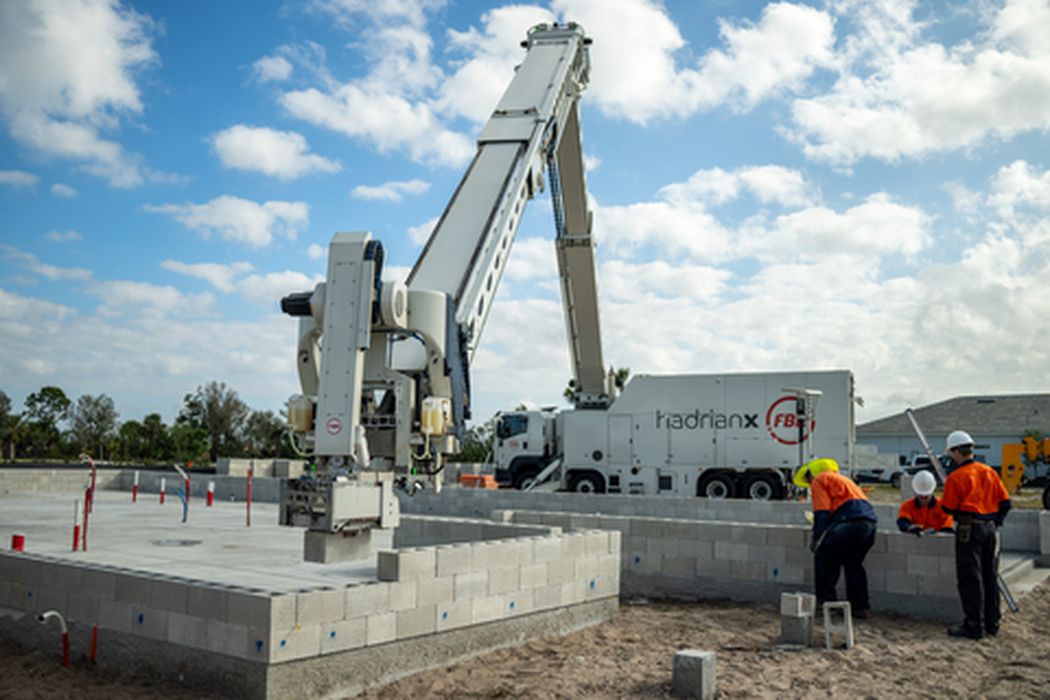
Pulte has also explored automation in core construction activities. The company has evaluated robotic bricklaying systems such as the Hadrian X, developed by FBR Ltd. The Hadrian X robot uses a dynamic stabilization system and robotic arm to place blocks rapidly and with consistent mortar application. As discussed in our August 2025 coverage of American industrialization efforts around Hadrian, robotic bricklaying can significantly reduce labor requirements while improving repeatability.
For large-scale builders like Pulte, the value is not only speed. Standardization improves inspection outcomes and reduces warranty claims. A precisely placed wall assembly with minimal variation is easier to integrate with prefabricated trusses, windows, and MEP systems.
There is also an interesting policy link. Bill Pulte, grandson of Pulte’s founder, now serves as head of the Federal Housing Finance Agency, overseeing Fannie Mae, Freddie Mac, and the Federal Home Loan Bank System. His background in home building provides practical insight into construction costs, supply chain challenges, and the importance of scalable innovation. While regulatory oversight and builder operations remain separate, this alignment underscores how deeply construction efficiency now connects to national housing strategy.
Lennar Corporation
Lennar has taken one of the most visible steps into 3D printed housing with its Wolf Ranch development in Georgetown, near Austin, Texas. In partnership with ICON, Lennar began constructing what is widely described as the largest 3D printed housing community in the world at Wolf Ranch.
At Wolf Ranch, ICON’s gantry-style concrete printers fabricate wall systems layer by layer using a proprietary cementitious material. The printed walls are then integrated with traditional roofing, windows, plumbing, and electrical systems. The homes are marketed as energy-efficient, resilient, and competitively priced relative to comparable site-built homes.
The benefits are measurable. Printed wall systems reduce framing waste, minimize jobsite debris, and offer strong thermal mass performance. Combined with Lennar’s broader energy-efficiency focus, including high-performance insulation and smart home systems, the printed structures help reduce long-term operating costs for homeowners.
The Wolf Ranch project is also a test of scalability. One-off demonstration homes prove feasibility. A multi-home development tests supply chain coordination, inspection frameworks, subcontractor training, and buyer acceptance. Early indications suggest that buyers are willing to embrace printed homes when design and finishing quality match conventional construction.
For Lennar, 3D printing is not replacing the entire construction process. Instead, it standardizes one of the most labor-intensive portions: wall assembly. That targeted integration approach reduces risk while capturing efficiency gains.
D.R. Horton, Inc.
D.R. Horton, the largest U.S. home builder by volume, has also explored additive construction technologies. The company previously partnered with ICON on pilot 3D printed homes in Texas, testing concrete wall systems within traditional subdivisions.
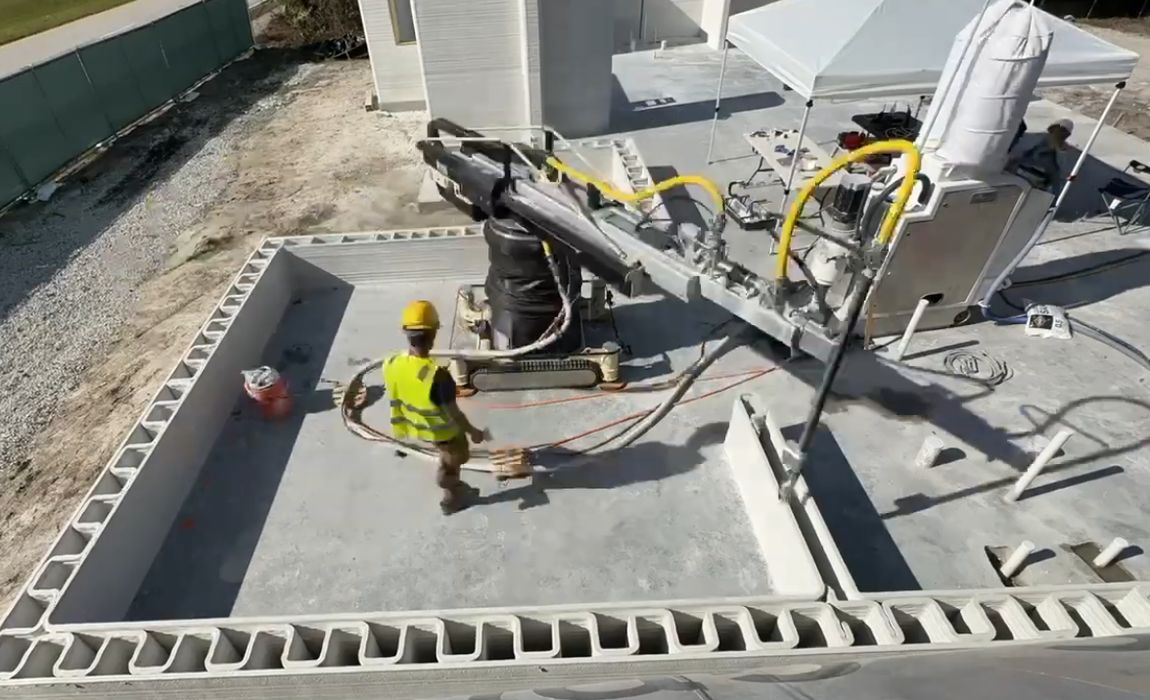
More recently, D.R. Horton has worked with Apis Cor, whose mobile 3D printing systems can operate directly on site. Apis Cor’s approach differs from gantry systems in that its robotic arm printer can rotate and print curved or complex geometries without extensive fixed infrastructure.
In practical terms, this allows builders to deploy printers across multiple lots without dismantling large frames. It also opens the possibility of customized layouts or architectural features without major cost penalties.
Images of 3D printed homes from these projects typically show distinctive layered wall textures, curved corners, and monolithic wall assemblies. Behind the aesthetics lies a more important metric: labor efficiency. Concrete extrusion systems can operate with smaller crews and reduced reliance on scarce skilled trades.
D.R. Horton’s experimentation reflects a cautious but serious approach. Rather than betting on a single platform, the company appears to be evaluating multiple technologies to determine which integrates best with its standardized production model.
KB Home
In our May 2022 article, we highlighted how KB Home faced critical component shortages during pandemic-era supply chain disruptions. At that time, we suggested that 3D printing could fill supply chain gaps by producing small but essential components locally.
That prediction has proven increasingly relevant.
Across the construction sector, additive manufacturing is now used to produce HVAC connectors, electrical conduit fittings, plumbing brackets, custom fasteners, and even replacement parts for jobsite equipment. Instead of waiting weeks for overseas shipments, builders can produce short-run components in regional hubs or through third-party service bureaus.
In addition, polymer 3D printing has become more common for jigs, alignment guides, and installation templates. These tools improve assembly accuracy and reduce rework. For a high-volume builder like KB Home, small efficiency gains multiplied across thousands of units translate into significant cost savings.
The broader ecosystem is also evolving. Construction-focused additive firms are developing printable cement blends with improved curing times and structural performance. Robotics companies are refining autonomous systems for repetitive site tasks. Meanwhile, inspection authorities are becoming more familiar with printed structures, reducing approval friction.
For KB Home and its peers, the lesson is clear: additive manufacturing does not need to replace traditional construction wholesale to deliver value. It can address bottlenecks, reduce dependency on fragile supply chains, and improve part consistency.
The Research & Development Tax Credit
The now permanent Research & Development Tax Credit (R&D) Tax Credit is available for companies developing new or improved products, processes and/or software.
3D printing can help boost a company’s R&D Tax Credits. Wages for technical employees creating, testing and revising 3D printed prototypes can be included as a percentage of eligible time spent for the R&D Tax Credit. Similarly, when used as a method of improving a process, time spent integrating 3D printing hardware and software counts as an eligible activity. Lastly, when used for modeling and preproduction, the costs of filaments consumed during the development process may also be recovered.
Whether it is used for creating and testing prototypes or for final production, 3D printing is a strong indicator that R&D-eligible activities are taking place. Companies implementing this technology at any point should consider taking advantage of R&D Tax Credits.
The Bigger Picture
The largest residential builders excel at standardization. They design repeatable floor plans, negotiate volume-based material contracts, and refine production sequences. 3D printing aligns naturally with this model.
Standardized printed components improve quality by reducing human variability. Layer-by-layer fabrication produces consistent geometries. Digital files can be version-controlled and updated centrally. Design improvements propagate quickly across projects.
Cost reductions come from several sources: lower material waste, reduced labor intensity, fewer errors, and shorter build times. In a market where even small cost savings can expand affordability, these improvements matter.
Housing affordability will always depend on macroeconomic conditions such as interest rates and wage growth. But construction efficiency is a lever builders can control directly. The companies profiled here are not experimenting for publicity. They are preparing for scale.
If demand accelerates due to lower rates or policy incentives, builders equipped with automated and additive technologies will be positioned to respond faster and at lower cost. That responsiveness could help close the housing gap more quickly than traditional methods alone.
3D printing will not solve the housing shortage by itself. But integrated thoughtfully into standardized, high-volume production systems, it can make homes more affordable, more energy-efficient, and more consistent in quality.
For an industry often criticized for slow innovation, that represents meaningful progress.