
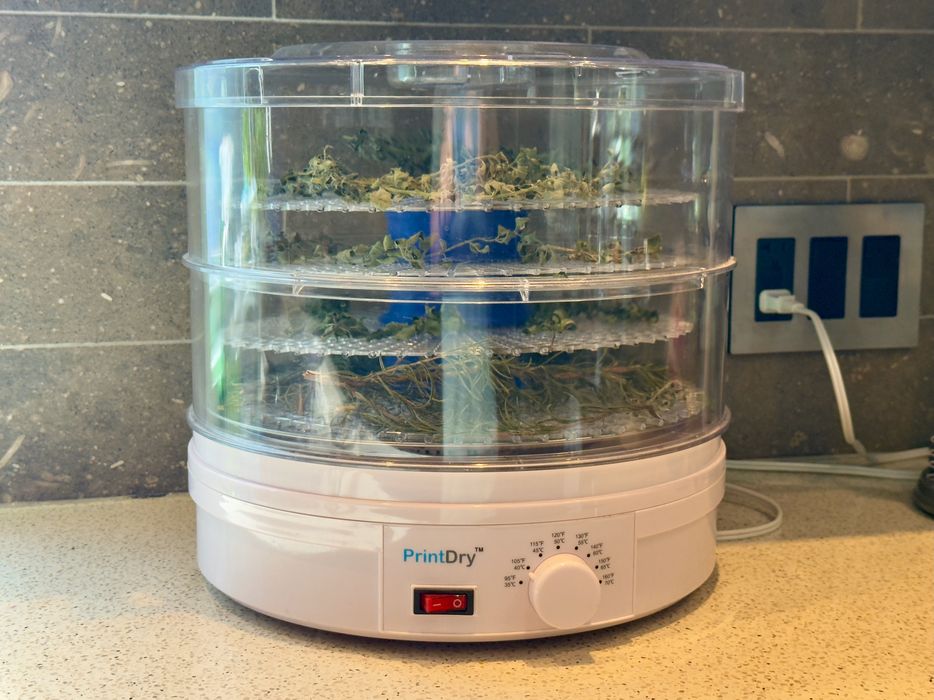
Oh, how times have changed with filament drying.
Today, many new machines include integrated drying or accessories to perform filament drying. But many years ago, at the dawn of desktop 3D printing, there was no concept of drying filament. It was a miracle if the print happened at all, let alone tuning the result by drying filament.
Then, around 2015 the concept of filament drying emerged, but it wasn’t something you could easily do. Many people tried baking filament in their home ovens — sometimes with disastrous results. It was then clear that specific drying hardware was required.
One of the very first drying systems to appear was the PrintDry, from, not surprisingly, Ontario-based PrintDry. It was launched on Kickstarter back in 2016, and I actually have one of them.
Since then, PrintDry went on to produce a series of increasingly capable print drying systems, now marketing the PRO4 model.
But the original PrintDry was essentially a repurposed food dryer. I mean, it was literally a food dryer with some slightly different shelving.
It worked pretty well as a filament dryer, and I used it for a few years. Nowadays, filament dryers are everywhere; they seem to come with most machines. In fact, looking around the lab here, I can count capacity to dry up to 17 spools at once. We’re drowning in dryers.
But what of the original PrintDry?
This fall, I harvested a number of herbs and needed to dry them for the winter. I didn’t have a food dryer.
But I did have the PrintDry!
I then repurposed the repurposed dryer back into a food dryer, as you can see above.
It worked perfectly, just as it did with filament spools, and the circle is complete.