
Could the answer to filament feeding problems be bigger wheels?
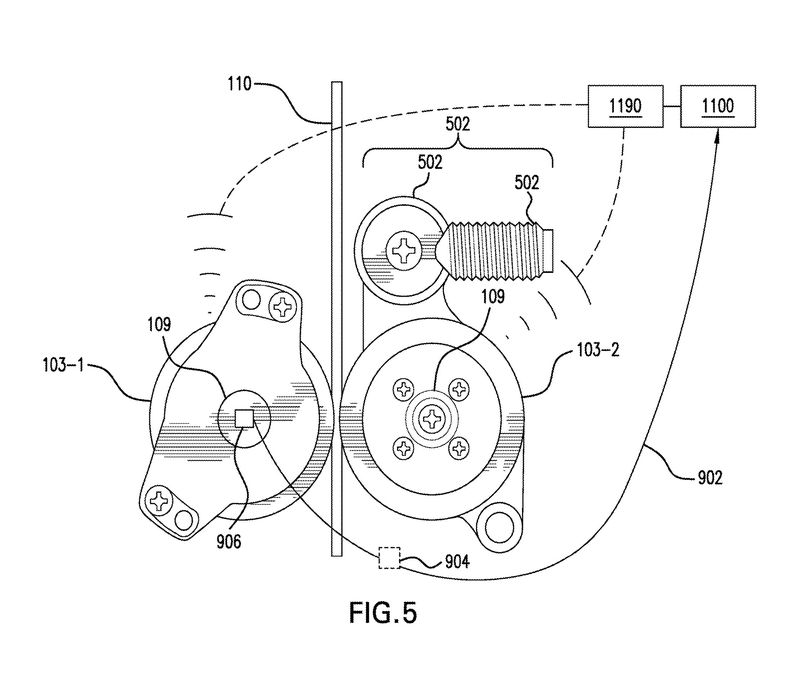
A recently published US patent application from 3D Print Innovations proposes an unusual FFF extruder arrangement that uses oversized drive wheels to grip filament over a longer distance. The idea is to push harder and respond faster without grinding up the filament in the process.
In a typical FFF extruder, a pair of small wheels pinches the incoming filament and forces it toward the hot end. One wheel is often powered while the other rolls along passively. When the printer needs more flow, the drive system has to apply additional force through a relatively small contact area.
There are some issues with that setup. Too much pressure can deform or damage the filament, and I’ve personally experienced that many times. Too little grip can produce slipping, inconsistent extrusion or jams. That, too.
Their patent, US20260316382A1, suggests increasing the diameter of these wheels, known as hobs, from the roughly eight to 15mm sizes used in today’s designs to around 20–40mm. That creates a longer contact area along the filament, distributing the driving force over more material.
The designers also describe shaped gripping surfaces and teeth, along with adjustable pressure to accommodate different filaments. One version uses a powered wheel and passive wheel, but another drives both sides independently.
Instead of squeezing a filament harder at one small point, the extruder can apply force along a longer section, potentially generating more grip.
The application claims that such a system could deliver 30 pounds of peak feeding force with 1.75mm filament, compared with the two to 14 pounds it claims is possible with conventional extruders. It also mentions 40 pounds or more with larger filament diameters.
With motors driving both hobs, the patent describes using motor current, encoders or other sensors to monitor what the extruder is doing. A controller could then adjust wheel speed and driving force as the print head accelerates, decelerates and changes direction.
Imagine the print head approaching a sharp corner. It slows down, but pressure inside the hot end doesn’t disappear instantly. The proposed controller could retract filament as the machine slows, then push material forward before it accelerates out of the corner.
Their goal is more consistent extrusion during rapid speed changes, with less unwanted material at corners and less delay when printing restarts. Increased grip might also help overcome resistance from the filament path or spool rotation.
This isn’t free, however. Larger wheels take up a lot more room, and driving two wheels independently requires more motors, electronics and calibration. Larger wheel diameters also change how much filament advances for each revolution, making motion resolution a design consideration. Slicer changes are obviously needed, too.
I’d be interested to see whether the extra contact area really produces better extrusion at high acceleration, particularly with softer or easily damaged materials, like TPU.
Via Espacenet