
We could see some very interesting DLP systems appear in the coming months.
Why? It’s because of a new component being developed by Norway-based Visitech.
But first, some background. The resin 3D printers we see have certain specifications, and a question you might ask is, why would the machines have those specific features? Why not something slightly different?
The answer is that the machine manufacturers do not build the entire machine. They are actually assembling components provided by other manufacturers. So, for example, the reason that a resin 3D printer had a resolution of 16K pixels was because its manufacturer found a source for 16K LCD panels. In that case, the resolution was effectively chosen by the supplier, not the manufacturer. Typically, 3D printer sales volumes are not high enough to influence the design of these components, so manufacturers take what they can get.
This all means that in order to understand what type of machines might be coming in the future, you can look at the nature of new components being made available. Presumably, a 3D printer manufacturer might use those new components in a new 3D printer.
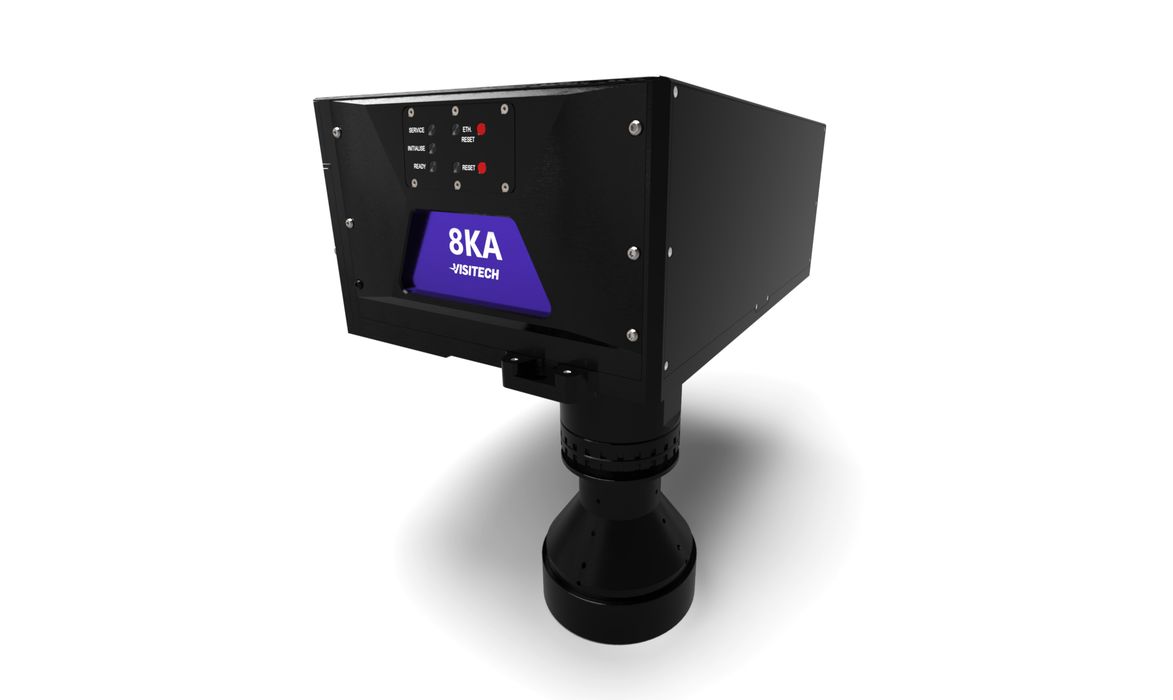
That could be the case here, as Visitech announced the LRS 8KA Laser 405. It is a DLP-powered light engine that can be used in 3D printers. The device selectively illuminates pixels on the build plane by bouncing laser light off of a 4K DMD chip. Through some secret magic, the LRS 8KA Laser 405 can hit more than 35 million pixels per exposure.
The interesting part is that the company’s earlier system used LED light as the light source. Here, they are using a laser, which is much more powerful. In fact, Visitech said the new component delivers 2X the energy of its predecessor.
The implication here is that resin machine manufacturers might consider using the LRS 8KA Laser 405 in their machines. If so, they could deliver energy to the resin at a far faster rate. This means that curing would happen more rapidly, increasing print speed. More energy equals more polymerization.
There’s also the number of pixels, 35M. That’s quite a large number. A manufacturer building a 3D printer around this light engine could choose to build in a smaller area, providing extremely fine resolution, or print a much larger object at a normal resolution.
Either way, we could be seeing some interesting resin 3D printers appear soon.
Via Visitech
