
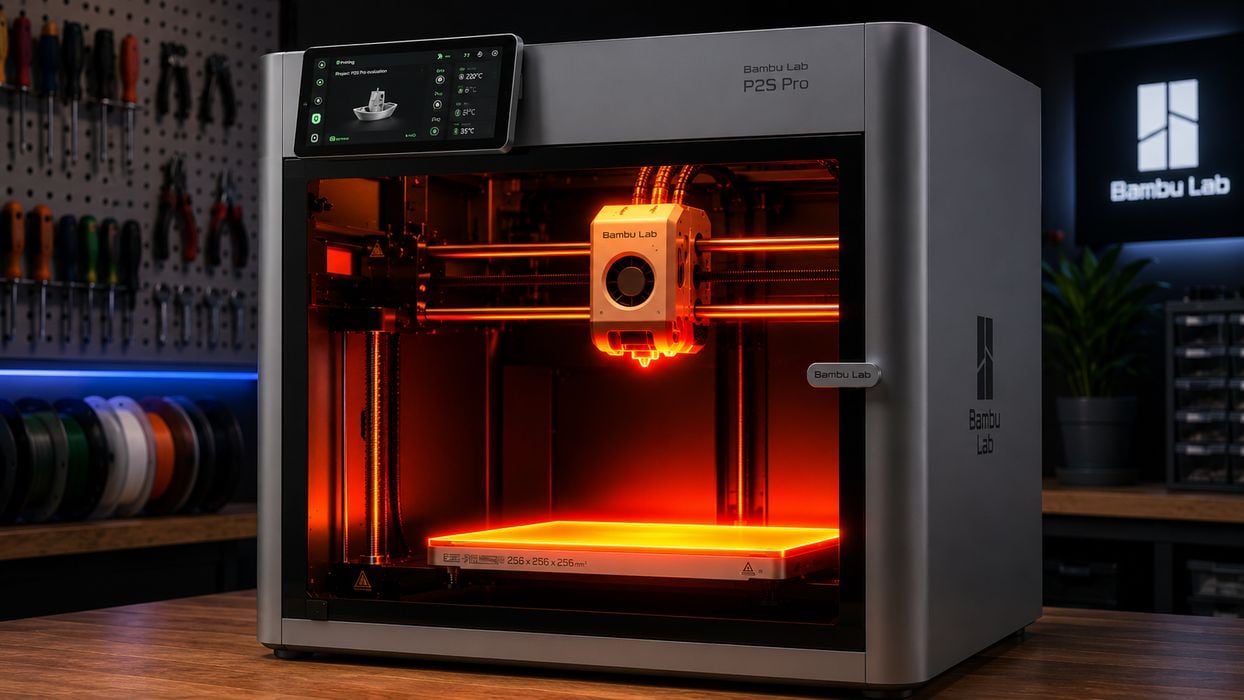
Shenzhen Tuozhu Technology has filed a patent application for a 3D printer control system that manages heating loads more intelligently.
The patent is CN-121973446-A. The assignee is Shenzhen Tuozhu Technology Co., Ltd., which is, of course, better known internationally through its well-known Bambu Lab brand.
This is not a flashy patent about speed, multicolor printing, or exotic materials. Instead, it is all about efficient power control. That may sound routine, but it’s actually quite interesting.
Today’s desktop FFF systems can contain several heating elements, including the hot end and the build plate. In some machines, there is a heated chamber or auxiliary heating systems. Each of these heaters can create electrical loads that draw significant power, particularly during warmup.
The patent describes a 3D printer with two heating modules. Each heating module is connected in series with its own switch, forming two separate electrical branches. Those branches are then connected in parallel to the mains power grid.
In other words, the printer has at least two independently controlled heating circuits drawing from the same AC power source.
The interesting part is how the printer changes its behaviour after the heating phase.
During warmup, both heating modules require more power. That makes sense: the printer is trying to bring components up to their target temperatures as quickly as possible. Once the target temperatures are reached, however, the system enters a temperature maintenance phase, where much less power is required.
The patent’s method sends control signals to the two switches during the heating phase, and then different control signals once the heating modules reach their target temperatures. The later control signals have lower duty cycles, meaning the heaters are on for less of the time.
That sequence is standard; many heating systems use duty cycle control to maintain temperature.
But there’s one issue.
If two heaters switch on and off at the same time, the printer can create an unnecessary peak power draw. That can stress internal components, create electrical noise, or produce less stable behaviour on weaker circuits. In a home or small workshop, this can also cause problems when printers share an outlet or run near the limit of a breaker.
Bambu Lab’s patent seems to address that by staggering the switching pattern. Within a control cycle, the on and off times of the first switch during maintenance are different from those of the second switch.
In other words, rather than pulsing both heaters together, the printer can alternate or offset them. The total temperature maintenance work still happens, but the instantaneous electrical load may be smoother.
This could be a small but useful improvement for higher-power desktop printers, especially enclosed FFF machines that combine bed heating, nozzle heating, and possibly chamber heating. Those machines are becoming more common as consumer and prosumer systems move toward engineering materials.
Operators don’t buy a 3D printer because of advanced heater duty cycle logic. But they do notice faster warmup, fewer faults, more stable temperatures, fewer electrical surprises, and better reliability during long prints.
I should point out that a patent application is not a product announcement. Companies patent many internal ideas, and not all of them appear visibly in commercial machines. Some do, some do not.
Regardless, this patent suggests Bambu Lab is thinking carefully about the electrical behaviour of its printers, not just the visible mechanics and software features. They may be considering situations where their equipment is used in print farms, where many small electrical peaks can add up to a significant issue.
