
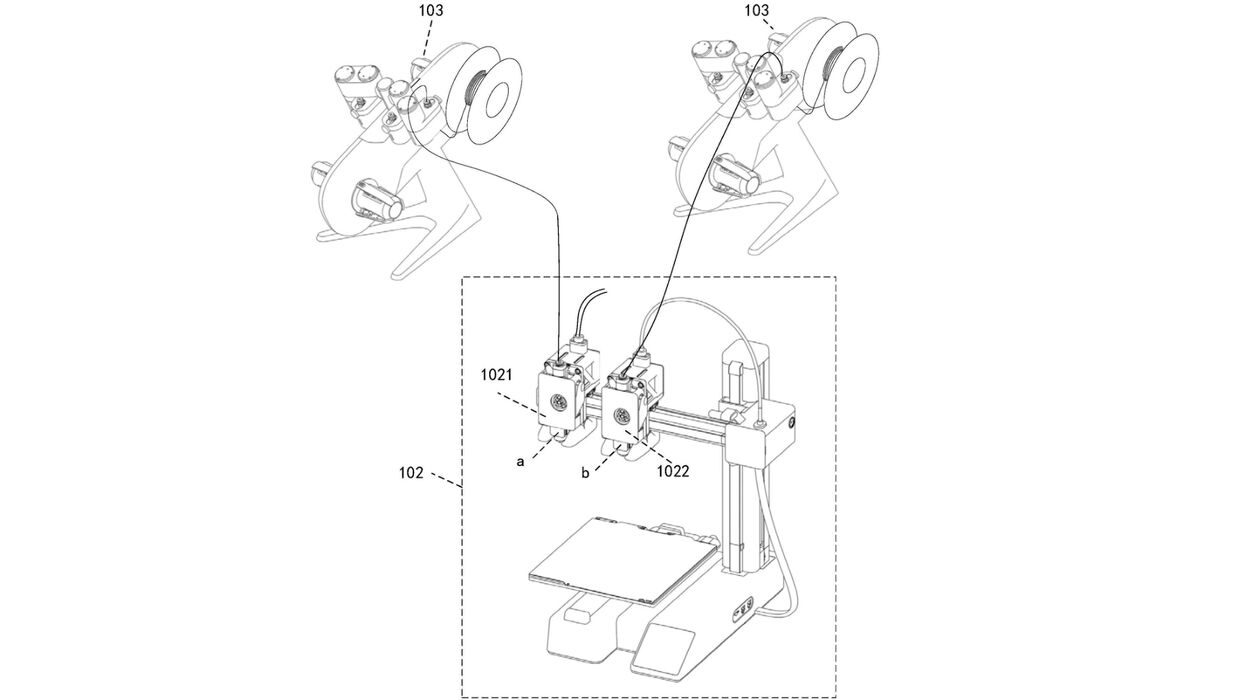
Bambu Lab just received a very interesting multimaterial patent.
The patent in question, WO-2025218693-A1, “MATERIAL CHANGE HANDLING METHOD FOR 3D PRINTER, AND RELATED DEVICE”, is assigned to Shenzhen Tuozhu Tech Co Ltd, a.k.a Bambu Lab.
Is this a new multi-filament hardware design? Nope, this is a methodology for assigning filaments to print heads. While this might not sound immediately interesting, it is actually an incredibly valuable technology.
When you run a FFF 3D printer with a single filament and hot end, there’s nothing to decide: the filament goes into that hot end. The problem gets more complex when there are multiple print heads combined with filament swapping accessories.
Consider this scenario: you are printing a part with a two printhead machine, and one printhead has a four-spool AMS attached. The model in question has five colors. Which filaments should be on which toolhead? The answer is that the most frequently used filament should be on the dedicated printhead to minimize the number of filament swaps — and purges.
That’s the obvious answer, but it’s actually more complex: which materials appear on the same layers, and therefore require swapping? The answer depends on the model geometry and color assignments.
That all makes sense, but what happens when there are more than two printheads? Or more than two AMS units?
How about when Bambu Lab later this year launches their Vortek system, which has SEVEN hot ends and two printheads? The problem gets vastly more complex, likely impossible for operators to figure out on their own.
The patent describes an approach where a co-occurence matrix is produced, which tallies up the frequency of times two colors appear on the same layer. This is then grouped by an algorithm to separate materials with high co-occurrences to different printheads.
The goals are to minimize the number of filament swaps, and also the amount of material purged.
Eventually, the algorithms produce a recommendation for filament assignments: “these four filaments are on this printhead, and these other four filaments are on the other printhead.” This is then reflected in the slicing software and ultimately provokes the operator to bounce some spools around in their AMS units.
The method seems to be a technology that would greatly optimize the use of Vortek technology, possibly dramatically reducing the amount of waste, number of filament swaps and reducing print time overall. If you think about it, how could you hope to figure out the best way to organize spools for a complex multicolor print job without this tech?
That’s all good news for Bambu Lab, which will certainly implement this technology on their upcoming Vortek system, and perhaps even in their slicing software for use with existing products.
It is not so good news for Bambu Lab’s competitors. Any company offering a filament swapping system with multiple printheads will not be able to use this approach unless licensed by Bambu Lab (unlikely).
There are two other companies that deserve mention: Prusa Research and Snapmaker, both of which have (or are) developing multicolor 3D print systems.
Snapmaker’s approach with their U1 device is to have four separate toolheads, each with a dedicated extruder and filament spool. The new Bambu Lab technology does not apply to them because they aren’t using a filament swapper. However, they are limited to a maximum of only four colors per job.
Prusa Research hasn’t released a new multicolor system, but they have hinted they’re working with Bondtech to implement that company’s INDX system. The INDX approach involves hot ends that are attached again to dedicated spools. There doesn’t seem to be a filament swapper in the configuration.
If either of those companies ever wanted to add a filament swapper to their multicolor systems, they’d run into a patent problem with Bambu Lab. Either that, or they would run their filament swappers with lower efficiency without the optimization algorithms. Print jobs would consume more material and take longer than the equivalent configuration on a Bambu Lab system.
In practice this could mean that Bambu Lab’s competitors might be constrained to the number of colors matching their hardware printheads. Meanwhile, Bambu Lab could attach filament swappers to potentially all of their printheads. If Vortek has seven hot ends, then that might eventually mean jobs could print with 7 hot ends times 4 AMS colors, 28 colors in total.
I don’t think other companies are going to produce machines with 28 printheads.
Via PatentScope
