
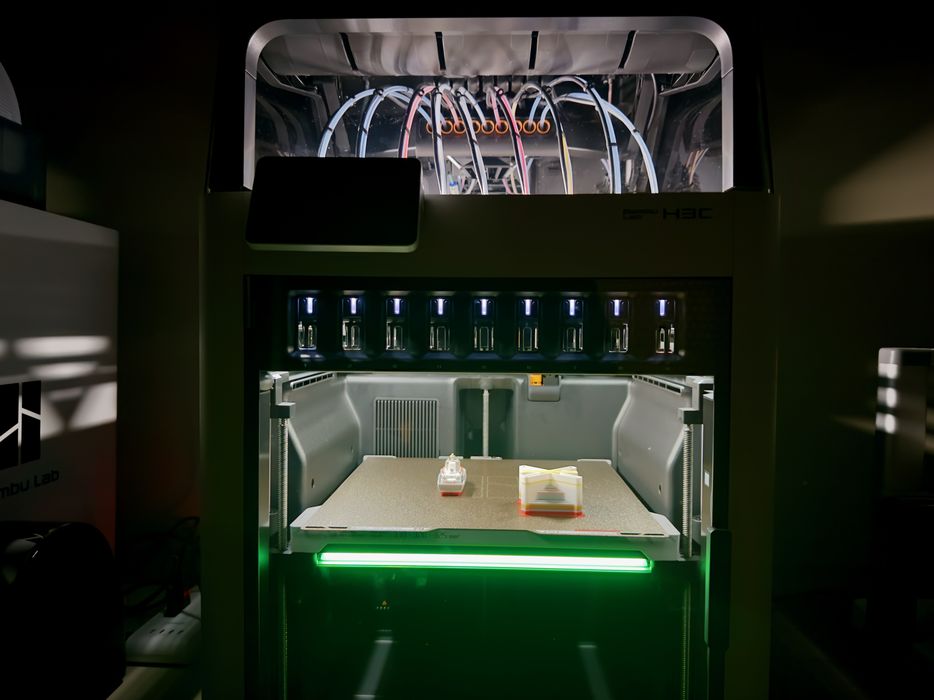
The high-end toolchanger market has suddenly become a bit more uncomfortable for many 3D printer manufacturers.
Bambu Lab’s new H3C includes nine independently heated print tools, automatic filament handling, a 330 × 320 × 325 mm build volume and a 65C actively heated chamber for just US$2,499. It handles different nozzle sizes and materials, including the very soft TPU 75A, and can do print tool swaps in only six seconds.
Two weeks ago, a machine with even half of those features would have looked pretty interesting.
Let’s consider Prusa’s XL+. Its five-tool model lists at US$3,899, with an enclosure costing even more. The XL+ has a larger 360 mm cubic build volume, proven reliability and the ability to use some specialized tools, including silicone printing.
But someone shopping for multicolor or multi-material printing must now rationalize why five tools cost way more than nine.
If the XL now finds itself in an uncomfortable market space, the company’s CORE One+ INDX could be in a better position.
That system has eight tools for US$2,249 fully assembled, with a pretty efficient priming system and an upgradeable, open architecture. Some independent comparison tests found there was quite a bit less purge waste on INDX than on the H3C. The problem for Prusa is that their INDX system has a smaller build volume, while the H3C is a fully integrated package with filament storage and drying right on board.
LightMake’s product launch seems to have not the greatest timing. Its L4, with four independently moving printheads, is prepping the first deliveries after a very successful crowdfunding campaign. Their US$2,399 system price is very close to the H3C price.
The L4 has one actual advantage over the H3C: it can build four separate objects simultaneously!
That could be of great interest if you’re using the system for production parts. But if you just print occasional multicolor/multimaterial parts there’s no need for simultaneous 3D printing, and the H3C might be a better choice.
Sovol is competing with its new seven-tool M1D model, currently available for pre-order at US$1,499. Its independent dual extruders allow copy and mirror printing, like the L4, but again, fewer operators require that feature.
Then there are Snapmaker and Creality. Snapmaker’s U1 carries four toolheads and has recently been offered around US$700–750. Creality announced US availability of its four-nozzle K3 at US$849 on November 3 — precisely the day Bambu unveiled the H3C. Flashforge’s four-tool Creator 5 Pro is also in this lower-cost territory.
These machines should not be threatened by the H3C, because they provide real toolchanging at about one-third of Bambu’s price. Plenty of operators need four materials, not nine, and will enjoy saving some cash.
Perhaps the most interesting question is about the major 3D printer companies that are still without an automatic toolchanger.
Anycubic’s Kobra X and Kobra S1 Max are filament swappers systems, capable of printing many colors but generating massive amounts of material waste. ELEGOO has a similar lower-cost approach with its Centauri Carbon 2 with CANVAS filament swapper.
These companies have quite a large price advantage over the H3C, but they now have a big decision about adding more powerful systems to their product lines.
Developing a fancy toolchanger takes a lot of effort, and Bambu has already launched a powerful system at a good price. Anycubic, for example, may have to reconsider what kind of premium multi-material machine it should develop in their lab, assuming they are going to make one at all.
It seems that Bambu Lab has dramatically collapsed the market for expensive toolchangers. Their competitors will now need off products that are noticeably cheaper, or offer a feature that is truly different and useful.
Multiple printheads are no longer a game changing feature. They are now the default.
Via Bambu Lab