
The 3D printer price reset seems to be complete.
I’m referring to the cascade of price changes that should be happening as a result of Elegoo’s Centauri Carbon 3D printer. This machine was announced several months ago, and it shocked the community. The machine’s capabilities were similar to advanced desktop devices of the day: CoreXY, enclosed system, high speed, convenience features, high quality, reliability, etc.
However, instead of carrying the typical price point of around US$700-800, the Centauri Carbon was priced at an amazing US$300. This was less than half of the cost of similar machines, and drew in a large number of orders.
At the time I believed that they had effectively “reset” the price scale for desktop 3D printers. At the price of US$300 there would no longer be a reason to purchase open gantry 3D printers that had dominated the market for over a decade, for example. Competing machines would have to make adjustments to keep up with Elegoo’s price point.
Accordingly, we saw several desktop 3D printer manufacturers offer discounts of varying amounts, which presumably helped their sales. Competition is wonderful for buyers, but less so for the manufacturers. In fact, several smaller 3D printer manufacturers have effectively left the business because of this shift.
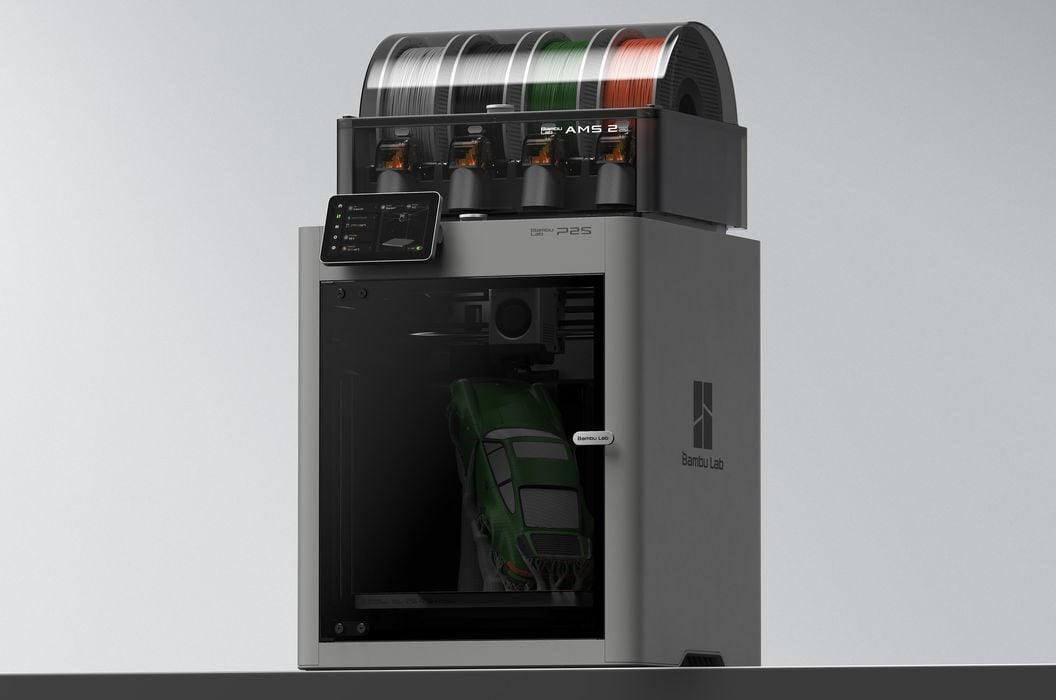
This week saw the introduction of the Bambu Lab P2S, a replacement for the popular P1S. The P2S turns out to be far more interesting than first thought.
First, let’s consider the P1S and the X1C. The X1C was the earlier machine, and it was targeted at professionals. It was designed to print composite materials, and used a number of sensors and systems to ensure high quality output. But as such it carried a fairly high price point well over US$1000 before tariffs.
The P1S was a very similar machine, but with stripped down features to allow a lower price point. Because of the lower price, many operators acquired P1S systems, and were happy with the result. The P1S was priced around US$700, although it is now discounted.
The P2S suddenly appeared this week, billed as the replacement for the P1S. That is indeed where it seems to fit into the Bambu Lab product lineup, but as I went through the P2S specifications I saw many familiar things.
The P2S can print composite materials, for example. It uses a variety of sensors to ensure print quality. And more.
It seems to me that the P2S is a lot more like the X1C than the old P1S.
Is the P2S really replacing the X1C and not the P1S? Price-wise it replaces the P1S, but function-wise it is really very much like the X1C.
Bambu Lab still sells the X1C, currently priced at US$799 (lower outside of the US), so the P2S isn’t officially replacing the X1C. If it was, the X1C would no longer be sold. However, if you are considering buying an X1C why wouldn’t you buy a P2S instead? It’s less expensive and seems to have the same features — and some advancements.
The P2S is sold (outside the US until tariffs are sorted out) at around US$750, the previous price of the P1S. If it’s functionally replacing the X1C, this means that the X1C function price has been lowered to that level.
The Elegoo price move seems to have percolated into the Bambu Lab pricing logic, as it has for other manufacturers.
For buyers this is all incredibly good news: advanced machines are available at even lower price points.
That is, if you’re allowed to buy the products, sigh.
