
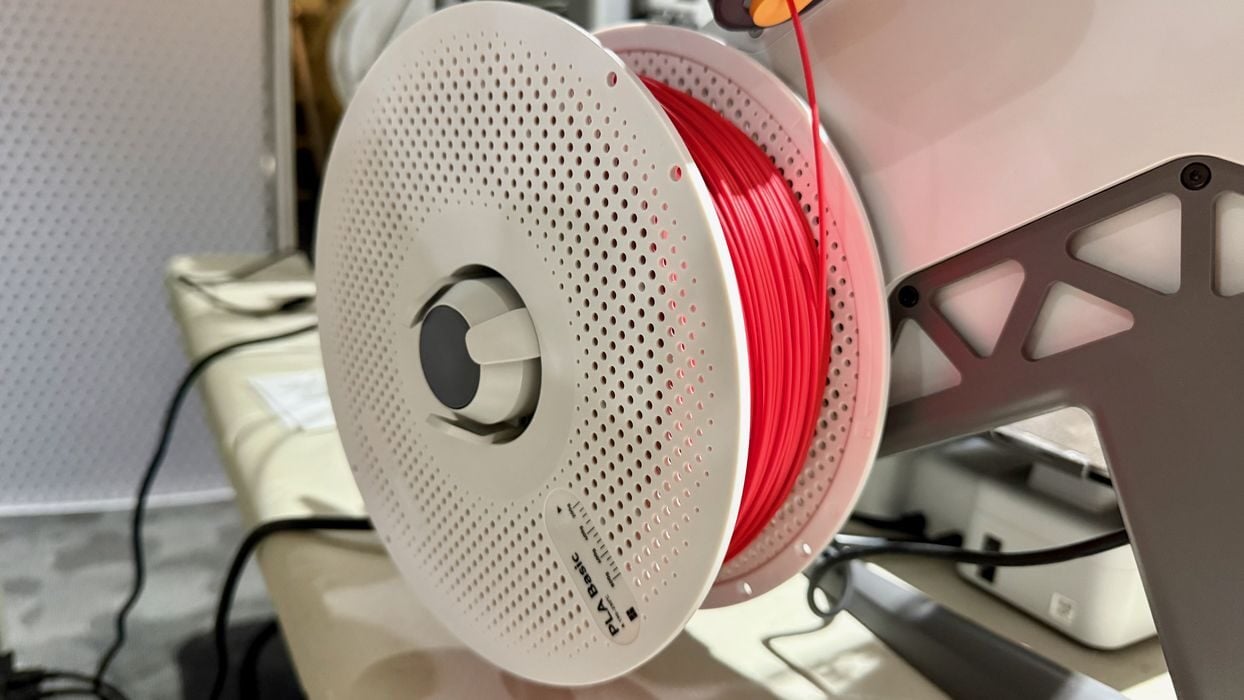
Has Bambu Lab won the filament spool format war?
Bambu Lab arrived on the scene two years ago, and their equipment’s reliability, ease of use, and low prices have generated staggering growth for the Chinese company. The company produces vast amounts of filament spools sold with their equipment, and all of those spools fit neatly into the AMS filament-switching accessories for their devices.
The problem has been that spools from other providers don’t exactly fit. There can be variances in the outer diameter, core diameter, or spool width, all of which can cause problems when using the spool in an AMS. If the core isn’t within a few millimetres of the Bambu Lab standard, you can’t mount it on an AMS Lite, for example. In the regular AMS, larger spools might not fit in the curved space, and they may not rotate smoothly.
Some 3D printer operators have reacted by designing 3D printable adaptors, creating compatibility lists, and other approaches. Some of this works, some does not.
Now I’m increasingly hearing that third-party filament providers are quietly changing their spool formats to be fully Bambu Lab compatible. There are also sales of refills that just happen to be perfectly sized to fit on empty Bambu Lab spools.
This makes an incredible amount of sense: if your product cannot be easily used on one of the leading 3D printers’ equipment, you’re losing sales.
That has no doubt caused most of the third-party providers to switch sizes, or at least consider doing so.
While there’s been no official announcement from anyone about this, it seems to be developing into a de facto industry standard. If you were opening a new filament shop today and had to design your spool format, what would you do?
Standards are like that: nothing happens for quite a while, and then a few move to it. And then a few more, and suddenly it’s a standard, and you’re obligated to use it.
What we haven’t really seen much of yet is 3D printer manufacturers themselves purposely designing new equipment to use Bambu Lab format spools, aside from perhaps Creality and Anycubic, where Bambu Lab format spools seem to fit well in their AMS-equivalent systems.
It’s likely that we will see many new 3D printers adopt this informal standard within a year or two, because it just makes sense technically and financially. With so many filament options now using this standard, a machine that doesn’t use it would be at a significant disadvantage.
What’s next? I’m hoping that the industry agrees to an RFID standard that could then be applied to all these spools. Then every AMS-like system could automatically detect the type of material mounted, and the 3D print world would be drastically simplified.
Elegoo has proposed such a standard, but we’re at the early stages, where almost no one uses it.
Be patient.
