
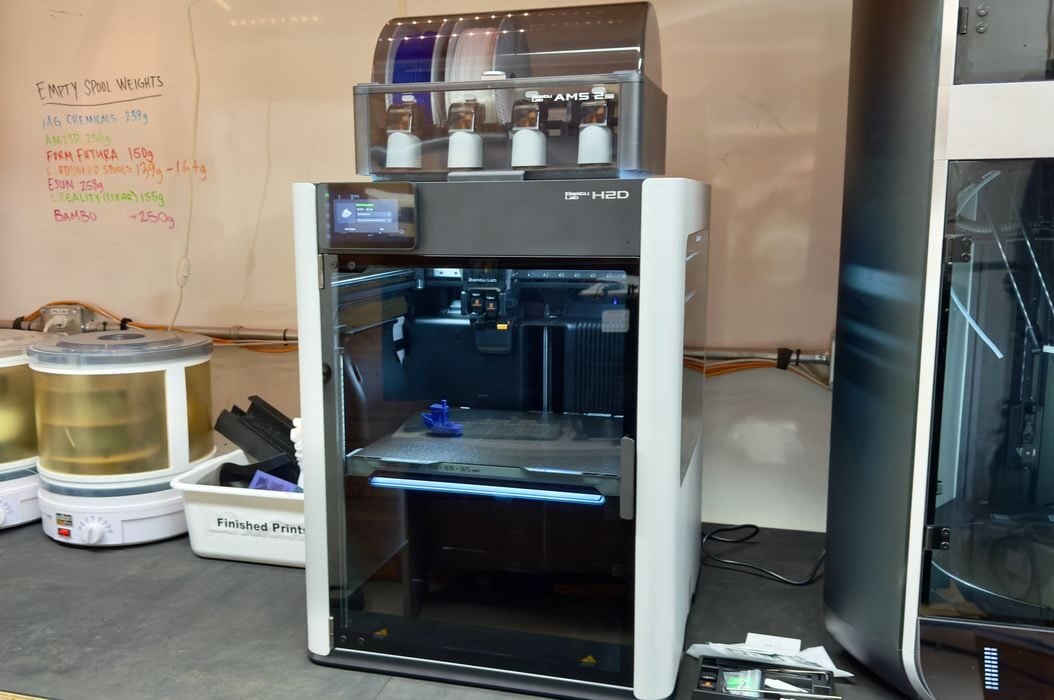
A curious cluster of Bambu Lab patent applications has suddenly appeared.
Six WO applications from Shenzhen Tuozhu Technology, the corporate entity behind Bambu Lab, were published on September 24. At first glance they look like separate inventions, but put together they form a coherent picture: cameras, calibration, tool identification and laser positioning.
In other words, they look very much like pieces of the H2D, which, don’t forget, includes a laser engraving option.
The timing is difficult to ignore. At least five of the applications claim Chinese priority dates between March 19 and March 21, 2025. Bambu Lab formally launched the H2D on March 25, introducing a hybrid machine combining FFF 3D printing, laser engraving, cutting and plotting.
The patents appear to protect some of the machinery that makes such a complicated device manageable.
WO2026194700 describes a motion calibration system. The machine moves through commanded positions while a camera observes a calibration pattern. Actual positions can then be compared with where the machine thought it was, producing correction information for the motion system.
WO2026194409 tackles another alignment problem. The printer produces parallel line segments, photographs them and calculates toolhead offset. The patent specifically contemplates a dual-nozzle toolhead and determining the offset between the nozzles.
Two more applications deal directly with the laser system. WO2026194989 has the laser make a mark, then uses a camera to locate that mark and calculate the laser’s actual position. WO2026195013 moves through different Z heights while producing laser marks, using the resulting patterns to determine the laser’s focal height automatically.
The remaining pair is about the machine knowing what has been installed. WO2026194461 uses visible identifiers on different processing platforms so a camera can determine which surface or panel is in place. WO2026195050 puts encoded information on the hot end cooling fin, allowing the machine to identify the installed hot end, including nozzle diameter.
Taken together, this looks less like six independent inventions and more like an intellectual-property fence around the H2D’s automation layer. Bambu Lab’s H2D documentation describes vision-based motion correction, camera-assisted spatial alignment, automatic laser focusing and automated nozzle calibration, all themes that appear throughout this group.
There’s another oddity here: they’re WO applications.
Most Bambu Lab patents we’ve encountered have appeared as Chinese CN publications. A WO number indicates an international application under the Patent Cooperation Treaty. It isn’t a worldwide patent, but it preserves a path to pursue protection in multiple countries. WIPO normally publishes these applications about 18 months after the earliest priority date, which explains why inventions filed just before the H2D launch have suddenly emerged together now.
I wonder whether Stratasys has influenced Bambu Lab’s thinking here.
Stratasys sued Bambu Lab in the US in August 2024, months before these inventions were first filed in China. That dispute has since become very real: a Texas jury recently found Bambu Lab infringed four Stratasys patents and awarded US$27.6 million in damages. Bambu Lab has said it intends to challenge the result.
There’s no evidence that the lawsuit caused this PCT filing strategy, and Bambu Lab had already used international filings before. But being on the receiving end of a serious international patent action is a pretty effective demonstration of what patents can do.
For a company now selling machines globally, protecting major new technology only in China would leave a big gap. These filings suggest Bambu Lab may be becoming more aggressive about building an international patent portfolio around technologies it considers strategically important.
