
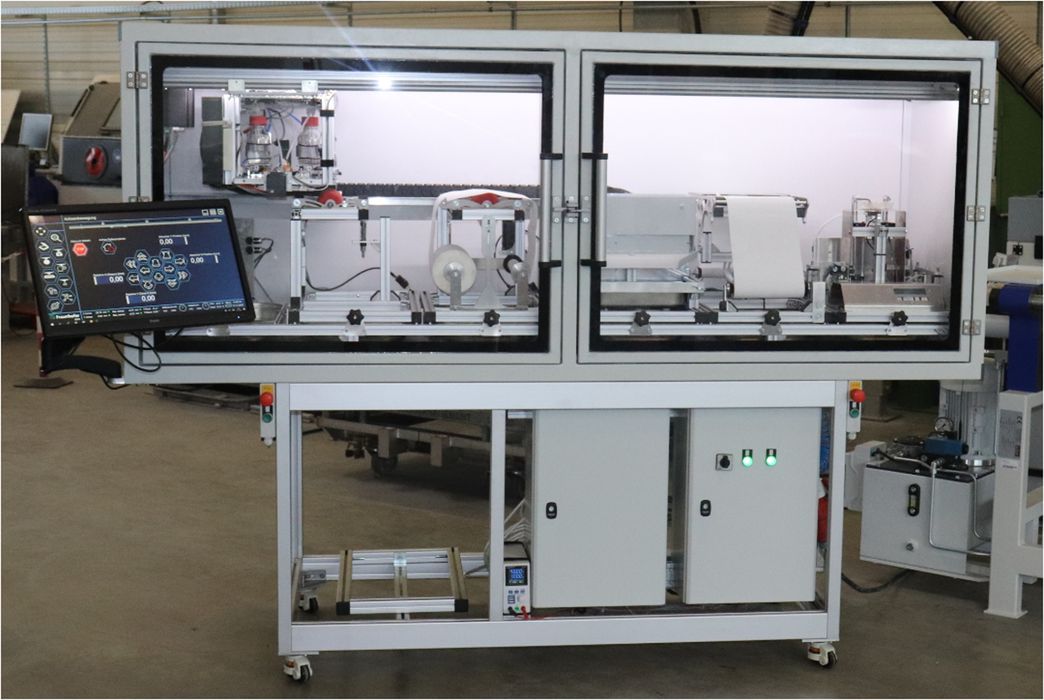
A new Open Ceramics research paper examines how sand binder jetting already supports series production and what it will take to industrialize slurry-based ceramic 3D printing.
Binder jetting has quietly become a mainstream approach in some foundry workflows, where printed sand molds and cores enable complex castings without tooling lead time. Industrial systems from players such as the ExOne line and voxeljet are now common in automotive and heavy industry, thanks to huge build volumes, job box swapping, and increasingly automated depowdering. This research paper assembles that progress and contrasts it with slurry-based ceramic 3D printing, which has impressive part properties but remains harder to scale.
In sand applications, binder jetting uses organic or inorganic binders to selectively solidify foundry-grade sand. Typical systems run layer thicknesses around two to three tenths of a millimeter, with build volumes reaching up to four by two by one meters on the largest platforms. Foundries value the ability to tile cores across the bed, implement shift-based job changes, and reclaim a high percentage of unused sand, reducing material cost and waste.
By comparison, slurry-based ceramic printing — most commonly stereolithography of high solids slurries for alumina, zirconia, or silicon nitride — can deliver dense, near-net parts after debinding and sintering. However, it faces different bottlenecks: slurry rheology and stability, green body handling, sintering shrinkage control, and the sheer logistics of post-processing at larger scales. The paper’s core question is how to bring the repeatability and throughput of sand binder jetting to ceramics that must be sintered.
Sand Binder Jetting Has Crossed The Production Threshold
Series production with sand is no longer an aspiration. Automotive programs routinely print thousands of cores per year, exploiting job box exchange to minimize idle time and deploying automated unpack stations to reduce labor. Some users report sand reclaim rates above ninety percent with stable loop control when powder conditioning and sieving are integrated. Inorganic binders reduce emissions in the foundry and simplify burnout, though they often demand tighter humidity and temperature control during printing and curing.
However, binder costs are non-trivial, curing procedures add hours to cycle time, and geometric fidelity can be limited by sand grain size and layer height. Accuracy in the tenths of a millimeter plus a percentage of part size is typical, good enough for casting cores but not quite finished parts for some applications. Yet the economics work when compared against tooling, especially for complex cooling channels or late design changes where printed cores enable castable geometries that CNC tech can’t reach.
What It Takes To Industrialize Slurry-Based Ceramics
For slurry-based 3D print processes, it starts with materials. High solids loading in the slurry — often more than fifty volume percent — is required to reach density after sintering, but raises viscosity, captures air, and risks sedimentation. The paper highlights the need for in-printer mixing, temperature conditioning, and continuous rheology checks to keep the window of printability open for long builds. Closed-loop exposure control and layer inspection might reduce defects before parts ever reach the kiln.
Downstream from the actual print job, debinding and sintering occupy most of the schedule, energy, and yield. Green parts must survive solvent or thermal debinding without cracking, then shrink predictably — often in the mid-teens percent linearly — to hit tolerance. That implies standardized fixtures, burn-off recipes customized to each specific binder, and predictive compensation in the slicer before the print even starts. Continuous monitoring, such as CT sampling, and statistical process control become essential as volumes rise. Throughput is controlled by furnace capacity; multi-lane printers paired with conveyorized furnaces or modular kiln banks could prove useful in larger scale scenarios.
Economically, slurry-based ceramics will succeed first where material value is high and part counts are moderate. These applications might include dental zirconia, electronics substrates, wear components, and fluid handling. Service bureaus and OEMs in these verticals will demand documented yield, overall equipment effectiveness, and clear total cost per part. The paper does not disclose pricing or specific cycle times, but does list the controlling factors: solids loading, green strength, debind time, sinter utilization, and automation of washing, handling, and inspection.
Also note IP and qualification hurdles. Medical and aerospace applications require validated materials and audited process chains. Cloud or MES lock-in may accelerate traceability, but can add cost and limit flexibility.
Proof will come from factories that publish sustained yield and OEE over months, not days. Watch for case studies with named customers, automated cells with robots between printer and furnace, and standardized powder or slurry cartridges that simplify changeover. A likely milestone is when an operator can swap a slurry on a line with the same reliability a foundry swaps sand jobs today.
If all this really works, then we could see factories producing parts with smoother surfaces and more complex features.
Via Open Ceramics
