
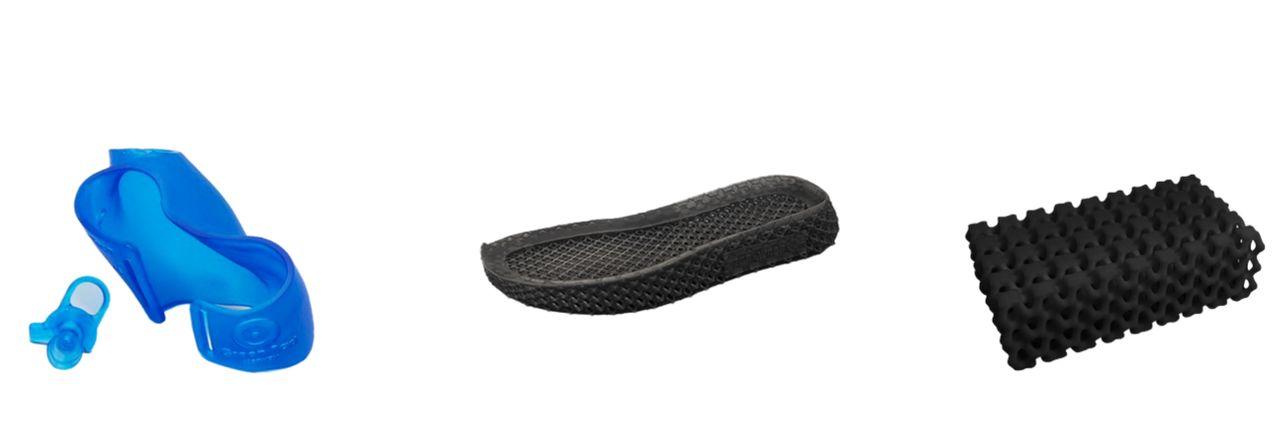
Axtra3D continues to progress with more announcements about new materials and capabilities.
I’ve been quite impressed with Axtra3D. They appeared on the scene only a few years ago, offering a unique resin 3D printing process that combines two techniques typically used separately. The result was a system that seems to be growing in adoption.
Part of their success is likely due to their continual progress in materials. While much media focus is on the machines, the real action is in the materials: engineers design parts that require specific materials, and if that material isn’t printable, then it won’t be printed.
Making more materials available should always be a priority among 3D printer manufacturers.
Axtra3D’s latest announcement involves three new resin materials:
- Loctite 3D IND475
- Loctite 3D Med414
- Ultracur3D EL 4000
Let’s take apart these new materials. IND475 turns out to be an elastomer. When cured, it results in a material that is a very soft 48A. That’s quite soft and therefore suitable for gaskets, seals, pads, and much more.
Med414 is also an elastomer that is Shore 50A, also quite soft. However, it is certified for use in medical environments, making it ideal for skin contact applications, medical seals, and similar. Along with the availability of the material, the certifications also open up applications in regulated environments that otherwise would not legally be able to use the material.
And yes, EL 4000 is also an elastomer, but a much harder one at 90A. This material is ideal for more aggressive applications, such as seats, shock-absorbing pads, etc.
While each of these materials is an elastomer, they are all very different from each other. This illustrates the importance of a broad set of available materials, since all three would be used in quite different applications.
Along with the materials, Axtra3D also announced a new product they call “Axtra Workflow”. It’s not a software product, as you might expect something called “workflow” to be; instead, it’s a kind of all-in-one bundle of equipment and software that makes up a small manufacturing centre.
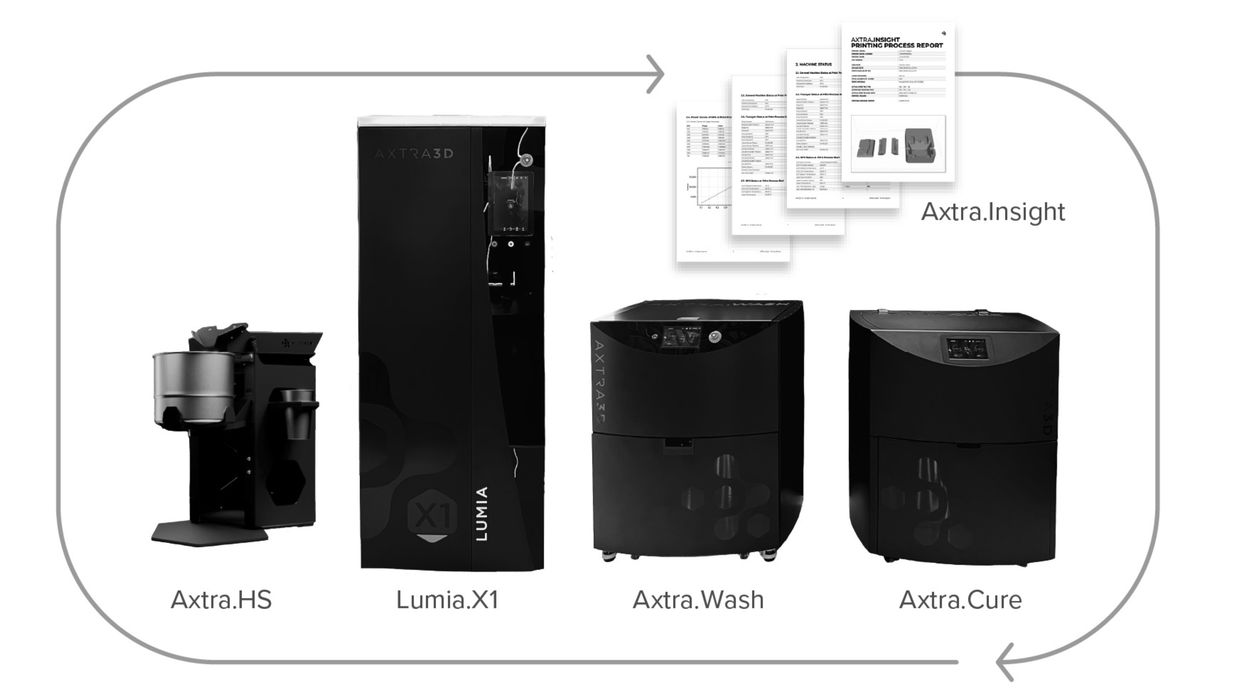
Axtra Workflow includes not only the Lumia 3D printer itself, but also new wash and cure stations (Axtra.Wash and Axtra.Cure), which perform those necessary functions.
In addition, there is something called the “Axtra.HS”, which is a “handling system”. This is a unique product that I haven’t yet seen in other systems. The idea is to provide a platform for easy removal of leftover resin from a resin vat.
Normally, that process involves manually pouring resin through filters to recover and clean it for future use. That’s often an awkward procedure that can be dangerous if PPE isn’t present. The Axtra.HS simplifies things by holding up the resin tank in a proper position for this work. Axtra3D said this unit can “save time, cost, and resin”, and I don’t doubt that.
Finally, the bundle includes Axtra.Insight, which is a software tool to provide a complete, end-to-end management system for parts production. The system can perform layer-level process monitoring and traceability, for example. It integrates with manufacturing execution systems to accept new work and generates copious reports on activities. Not only do you get the hardware here, but also sophisticated software to run it all in an efficient manner.
The Axtra Workflow system will certainly be of interest to those already running Axtra3D gear, as it should simplify operations and perhaps even encourage a bit more throughput. For new buyers, it could also be attractive due to its simplicity: it’s all included, and you just need to start printing.
Competing systems should offer something as straightforward as this combo product.
Via Axtra3D
