
Fake 3D printed tokens flood a charitable event in Canada.
The town of Esquimalt in British Columbia is known for a few things: its beautiful parklands and beaches; its large Canadian Forces naval base; and its annual Ribfest, which brings locals and visitors together to eat BBQ and raise money for local charities. This year’s Ribfest, while delivering on the fun and food promised, was also rocked by a scandal that saw the organizers lose thousands of dollars in charitable funds due to a scam involving 3D printed drink tokens.
Tens of thousands of people turned out to the three-day event, and many ribs and drinks were sold, all in the interest of raising money for local organizations and charities. When the end of the event rolled around, however, the organizers realized that many of the tokens that had been exchanged for drinks were counterfeits that had allegedly been 3D printed.
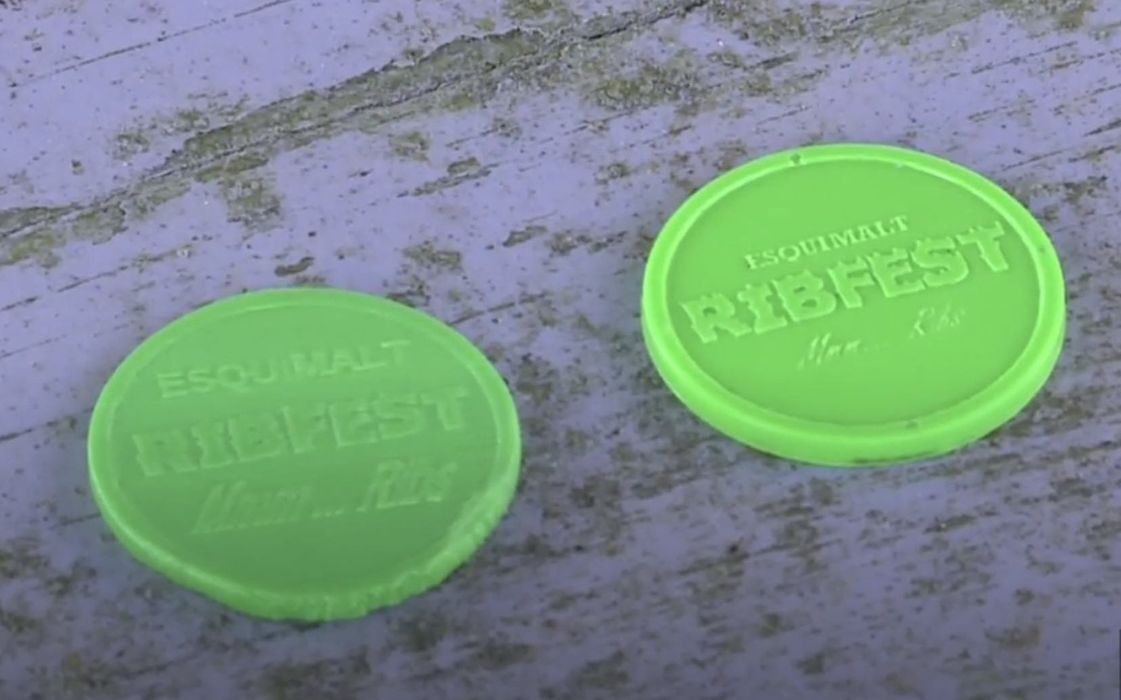
The tokens themselves are green plastic coins with “Esquimalt Ribfest Mmm…Ribs” embossed on one side. With the coins placed side by side, the small differences between the real and fake ones are discernible—one has a larger font for the final words, for example—but for a bartender serving a crowd, it’s no surprise the fake tokens went undetected.
Tom Woods, Esquimalt Ribfest Committee Chair, told Global News that he believes someone with a 3D printer copied the original token and printed out hundreds of copies, selling them to people for a profit. The real tokens could be purchased for $8 and exchanged for beer, wine and coolers at the Ribfest. “Every festival that uses these plastic tokens, it’s a shot across the bow,” he said. “You can’t do this anymore because you can show up in the morning with a digital printer, buy one token and go home and create 50 of them, right? So we all have to figure out different ways. There’s ways you can load a wristband and then tap the wristband.”
There are certainly risks with 3D printing when it comes to counterfeiting. The technology can be used to reproduce products that are not authentic and are then sold under false pretences. On a small scale, that can look like a maker misusing a 3D model that is protected under certain copyright laws. On a larger scale, you have what happened at Ribfest. (It is worth mentioning, that while there was much discourse on the risks of 3D printing for counterfeiting a few years ago—with a 2017 EU parliament report even citing it—few examples have materialized since.)
We do, however, see 3D printing being used more and more for anti-counterfeiting applications. For instance, a team of engineers from the University of Hong Kong were investigating the use of 3D printing to create polarization-encoded anti-counterfeiting labels, which could encrypt more digital information that a QR code, say. More recently, another group of researchers from Washington University developed a way to embed fingerprints into 3D printed parts, which could be useful for forensic investigations and traceability.
Read the rest of this story at VoxelMatters
