Charles R. Goulding and Preeti Sulibhavi investigate how Austal USA is not just expanding shipyard capacity with new multi-hundred-million-dollar facilities but also embedding cutting-edge 3D printing and additive manufacturing to transform naval supply chains and dramatically cut lead times.
Austal USA is undergoing one of the most aggressive growth phases in its history—massive facility expansions, hundreds of millions in investment, and a major ramp-up in additive manufacturing (AM) capability. As shipbuilding demands rise, particularly for the U.S. Navy’s submarine programs and the Coast Guard, Austal is betting big on new infrastructure, 3D printing, and advanced technologies to reduce lead times, boost resilience in the supply chain, and deliver warships more efficiently.
From Steel Modules to Submarine Modules: The Infrastructure Boom
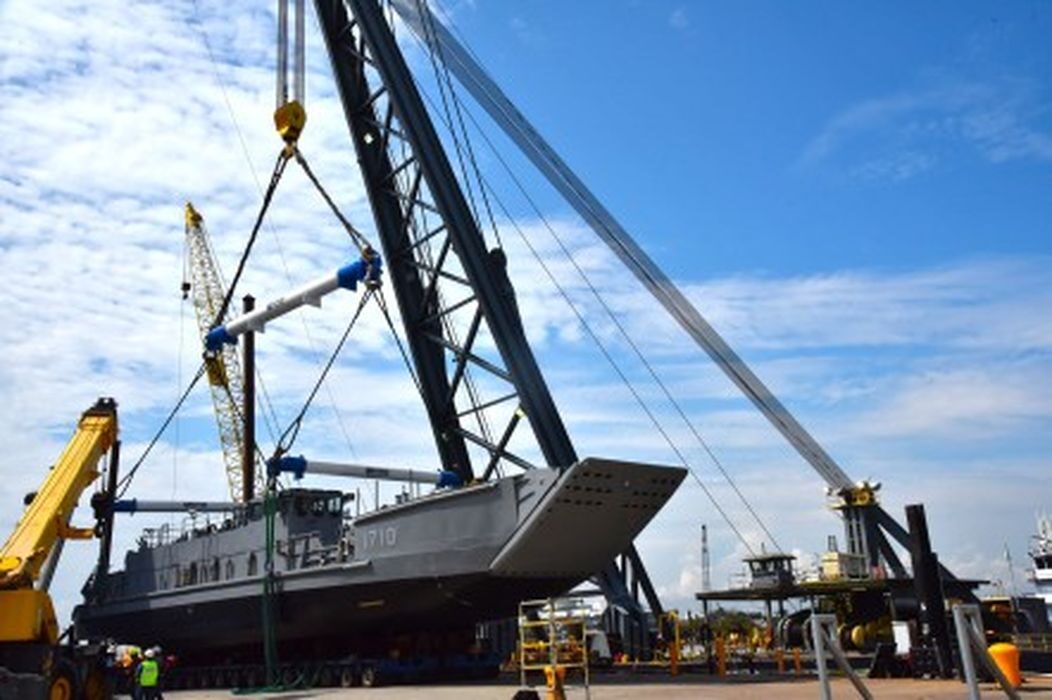
Based in Mobile, Alabama, Austal USA is in the midst of two major expansion projects totaling about US$750 million. One is a Submarine Module Fabrication Facility (MMF3), a 369,600-square-foot building designed to build structural assemblies for Columbia- and Virginia-class submarines. The other is a large steel ship assembly facility, which will feature a new assembly bay of approximately 192,000 square feet, waterfront infrastructure including a ship-lift, and improvements for handling and launching large steel vessels for the U.S. Navy and Coast Guard.
These projects are expected to create around 2,000 new jobs, significantly raising Austal’s workforce from around 3,100 to over 5,000 once fully operational. The aim is for the facilities to be up and running by late 2026.
This expansion is both economic and strategic: it supports U.S. Navy goals to accelerate submarine production (targeting one Columbia-class and two Virginia-class submarines annually) and strengthen defense industrial base capacity.
Austal and Master Boat Builders: Expanding Regional Capacity
Another major development is Austal USA’s recent deal with Master Boat Builders (MBB), a long‑established shipbuilder also located in Mobile, Alabama. In 2025, Austal acquired Master Boat Builders’ facilities and workforce, a move that expands Austal’s Gulf Coast footprint and increases production capacity for both government and commercial customers.
MBB, known for constructing offshore supply vessels, tugs, and other commercial workboats, brings valuable expertise in smaller craft construction. By integrating MBB’s capabilities, Austal gains a broader product portfolio and greater flexibility to balance large‑scale defense contracts with smaller, quicker‑turnaround shipbuilding projects.
Strategically, this acquisition also strengthens Austal’s skilled labor pool. With the ongoing challenge of recruiting and training thousands of new workers, MBB’s existing workforce provides a boost of experienced talent that can support both traditional shipbuilding and new additive manufacturing initiatives. It also consolidates Mobile’s status as one of the most important hubs of U.S. maritime manufacturing.
For the additive manufacturing community, the Austal‑MBB integration suggests more potential applications of AM in smaller vessels and commercial projects. While submarine modules and naval combatants require rigorous qualification for every printed component, smaller craft may provide opportunities for Austal to accelerate AM adoption in fittings, brackets, housings, and other parts with fewer certification hurdles.
Additive Manufacturing: From Pilot Parts to Industrial Role
Alongside the infrastructure buildup, Austal USA is significantly growing its investment and capability in additive manufacturing. Some key recent developments:
- AM Center of Excellence (AM CoE), Danville, Virginia: Operated by Austal USA, this facility is central to many of its 3D printing efforts. It focuses on supplying printed components (fittings, brackets, pump parts, etc.) and shifting traditional castings and forgings toward additively manufactured counterparts.
- New printers and technologies: Austal has ordered a containerized “ARCEMY Small” system from AML3D, slated for delivery in January 2026. This smaller system, preinstalled in a shipping container, is intended for small-part manufacturing and faster field deployment.
- Largest custom ARCEMY system installed: A large format ARCEMY printer with roughly 35 cubic meters of build volume has been brought online at the AM CoE. It supports large metal parts and heavy components, accelerating Austal’s ability to address supply chain gaps.
- Cold spray additive manufacturing: Via acquisition of a WarpSPEE3D CSAM system. Cold spray offers advantages for producing metal parts with cast-equivalent properties on demand.
- “100-part challenge” milestone: At the expanded Advanced Technologies center in Charlottesville, VA, the AM CoE has printed and delivered its 100th part—a copper-nickel angle valve (for submarine use)—using LPBF (laser powder bed fusion) printer. This part was requested for installation on an Ohio-class submarine (USS Pennsylvania).
- Industry 4.0 integration: The shipyard expansions in Mobile are being designed with advanced automation, digital twins, horizontal and vertical integration, big data analytics, and workforce tools like augmented reality for training.
All these developments show that AM is no longer experimental at Austal; it is becoming an essential part of their supply-chain strategy and factory transformation.
Why This Matters: Supply Chains, Speed, and Strategic Strength
Several broader trends make Austal’s moves especially important:
- Reducing lead times & supply chain risk
Traditional castings and forgings often have long lead times, single-supplier bottlenecks, and are vulnerable to disruptions. By digitizing parts and enabling multiple qualified suppliers to manufacture from 3D printable “recipes,” Austal’s AM CoE helps flatten bottlenecks and enables faster repairs and sustainment. - Supporting fleet readiness and naval production goals
As the U.S. Navy presses to deliver more submarines and surface vessels per year, any process that can accelerate production or reduce downtime (e.g., through printed replacement parts) becomes very valuable. Austal is positioning itself to meet that demand. - Job growth and regional economic impact
The expansions will pump in thousands of jobs, not just within Austal but across local suppliers. For Alabama in particular, the injection of 2,000 jobs and nearly US$750 million investment in advanced manufacturing and shipbuilding infrastructure is a major economic boost.
Technology leadership and resilience
Shipbuilding and maritime defense require high reliability, tight tolerances, and adherence to stringent safety and environmental standards. The adoption of large AM systems, cold spray, and quality systems (inspection, qualification, etc.) demonstrates Austal’s maturity in moving AM beyond prototypes to mission-capable components.
Challenges & What’s Next
Of course, scaling AM in shipbuilding is not without hurdles.
- Qualification & certification: Naval parts must meet strict military standards. Ensuring that additively manufactured parts (from various technologies: LPBF, WAAM, CSAM, etc.) meet the necessary strength, durability, corrosion resistance, and certification requirements is a non-trivial task.
- Materials & post-processing: Some materials are still difficult to 3D print or require complex post-processing; for heavier structural components, traditional methods may still dominate for some time.
- Workforce & skills: Integrating Industry 4.0, digital twins, AR, etc., demands a workforce skilled in software, robotics, metrology, and AM. Hiring thousands of workers is one thing; ensuring they have the right training is another. Austal is expanding its research centers and AM CoE footprint in part to buttress that competence.
Looking forward, some key questions: How broadly will AM-printed parts be allowed in full-scale submarine and steel-hull vessel builds? How much will the digital recipe model scale across suppliers? Will forward deployment (printing small parts at or near active ships or bases) become commonplace? Austal seems to be setting the infrastructure and investment to make those things possible.
The Research and Development Tax Credit
The now permanent Research and Development (R&D) Tax Credit is available for companies developing new or improved products, processes, and/or software. 3D printing can help boost a company’s R&D Tax Credits. Wages for technical employees creating, testing, and revising 3D-printed prototypes can be included as a percentage of the eligible time spent for the R&D Tax Credit. Similarly, when used as a method of improving a process, time spent integrating 3D printing hardware and software counts as an eligible activity. Lastly, when used for modeling and preproduction, the costs of filaments consumed during the development process may also be recovered.
Whether it is used for creating and testing prototypes or for final production, 3D printing is a great indicator that R&D Credit-eligible activities are taking place. Companies implementing this technology at any point should consider taking advantage of R&D Tax Credits.
Conclusion
Austal USA is making a fundamental shift—not just more shipyard capacity, but smarter, more flexible, and more responsive manufacturing. With large new facilities coming online, advanced AM systems installed and growing in capability, and strategies building around digital supply chains and workforce modernization, it’s clear that Austal is aiming to lead in maritime additive manufacturing—not just follow.
For the 3D printing industry, those moves mean more demand for metal AM hardware, more materials innovation, more quality assurance, and potentially stronger markets for suppliers of printers, post-processing, inspection, and software tools.