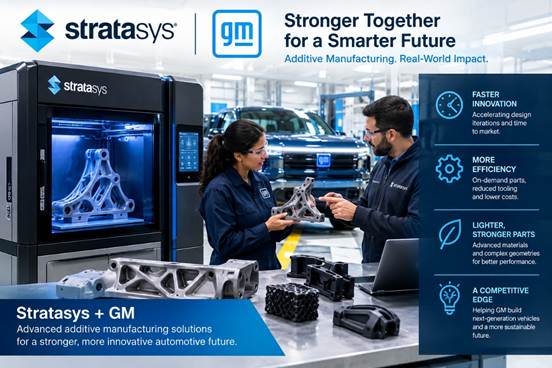
Charles R. Goulding explains what happens when a global automaker turns 3D printing from a prototyping tool into a standardized manufacturing capability, like Stratasys and GM are demonstrating.
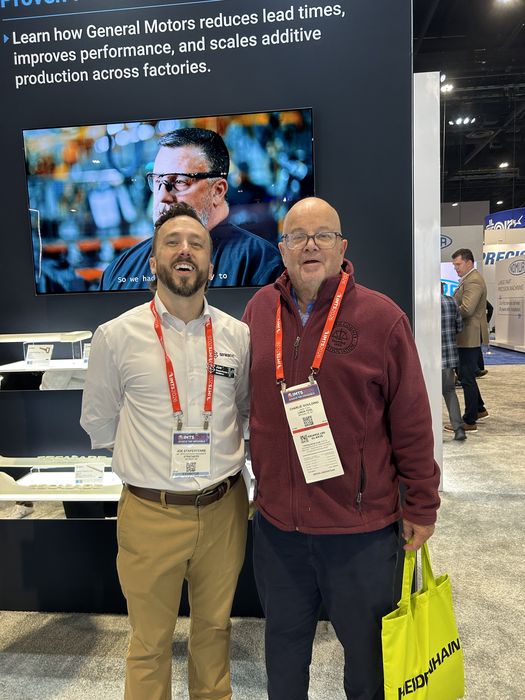
Walking through the Stratasys booth at IMTS 2026 in Chicago, from September 14 – 18, 2026, one of the more interesting things on display was not simply another new 3D printer. It was evidence of where industrial additive manufacturing is heading: away from isolated demonstrations and toward standardized tools that can be deployed repeatedly across large manufacturing organizations.
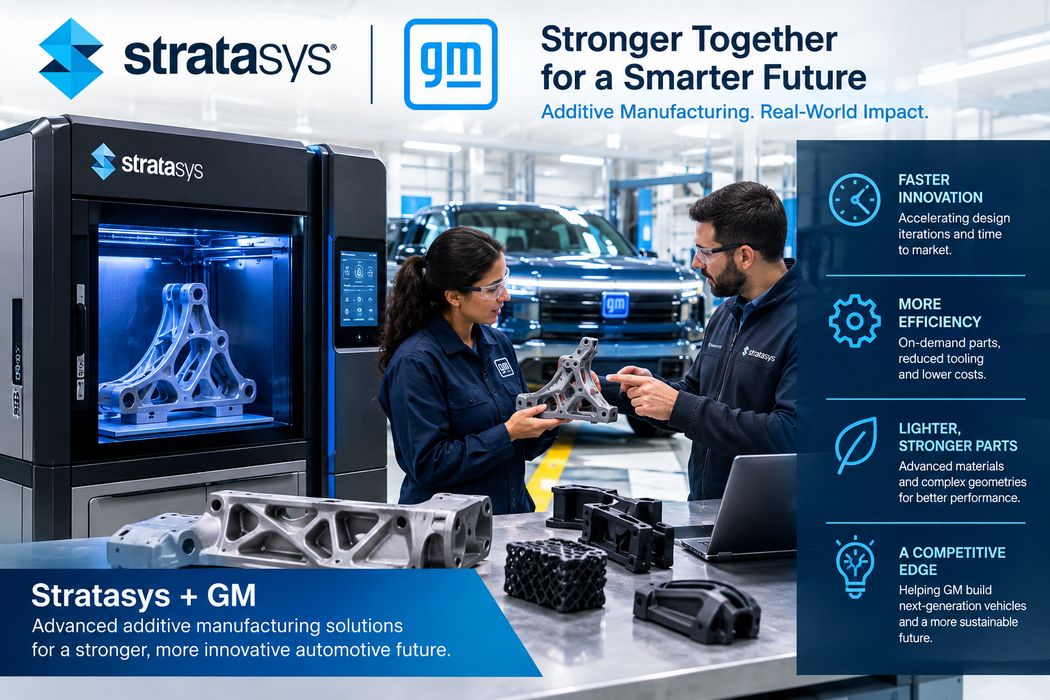
That direction is underscored by Stratasys’ longstanding collaboration with General Motors. On September 14, 2026, Stratasys announced that its additive manufacturing solutions are rolling out across more than 20 GM manufacturing facilities in North and South America. The companies are highlighting an approach in which factory teams use additive manufacturing to address production problems locally, validate solutions quickly and then replicate successful applications elsewhere in the manufacturing network.
The important story here is not simply that a major automaker is using 3D printers. GM has been doing that for years. The bigger development is the effort to make additive manufacturing part of the operating system of the factory.
Stratasys: A Global Additive Manufacturing Company
Stratasys is one of the longest-established names in industrial 3D printing. The company provides additive manufacturing systems, polymer materials, software and manufacturing services to customers in industries including automotive, aerospace, healthcare and consumer products. Its technologies include FDM, PolyJet and other additive platforms, while its broader offering extends into software, materials and parts-on-demand manufacturing.
The company’s corporate structure is also somewhat unusual. Stratasys is incorporated in Israel and maintains dual headquarters in Minnetonka, Minnesota, and Rehovot, Israel. Its current U.S. headquarters is at the Minnetonka campus, while its Israeli headquarters and major research and development activities are in Rehovot.
The company’s 2025 numbers provide some perspective on its scale. According to its 2025 annual report, Stratasys generated US$551.1 million in revenue for the year, consisting of US$380.3 million in product revenue and US$170.8 million in services revenue. As of December 31, 2025, it had 1,757 full-time-equivalent employees worldwide, including 812 in the Americas, 474 in Israel, 343 in Europe and 128 in Asia Pacific.
Those numbers make the GM relationship particularly interesting. Stratasys is not simply supplying equipment to a single plant. It is working with a global-scale manufacturer on a model for taking proven additive applications and extending them across a manufacturing network.
From the Prototype Shop to the Factory Floor
One of the themes that stood out at IMTS was the changing role of additive manufacturing.
For years, the easiest way to explain industrial 3D printing was through prototyping. Designers could produce a physical model quickly, make changes, and repeat the process without waiting for conventional tooling.
That remains important, but the technology has moved much further into manufacturing operations.
GM’s use of Stratasys FDM systems illustrates this transition. According to Stratasys, GM teams are producing tooling, fixtures, jigs, factory aids, quality-control tools, protective components, ergonomic aids, replacement parts and some end-use parts. The systems are being used to address practical production issues rather than simply to demonstrate what additive manufacturing can do.
This is where the economics become particularly interesting.
A factory does not necessarily need to 3D print millions of identical vehicle components to justify additive manufacturing. Instead, a printer can be valuable because it can quickly produce the specialized tool needed for a particular manufacturing operation.
Traditional tooling may require machining, outside suppliers, transportation and scheduling. A plant equipped with an industrial 3D printer can potentially design and manufacture a solution closer to the point of use.
Stratasys’ GM case studies provide some striking examples. Its published material cites US$1.4 million in annual savings at GM’s Lansing Delta Township facility and US$1.1 million in savings over five months at Fort Wayne. Stratasys also cites a six-month return-on-investment benchmark for capital investment.
These are the kinds of metrics that can change the conversation with a manufacturing executive.
The Real Innovation Is Standardization
The most significant part of the GM deployment may therefore be less about the individual printed parts than about standardization.
Manufacturing companies are understandably cautious about introducing new processes into production. A solution that works beautifully at one facility does not automatically become a corporate manufacturing standard.
GM’s approach addresses that problem by allowing plant teams to develop solutions where production problems occur. Once an application has been tested and proven, it can potentially be shared with other facilities.
Stratasys describes this as “scale the solution, not just the part.” Its F900 systems, production-grade materials, software and application expertise are being combined into a repeatable manufacturing workflow.
That concept was very visible at IMTS. The conversation around industrial additive manufacturing increasingly centers on repeatability, materials, workflows, qualification, software and return on investment. The printer itself is only one component.
Traditional machine shops and manufacturing environments alongside CNC equipment create a more holistic manufacturing ecosystem. The underlying theme is similar: manufacturers are increasingly treating additive as another production capability rather than as a separate experimental department.
A Manufacturing Tool, Not a Manufacturing Replacement
There is also an important economic nuance here.
Additive manufacturing does not need to replace injection molding, CNC machining or conventional fabrication to create substantial value.
Our earlier analysis of the Stratasys SAF H350 and injection molding looked at precisely this question. Conventional manufacturing methods remain extremely competitive at high volumes. The advantage of additive manufacturing often emerges when volumes are lower, designs are complex, customization matters, or lead time carries a significant cost.
The GM deployment demonstrates another version of that principle. A custom factory tool may have a relatively small production volume but getting that tool quickly can be enormously valuable when a manufacturing line is waiting for it.
That is why the phrase “hours instead of weeks” in Stratasys’ GM announcement is important.
The value is not necessarily the plastic itself. The value can be the time saved, the downtime avoided, the ergonomics improved or the outside tooling expense eliminated.
Stratasys’ Broader Industrial Strategy
The GM relationship also fits into a broader Stratasys strategy of embedding additive manufacturing into established industrial workflows.
That strategy extends beyond automotive. Our coverage of Philips’ partnerships with 3D Systems and Stratasys examined how Stratasys technology can become part of a larger digital workflow, in that case connecting medical imaging and 3D printed anatomical models.
And our previous reporting on Stratasys and the effects of military mobilization in Israel highlighted another dimension of the company’s unusual global footprint, including its significant Israeli operations and dual-headquarters structure.
Across these examples, the common thread is that 3D printing becomes more valuable when it is integrated into an organization’s existing processes.
Why the GM News Matters
The GM announcement is therefore bigger than another automotive 3D printing application.
At IMTS 2026, it was possible to see the manufacturing industry moving toward a more practical view of additive manufacturing. The question is increasingly not “Can a 3D printer make this?” but “Can this process reliably solve a manufacturing problem at a cost and speed that makes business sense?”
GM’s deployment across more than 20 facilities provides a large-scale test of that proposition. Plant employees can identify problems, create solutions, validate them and, where appropriate, replicate those solutions elsewhere.
That is a meaningful change in how additive manufacturing fits into the industrial organization.
For the automotive industry, the collaboration demonstrates how polymer additive manufacturing can contribute to tooling, quality, safety, ergonomics and production continuity. For the 3D printing industry, it provides a concrete example of what happens when additive manufacturing moves from individual applications to a standardized enterprise capability.
The Research and Development (R&D) Tax Credit
The Stratasys–GM developments strengthen a potential IRC § 41 R&D credit position because the article describes activities that map to qualified research: developing or improving products, processes, techniques, and manufacturing tools through engineering-based experimentation. Stratasys’ additive manufacturing solutions are being deployed across more than 20 GM facilities, where plant teams identify production problems, develop local solutions, validate them quickly, and replicate proven applications across the network. Those activities may support the IRC § 41(d) “business component” requirement because qualified business components include products, processes, software, techniques, formulas, or inventions used in the taxpayer’s trade or business.
The iterative prototyping, tooling, fixtures, jigs, quality-control tools, ergonomic aids, replacement parts, and some end-use parts, may evidence attempts to improve function, performance, reliability, or quality. Under IRC § 41(d), qualified research must be technological in nature and must involve substantially all activities constituting a process of experimentation for a qualified purpose. GM’s testing, proving, and scaling of applications could help document uncertainty, alternatives evaluated, and systematic trial-and-error required under Reg. § 1.41-4.
R&D Tax Savers has been helping companies navigate the complexities of the R&D tax credit since it was introduced into law in 1981.
Stratasys’ R&D Book Per Capita
| Company | Reporting Year | R&D Expenses (USD) | Employee Count | R&D Expenses (USD) / Employee Count |
| Stratasys Ltd. | 2025 | 77,304,000 | 1,757 | 43,998 |
| Stratasys Ltd. | 2024 | 99,142,000 | 1,779 | 55,728 |
| Stratasys Ltd. | 2023 | 94,425,000 | 1,980 | 47,689 |
| Stratasys Ltd. | 2022 | 92,876,000 | 2,062 | 45,042 |
This is big news for both the automotive and 3D printing industries
The significance is not simply that General Motors is using more Stratasys printers. It is that a major automaker is demonstrating a model in which additive manufacturing can become a repeatable, measurable and scalable part of factory operations. The next stage of industrial 3D printing may be less about proving that additive manufacturing works and more about determining how broadly a proven solution can be deployed.