
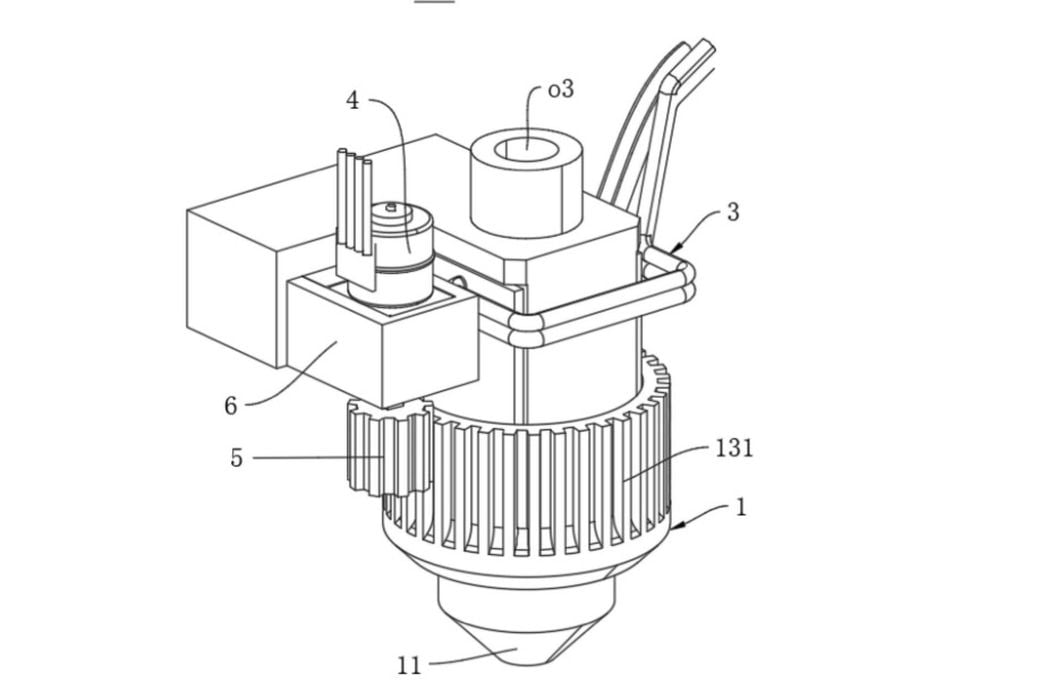
A newly granted Chinese utility patent proposes a variable extrusion head for FFF 3D printers, aimed at avoiding one of the oldest annoyances in desktop and industrial extrusion printing: changing nozzles.
The patent is CN 224311213 U, assigned to Yu Huangliang, granted on June 2, 2026. The patent assignee in this case is not a 3D printer company, but appears to be an individual. The title translates roughly as “A 3D Printer Extrusion Head and 3D Printer.”
The basic idea is simple: instead of using one fixed nozzle or manually swapping between nozzle diameters, the extrusion head uses an inner nozzle and an outer sleeve nozzle. The outer nozzle can move axially around the inner nozzle, creating two different extrusion states.
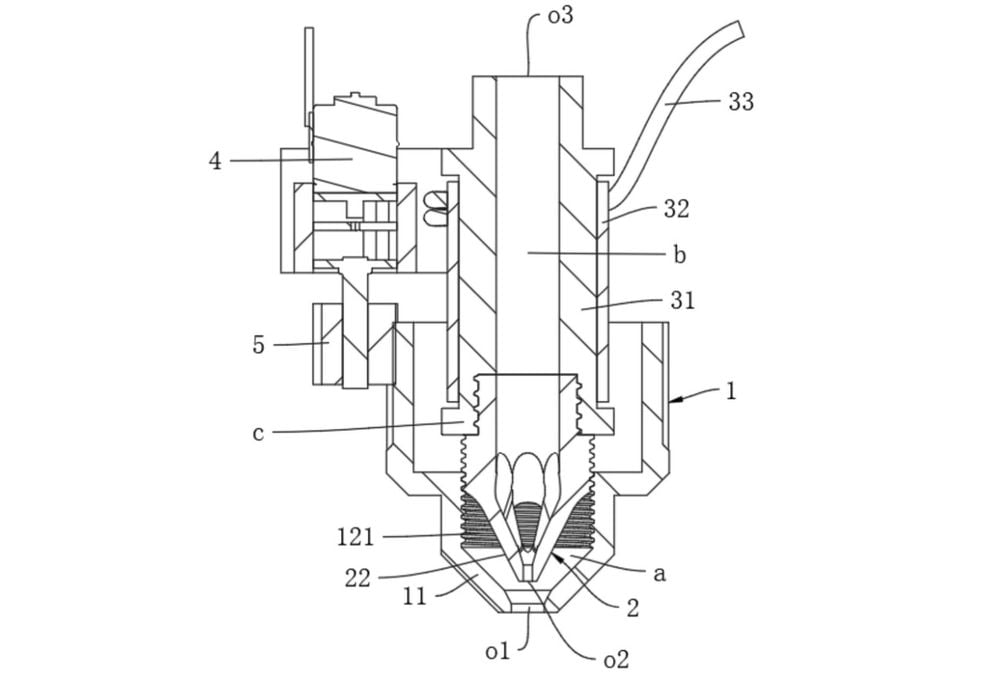
In one position, the inner nozzle sits inside the outer nozzle chamber. In that mode, material exits through the larger outer nozzle. In the second position, the inner nozzle protrudes beyond the outer nozzle, allowing extrusion through the smaller inner opening.
In other words, the system is attempting to give one hot end two effective nozzle sizes.
That could be a pretty useful idea. FFF operators constantly trade off speed against detail. A small nozzle can produce cleaner fine features, but it slows large prints. A larger nozzle can push more material and reduce print time, but it cannot reproduce small details as well. Today, the usual solution is to choose a nozzle before the print, or stop and change hardware.
This patent suggests a different workflow: let the printer switch mechanically between two extrusion diameters.
The interesting part is the adjustment method. The outer nozzle is sleeve-shaped and includes internal threads that engage with external threads on the inner nozzle. A stepper motor, mounted beside the heater block, drives a transmission gear. That gear meshes with teeth around the outer nozzle sleeve, rotating it. Because of the threaded connection, rotation translates into axial movement.
That means the printer could theoretically shift between the two nozzle modes under software control.
The patent also describes several feed windows around the inner nozzle. These appear to help material flow into the outer nozzle chamber when the system is operating in the larger diameter mode. In the small nozzle position, the front of the inner nozzle seals against the outer nozzle, with the feed windows remaining inside the chamber to avoid leakage.
For consumer printers, it could simplify the decision between speed and quality. For professional machines, it could allow toolpaths that use a larger extrusion for infill and bulk geometry, then switch to a smaller outlet for walls, fine details, or surface features. That is the same general goal behind multiple nozzle systems, pellet and filament hybrid systems, and variable extrusion research: place more material where precision is less important, and slow down only where the model needs it.
But there are some difficult engineering questions raised here.
First, sealing is critical. Molten polymer will exploit small gaps, especially under pressure. A threaded moving nozzle assembly operating at hot end temperatures could also face wear, contamination, thermal expansion, and clogging.
Second, the slicer would need to understand this unusual system. Switching nozzle sizes during a print is not useful unless toolpath generation, flow control, retraction, pressure advance, and Z behavior are all coordinated. A simple mechanical nozzle switch is only half the problem.
Third, the mass and complexity of the print head increase. The drawings show a motor, gear, toothed sleeve, heater component, and moving nozzle structure. That could add cost, weight, failure modes, and calibration issues.
Nozzle swaps are annoying, but they are also simple. Replacing that simplicity with a moving hot end mechanism only makes sense if it works repeatedly, seals cleanly, and integrates smoothly with slicing software.
Even so, the patent points toward an important direction for FFF: fewer manual steps and more adaptive extrusion. If variable nozzle systems become dependable, they could make large prints faster without giving up all fine detail.
Via Espacenet
