
Changing filament in a multimaterial FFF printer usually means pushing the new material through the old hotend until the previous material is gone. A Chinese patent proposes a different solution: leave the extruder in place and swap the hotend underneath it.
The application, CN122606871A, comes from 原子重塑科技(深圳)有限公司, or Atom Reshaping Technology (Shenzhen) Co., Ltd., best known as “AtomForm”. They are the company that recently released details of a 12-nozzle FFF system.
The patent’s main claim covers an extruder with an installation area and at least two detachable hotends. Each hotend can have its own material channel, while the shared extruder feeds whichever hotend is currently attached.
One Extruder, Several Material-Specific Hotends
Imagine a printer carrying a small rack of hotends. One might contain PLA, another a higher-temperature engineering filament, and a third a soluble support material. The extruder moves to the selected hotend, aligns its feed passage with the hotend’s outlet passage, locks the two parts together, and prints through that assembly.
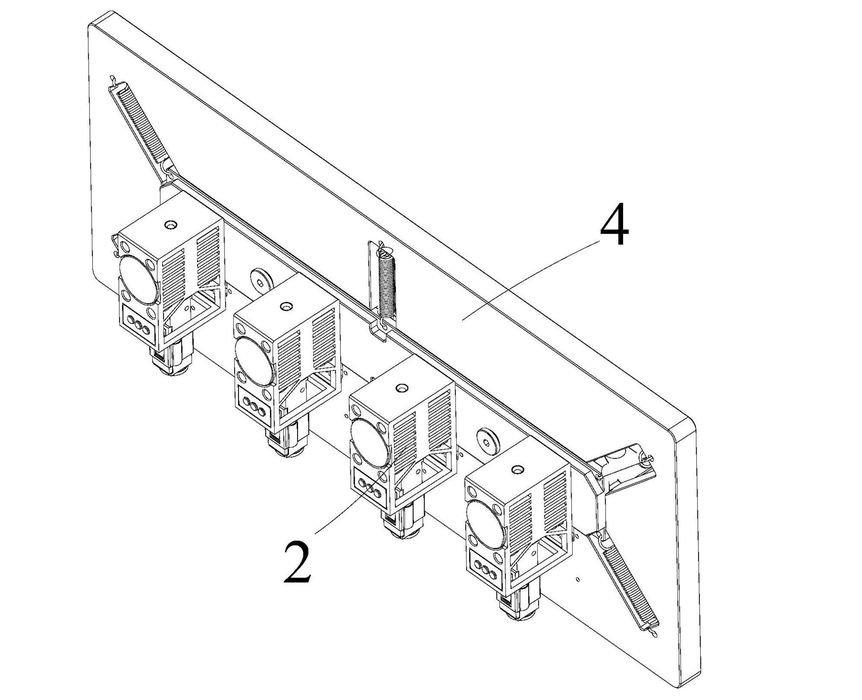
The drawings show a storage mount holding multiple hotends beside the printer’s motion system. A moving mechanism, described as a robotic arm or a three-axis device with a gripper, can transfer hotends between the mount and the extruder. A sensor checks whether the gripper has actually engaged before the printer releases the hotend. That small safety step is important: dropping a hot, partially loaded hotend would be an expensive way to end a job.
The proposed attachment is deliberately simple. One variation uses a permanent magnetic element on each hotend and an electromagnet on the extruder. Power holds the hot end in place; cutting power allows it to move away. The claims also cover mechanical alternatives, including mating snap-fit structures. Locating pins and chamfered guide surfaces help the new hot end settle into the correct position.
That configuration addresses two separate problems. Multiple complete toolheads provide clean material separation, but every additional toolhead needs its own extruder and motion hardware. A single shared hotend is cheaper, yet switching materials creates a purge column and leaves the previous material throughout the hotend’s feed path.
Less Purging And More Nozzle Choices
According to the description, the detachable hot end leaves material in only the cooler upper passage when it is removed. The material in the heated section is normally fluid and can be cleared separately. The filing therefore says the purged length is limited to the cooling passage, instead of the combined length of the cooling and heated passages in a shared-hotend purge. No quantities are provided, so the amount of savings would depend heavily on the actual geometry. This is somewhat different than current filament swapping systems, and could indeed lower the amount of waste required.
The temperature situation is just as interesting. Switching directly from a 250C material to a 200C material in one hotend can leave the hotter material stuck as the temperature falls. Using a separate hot end for each material avoids mixing those thermal histories. The same mechanism can also support different nozzle diameters for one material, letting an operator change between fine detail and higher deposition rates without replacing the whole toolhead.
There is a tradeoff. The printer now needs a hot end rack, a transfer mechanism, alignment hardware, attachment sensing, and software that knows which material is loaded in which hot end. The electromagnet must also hold the assembly rigidly enough to prevent movement during extrusion.
Even so, the filing suggests a middle ground between several full toolheads and a single purge-heavy nozzle, similar to the INDX, Vortek and KliTek technologies from AtomForm’s competitors.
Via Espacenet
