
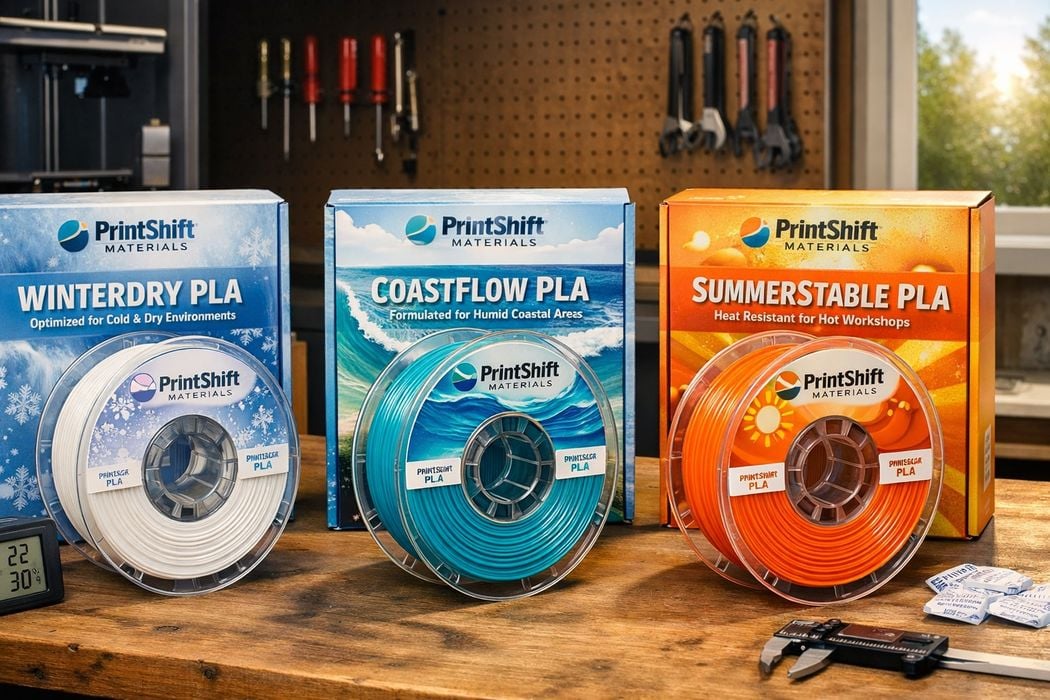
A materials startup claims your filament problems may be seasonal, not personal.
PrintShift Materials, a new consumables vendor based in Rotterdam, has introduced a line of “seasonally tuned” PLA formulated for specific local conditions, including dry winter interiors, coastal humidity, and overheated summer workshops. The company says the products are not simple repackaging jobs, but separate SKUs with adjusted plasticizers, nucleating agents, pigment carriers, and spool drying specs meant to compensate for the realities of where desktop FFF machines actually live: basements, garages, classrooms, and sheds with wildly inconsistent air quality.
That idea lands in a market that has spent years pretending all PLA is basically the same as long as it arrives in a cardboard box with a silica packet. In practice, users already know better. One spool prints beautifully in October, then turns brittle in January, and by July it extrudes like warm toothpaste after sitting in a workshop that feels one bad decision away from becoming a kiln. Vendors usually blame storage, user handling, or “improper printer settings,” which is technically true and also a wonderful way to blame the customer for weather.
PrintShift’s initial range includes WinterDry PLA, CoastFlow PLA, and SummerStable PLA. WinterDry is positioned for cold inland markets with low indoor humidity, where some users report brittle filament and poor layer adhesion after long storage. CoastFlow targets damp coastal regions and adds what the company describes as a moisture buffering package to reduce surface popping and inconsistent extrusion. SummerStable is tuned for higher ambient temperatures and is meant to resist softening during long prints in non climate controlled workshops. The company says each material remains dimensionally compatible with standard 1.75 mm and 2.85 mm hardware, although it did not state full shrinkage curves or long term shelf life.
Filament For Weather, Not Just Printers
Conceptually, this sits somewhere between standard PLA and the kind of application specific materials strategy already common in industrial additive manufacturing. Selective Laser Sintering (SLS) users choose powders based on thermal behavior. Resin users know viscosity changes matter. Even HP’s Multi Jet Fusion (MJF) ecosystem leans heavily on process matched materials. Desktop filament, by contrast, is still sold with the cheerful assumption that Manitoba in February and Florida in August are basically the same room.
PrintShift says it developed the products after surveying 2,400 desktop users across Europe, North America, and East Asia. The survey, which has not yet been published in full, apparently found that failed first layers, mid print brittleness, and stringing rose sharply during seasonal transitions. That is believable enough. Any Fabbaloo reader who has moved a spool from a heated office to a garage knows the machine may be the least chaotic variable in the system.
The clever part is not that climate affects polymer behavior. Everyone knows that. The clever part is productizing the excuse. Instead of telling users to buy dry boxes, room sensors, better enclosures, and perhaps a small meteorological station, PrintShift is suggesting they simply swap materials with the calendar. The company even plans regional subscription packs that automatically ship “spring changeover” spools. One assumes future add ons may include emotionally supportive desiccant.
A New SKU Strategy With Suspiciously Familiar Logic
Mechanically, the idea could make sense at the margins. Slight changes to additive packages can alter flow consistency, crystallization behavior, impact resistance, and print temperature windows. A PLA blend optimized for dry winter environments might reduce brittleness and widen the usable temperature range. A humid climate version could be better dried at packaging and include chemistry that tolerates minor moisture uptake before print quality falls apart. None of that violates physics, although the company has not released independent benchmarks, comparative tensile data, or throughput studies.
That missing data matters because the likely benefit here is reliability, not magic. Service bureaus will not care much. Education users, makerspaces, and prosumer operators might. Those are exactly the environments where ambient conditions fluctuate, operators are inconsistent, and failed prints quietly consume shocking amounts of labor. If PrintShift can reduce touch time and reprints by even a small percentage, that is commercially useful.
Pricing starts at US$29 per 1 kg spool, about a modest premium over mid market PLA, with regional bundles shipping later this year through reseller channels. PrintShift did not disclose production partners, which is often where the real story hides in filament announcements.
If this works, filament shelves may start looking less like materials catalogs and more like weather forecasts. And honestly, that would still be more scientific than blaming every bad print on “user error.”
