
A new industry forecast from CONTEXT shows continued stress on professional 3D printer manufacturers.
Industry analyst CONTEXT divides the 3D print market pie into four categories based on price:
- Entry-level under US$2,500
- Professional US$2,500 to US$20,000
- Midrange US$20,000 to US$100,000
- Industrial above US$100,000
They track sales of equipment in these categories, and by examining the ratios between them, we can draw some conclusions about the state of the industry.
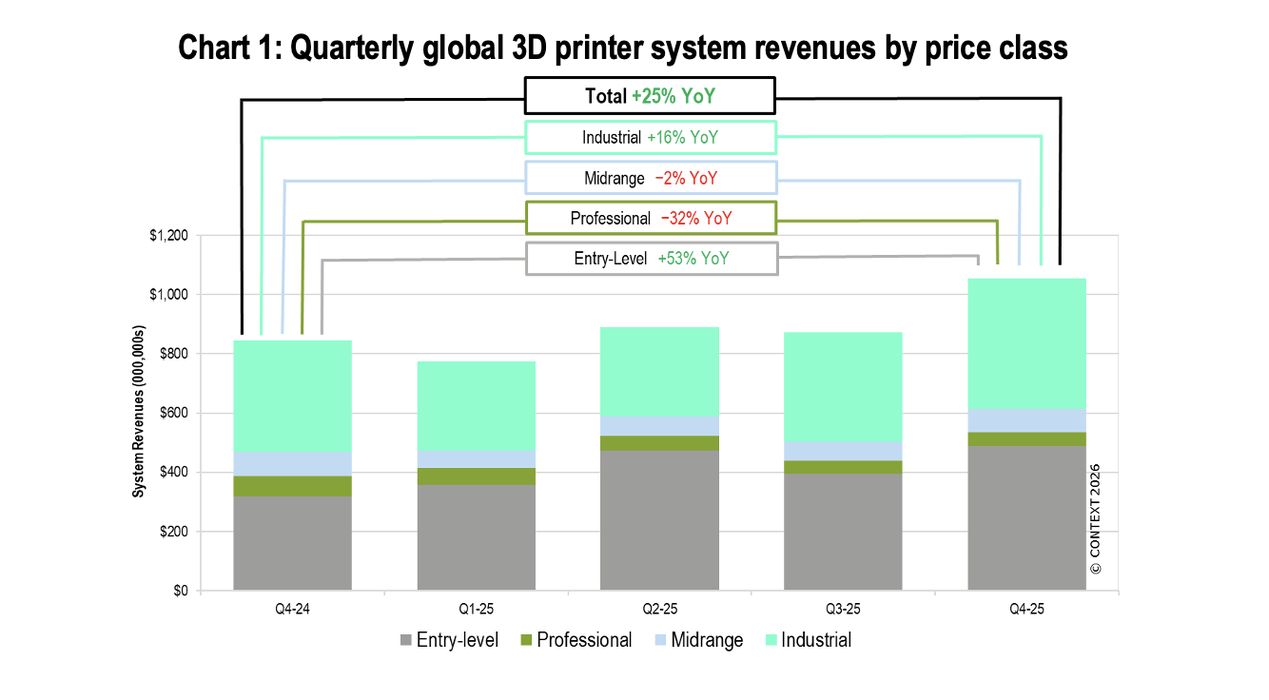
At the top, you can see their chart for the past five quarters. Let’s see what’s going on.
The total amount of sales is definitely increasing over time, with 25Q4 exceeding US$1B. While there was a dip in 25Q1, that seems to be quite over, as succeeding periods consistently rose. While wars are never a good thing, it likely helps the industry that multiple wars have erupted in this period, leading to increased usage of equipment to quickly build weapons.
We can also see that the industrial segment is also growing steadily. This is likely due to increased and consistent use of the technology by major manufacturers, particularly in the aerospace sector. Metal 3D printing does work and has become a default technology for several types of parts.
We can also see that the midrange segment is nearly flat over the past year. This is possibly due to similar effects seen in the industrial segment, but also because of the effects of entry-level equipment, as we shall see.
The professional segment has collapsed, with more than a 30% decline in sales over the past year. This is simply because of the massive increase in entry-level equipment, which grew over 50%.
Why would the entry-level segment grow so much? It’s because the leading vendors have finally figured out how to make machines easy enough for almost anyone to use. We now see people in the general public buying 3D printers in a big way, something that has never happened previously.
But those entry-level machines are very capable, and now include many — and in some cases all — of the features that once distinguished professional machines. Why would you buy an expensive professional machine when a cheap desktop unit has the same or more performance?
It seems to me that the professional category could entirely disappear within a few years because of this phenomenon. Entry-level machines are only getting better, and the professional manufacturers don’t have as much cash and resources to properly compete. It’s likely that several professional 3D printer manufacturers will simply disappear, and indeed some already have.
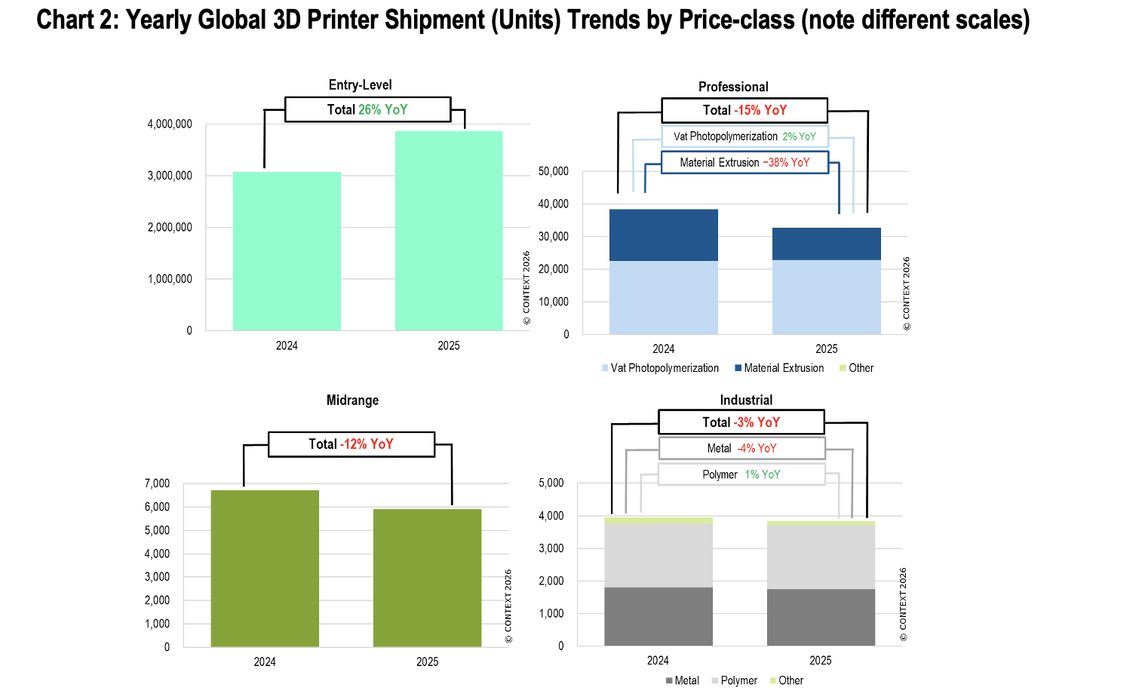
In the second chart, we zoom in on some of these categories. Note that in the professional segment, the losses are almost exclusively within the material extrusion sub-segment. In other words, the professional FFF machines are being eaten up by entry-level FFF devices. Meanwhile, the professional resin equipment is holding flat, at least for now.
Segments might seem to be very distinct and separate, but really there is a lot more flow between them. As technologies improve, the equipment in these segments changes, and thus affects buying patterns.
That’s not so good for some of the manufacturers, but it’s all good news for buyers. More capability at lower costs.
Via CONTEXT
