
Bambu Lab has introduced a new feature to enable multiple colour shades.
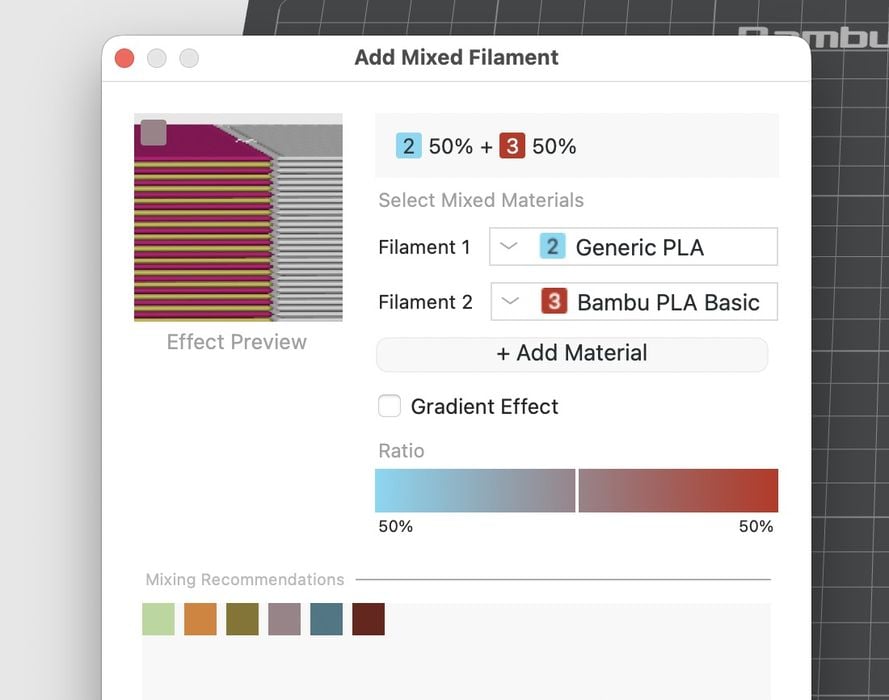
The latest version of BambuStudio includes a new feature they call “colour mixing”. This is how they explain it in their wiki:
”The Colour Mixing feature allows you to mix multiple filaments in the same print to create new colours by adjusting the ratio. To use it, click “Add Mixed Filament” at the bottom of the filament list to configure them in the pop-up dialog.”
Hold on, how could this possibly work? It’s inspired by some recently released open-source software that takes advantage of the slight transparency in thinly extruded material.
Here’s how it can work: if you have one wall with colour A, and the adjacent one has colour B, then the visual appearance from the outside will be a blend of A+B. It’s an ingenious approach that could be used with any 3D printer that can print in more than one colour. Colour blends can then generate far more colours than are actually available during the print job.
This concept first appeared as an open-source addition to OrcaSlicer, called Full Spectrum, made by GitHub contributor ratdoux. Once open-sourced in this way, the concept then made its way to other platforms based on OrcaSlicer. From there, this functionality has made its way into the latest release of BambuStudio.
At the top, you can see how it works. Essentially, you are “adding filaments” that don’t physically exist to the job palette. The mixing dialog shown above can select a colour as a ratio between two different base colours.
It’s also possible to create a colour with three base filaments. I suppose four might also be theoretically possible, but most colour shades can be generated with only three base colours.
Once these are added, they can then be used to assign colours to components of the job, just like a filament can be assigned. You can also paint them onto a model.
This is quite a capability, but it also comes at a cost. Generating a colour combo means you’re swapping filaments, which in turn generates purge waste. These mixed colours will tend to increase the amount of waste in a job, and there are going to be some pathological situations where an astounding amount of waste is created in order to deploy a mixed colour into a print.
I expect the best use of colour mixing will be with waste-free systems, such as Bambu Lab’s Vortek system that appears on their new H2C platform. Similarly, tool changers like the Snapmaker U1 and hot end swappers like the Prusa Research INDX system might also make good use of the colour mixing concept.
Either way, it seems that we will soon have a new way to generate slightly different colours from our otherwise colour-limited 3D printers.
Note: I would have given this feature a test, but the current version of BambuStudio 2.05.03.61 on Mac OS crashes when you attempt to save a new color mix. I’m hoping to give this a proper test when they fix the issue.
Via Bambu Lab
