
Researchers have found an interesting way to give a biodegradable 3D printing material a second job: fighting bacteria.
A team led by researchers at Hellenic Mediterranean University investigated a blend of PLA and PHBH, then added tiny copper particles to see whether they could simultaneously recover some lost mechanical strength and introduce antibacterial properties.
PLA is extremely familiar to desktop FFF users. PHBH is less so. It’s a member of the polyhydroxyalkanoate, or PHA, family of biopolymers, and can provide a wider biodegradation profile than PLA.
The difficulty is that mixing polymers is rarely free. Adding PHBH changed the mechanical properties of PLA, so the researchers first had to find a reasonable balance between the two.
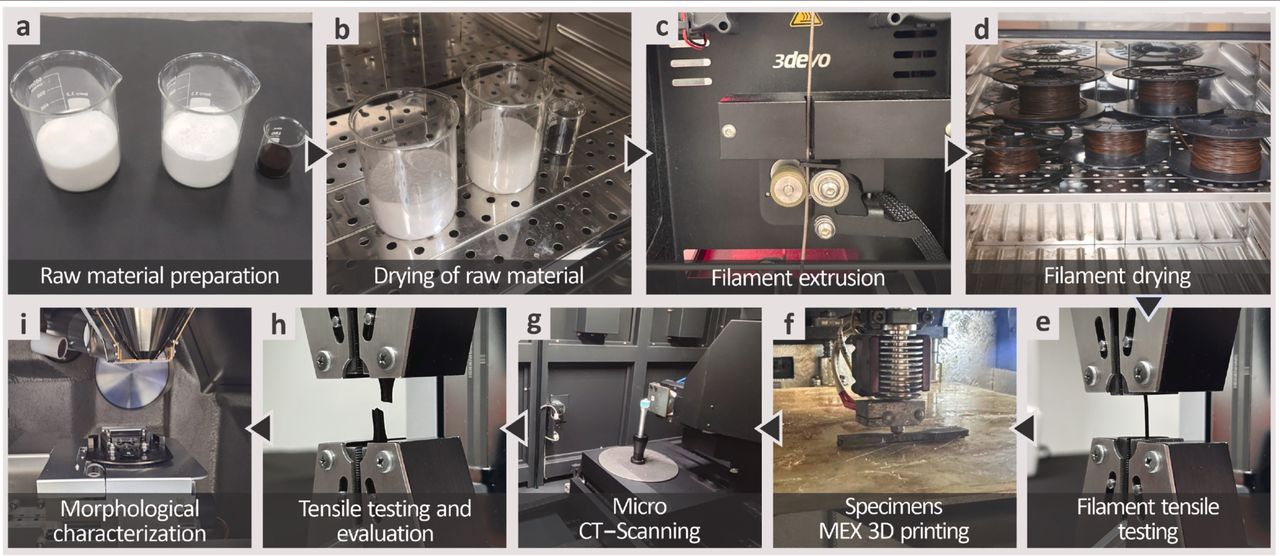
The researchers tested PLA/PHBH ratios of 75/25, 50/50 and 25/75, producing filament by melt extrusion and then 3D printing test specimens.
The 50/50 mixture turned out to be the most interesting compromise. It retained 76.6% of PLA’s tensile strength and 92% of its flexural strength, while its Charpy impact strength actually increased by 36.6%.
It also produced the lowest dimensional deviation of the blends tested.
That 50/50 formulation then became the base material for the second experiment. The researchers added spherical copper nanoparticles at concentrations ranging from one to five percent by weight.
This is where things became much more interesting.
At five percent copper, tensile strength rose 21.2% compared with the unfilled 50/50 blend, reaching 47.6 MPa. Tensile toughness increased 14.4%, while Vickers microhardness jumped 32.2%.
In effect, the copper recovered much of the mechanical performance sacrificed by blending PHBH into PLA. The five percent formulation reached 93% of the tensile strength and 95% of the flexural strength of the original PLA.
The researchers believe the rough surfaces of the 80-240nm copper particles help transfer loads into the polymer matrix, almost like microscopic mechanical anchors. Reduced porosity may also have contributed.
There was one mechanical issue. Charpy impact strength fell 11.4% as copper content reached five percent, so the particles didn’t improve every property.
Copper also altered the way the material flowed.
The melt flow rate of the 50/50 polymer blend was already considerably higher than pure PLA, and adding copper pushed it still higher, reaching 113.4g/10 min with five percent copper. The researchers suggest this should make the material easier to process by material extrusion and potentially improve bonding between deposited lines.
Then came the antibacterial testing.
The plain PLA/PHBH blend produced essentially no inhibition of either E. coli or S. aureus. As copper concentration increased, antibacterial activity rose steadily.
At five percent copper, the E. coli inhibition area reached 377.10mm2. In the particular agar diffusion experiment used by the researchers, that was larger than the inhibition areas produced by all three antibiotic controls tested. The result shouldn’t be interpreted as the printed plastic being a superior antibiotic, but it clearly demonstrates substantial antibacterial activity at the material surface.
The researchers suggest possible applications in medical devices, food related products and other situations where biodegradable materials and resistance to bacterial growth would be useful.
Instead of accepting weaker properties in exchange for a more biodegradable polymer blend, a relatively small amount of copper appears able to claw back much of that performance while adding an entirely new function.
Via ScienceDirect
