
A 3D printed fabric could contain tens of thousands of individual links.
There’s a big problem before printing even starts: getting all those links through the slicer.
A recently published patent application from Stratasys Powder Production, US20260368390, proposes an interesting shortcut to get around the issue. Instead of assembling a truly enormous 3D model of the entire fabric and converting it into layer images, the software would slice a small repeating element and reuse the that data through the build.
The method is aimed particularly at manufacturing processes driven by bitmap data, including powder bed systems using printheads and thermal consolidation. These machines need a pixel-by-pixel description of what should be processed in each layer.
Normally, a complicated assembly described in STL format must be converted into those layer images. For an interconnected fabric made from thousands of small elements, the original geometry becomes enormous. The patent suggests that repeatedly converting essentially the same shapes wastes considerable computing effort.
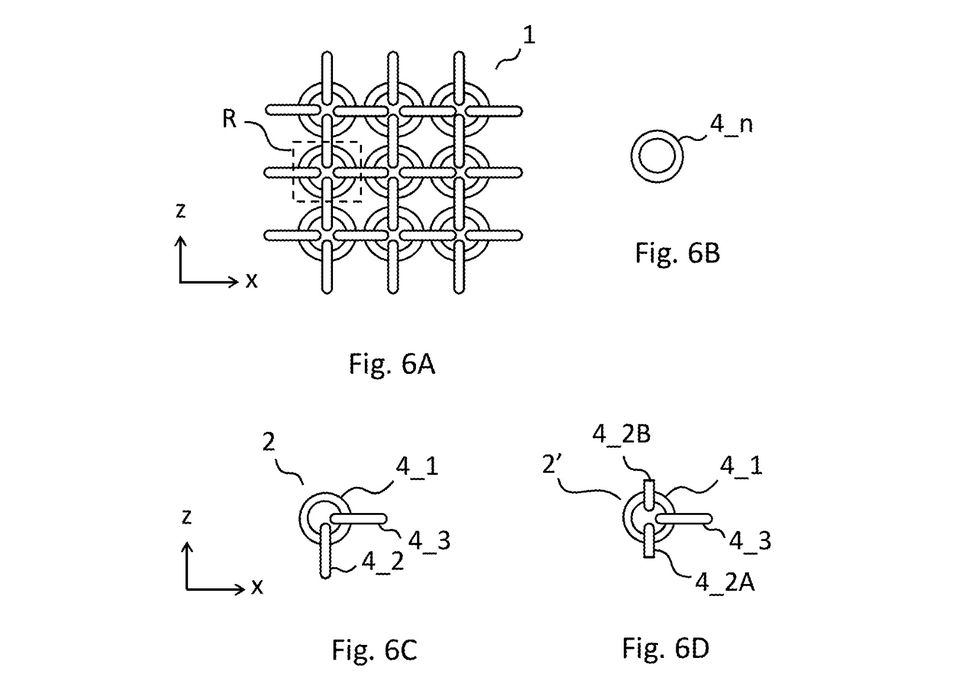
The proposed approach begins with one repeat unit, perhaps a pair of interlocking rings. The software slices that small model into a stack of bitmap cross sections. It then copies those slices into the corresponding layers of the virtual build volume, assigning each copy a position and orientation.
In effect, the geometry is calculated once and placed many times. Entire prepared sections can also be duplicated vertically. Different versions of the repeat unit can be stored for orientations that cannot be obtained by simply rotating an existing bitmap in its own plane.
But the examples go way beyond making simple chains.
One illustration in the document shows a linked fabric arranged as a spiral, like a roll standing upright in the powder bed. Every link follows the curved path, with the software adjusting its placement and orientation to preserve the interconnections. This would allow a large sheet of fabric to occupy a much smaller build volume than it would lying flat.
Another example uses scale-like elements joined by flexible connections. These are arranged in an accordion pattern, allowing a structure longer than the build volume to be manufactured in a folded configuration. The application even mentions garments and bags as possible objects.
There are some important details hiding in those arrangements. Neighbouring bitmap sections sometimes have to overlap so that their links interlock correctly. At the same time, the actual solid elements need enough separation to avoid fusing together during manufacture. The patent proposes controlling those clearances according to the material and machine involved.
Stratasys also describes placing repeated small parts into otherwise unused spaces around larger parts. That could improve build volume utilization without asking the slicer to repeatedly process identical geometry. Another variation staggers groups of small parts between layers to provide more uniform thermal conditions.
I find the rolled fabric example particularly interesting. It imagines making something much larger than the machine’s dimensions, provided it can emerge as a truly flexible, interconnected object.
While this approach could definitely work very well for fabric, I am now wondering if a variation of this would work for non-fabric applications, like lattices.
Via Espacenet