
A new patent application by Creality describes a way to make filament changes faster in FFF 3D printers.
That sounds like a small thing. It is not.
Anyone who has watched a multicolor, filament-swapping desktop 3D printer operate knows this problem. The machine spends a huge amount of time not printing. It is busy retracting filament, cutting filament, loading the next filament, purging the old colour, wiping the nozzle, and then finally getting back to the actual job.
This patent, WO2026091002, titled “3D Printing Method, System, Electronic Device and Storage Medium”, describes a method for reducing at least part of that delay.
The document does not identify a commercial product, and the assignee is not provided in the supplied text. That is important: this is a patent application concept, not a product announcement. But the mechanism is still interesting.
The basic idea is to stage the next filament just before it is needed.
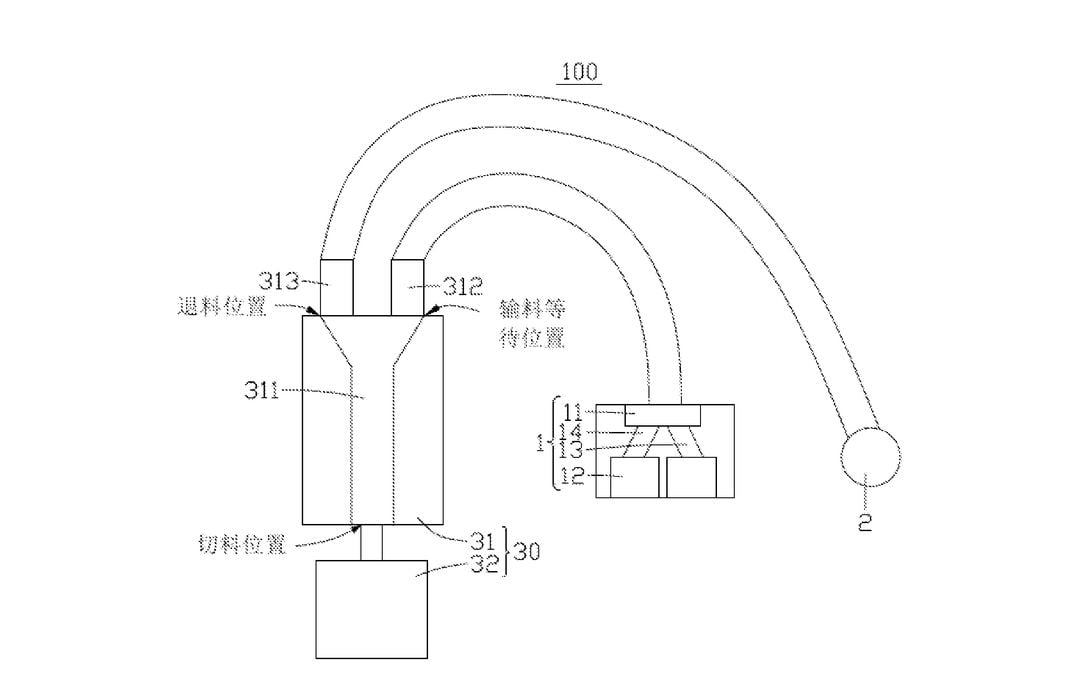
In the patent description, the 3D printer includes at least one filament storage device, similar to the Creality CFS. There is a main feed channel connected to the printhead, plus multiple branch channels that meet the main channel.
During a print job, the machine reads the G-code, including the upcoming filament swap. While the first filament is still being printed, the system can move the next filament from the CFS or spool into a branch channel. It stops feeding the filament at a waiting position very near the main channel.
Then, when the change instruction occurs, the printer retracts the current filament away from the printhead and into another branch channel. Once sensors detect that the old filament has cleared the main path, the staged filament moves from its waiting position directly into the main feed channel and onward to the nozzle.
In other words, the next material is ready for action at the closest possible position.
That could save considerable time in multicolor or multimaterial printing, especially when there are a lot of filament changes in the job. The machine is not necessarily printing faster, but it is spending far less time in the nonprinting part of the cycle, since a major delay factor is waiting for filaments to feed back and forth.
The patent also describes several related ideas. One version uses multiple filament storage devices and chooses the storage device containing the required next filament. Another version detects filament information using signals such as RFID or NFC, and may select the spool or cartridge with the largest remaining amount of the required filament.
That last point is really interesting. If the same colour or material is loaded in more than one storage position, choosing the fuller spool could reduce midjob runout risk and avoid wasting nearly empty rolls in the wrong situation.
Another version includes a convergence component, with multiple input ports from storage devices feeding into one output path. The patent also describes a multi-printhead configuration, where another printhead can be prepared with a third filament and used when the first printhead stops.
There is also a cutting step. The current filament can be retracted to a cutting position near the printhead, then cut, with one portion retracted to a waiting or return position and the other for purging.
This is mostly the strategy used by modern multicolor FFF systems: filament cutting, retracting, staging, purging, and sensor-based detection. Bambu Lab’s AMS, Prusa’s MMU, and other material handling systems are all trying to solve the same general problem: filament changes are slow, failure-prone, and wasteful. All of them currently have major delays when waiting for filament movement.
Note: this does not eliminate purge waste, but it could reduce job elapsed time.
While this method will certainly speed up jobs, in the long term, it may not matter. There is currently a shift towards waste-free approaches that may not be relevant for this approach.
However, for now, this patent would block Creality’s competitors from using this technique.
Via PatentScope
