
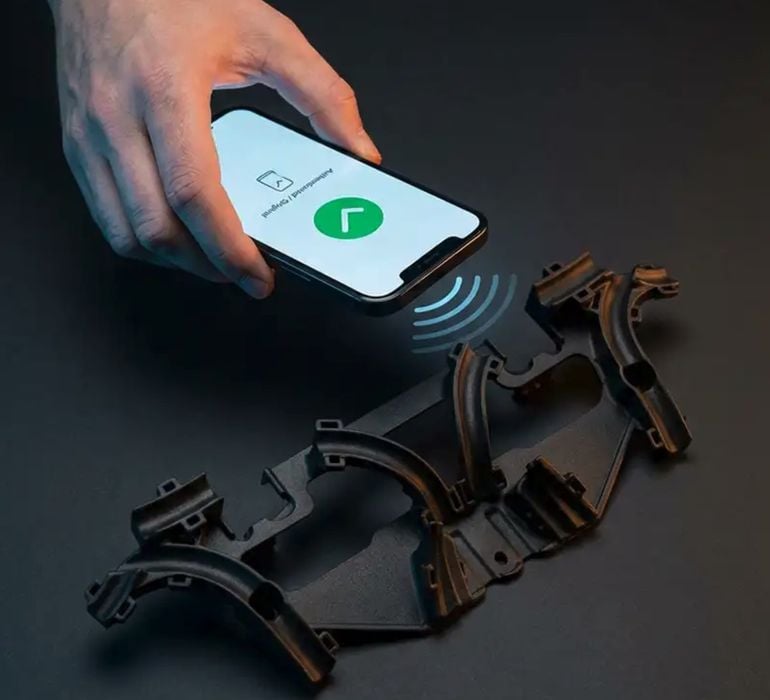
CRP Group has introduced CRP UniqTrust protocol, a method to identify 3D printed parts.
The company provides manufacturing services to industry using both traditional tools such as CNC milling, but also additive manufacturing in metal and polymers. They produce a line of high-performance materials for production.
Many of CRP Group’s customers, including aerospace, automotive, and defense organizations, are in industries that depend on certified parts. While CRP Group has been doing so for a long time, the process has required a considerable amount of paperwork to ensure the parts are indeed authentic. That is a requirement in certain industries.
Now they are short-circuiting that process with UniqTrust, which makes the authentication process digital.
Here’s how it works: a chip is embedded in each production part, which is assigned a unique UUID (a 128-bit number). The chip can broadcast its UUID value to a nearby smartphone. The UUID is then used to look up the part production data, which includes:
- Authenticity confirmation and number of recorded interactions
- Certificate of Authenticity
- Order number and date
- Component serialization and material used
And CRP Group says they can include additional information if required.
This capability allows part users to nearly instantly verify that a part they’re about to use is actually the correct part, and not a counterfeit part. The system provides an immutable record for the part and activities undertaken on it.
CRP Group explains:
“The system adopts today a digital identity infrastructure consistent with the direction of the European Digital Product Passport (DPP) and supports ESG objectives through the full dematerialization of technical documentation, reducing paper consumption and improving environmental traceability. The complete history of processes and interactions provides a solid foundation for controls and audits: an investment in quality that delivers value today and ensures compliance tomorrow.”
This is a very interesting step, and I am curious about how they physically apply the chip in both metal and polymer 3D printing. They don’t exactly explain how, but I suspect it is implanted after the print completes for a variety of reasons.
Nevertheless, this is a pretty cool idea: make each part tell you its history and provenance. Of course, it only works if the part user actually checks the part using the system, but that will be part of their governance process to ensure quality.
I’ve seen other attempts to modify the 3D print build process to somehow embed unique information in the structure of the print, but here they simply put in a chip that can easily be read. The structural alternations cannot, so I can see that UniqTrust might be far easier to implement.
This leads to a question: should this type of authentication solution be a feature provided by 3D printer manufacturers in general? Some 3D print processes (notably FFF) would definitely allow insertion of a chip during the build, so it could be done.
It would require some hardware changes to physically deposit a chip at the appropriate moment, and also software changes to control and read/track the chip.
If so, manufacturers would be able to buy a machine that would near-automatically print serialized parts that could be tracked for a variety of purposes. That is definitely something that manufacturers could use.
For now, however, it seems that CRP Group has implemented an approach usable for their customers only.
Via CRP Group
