
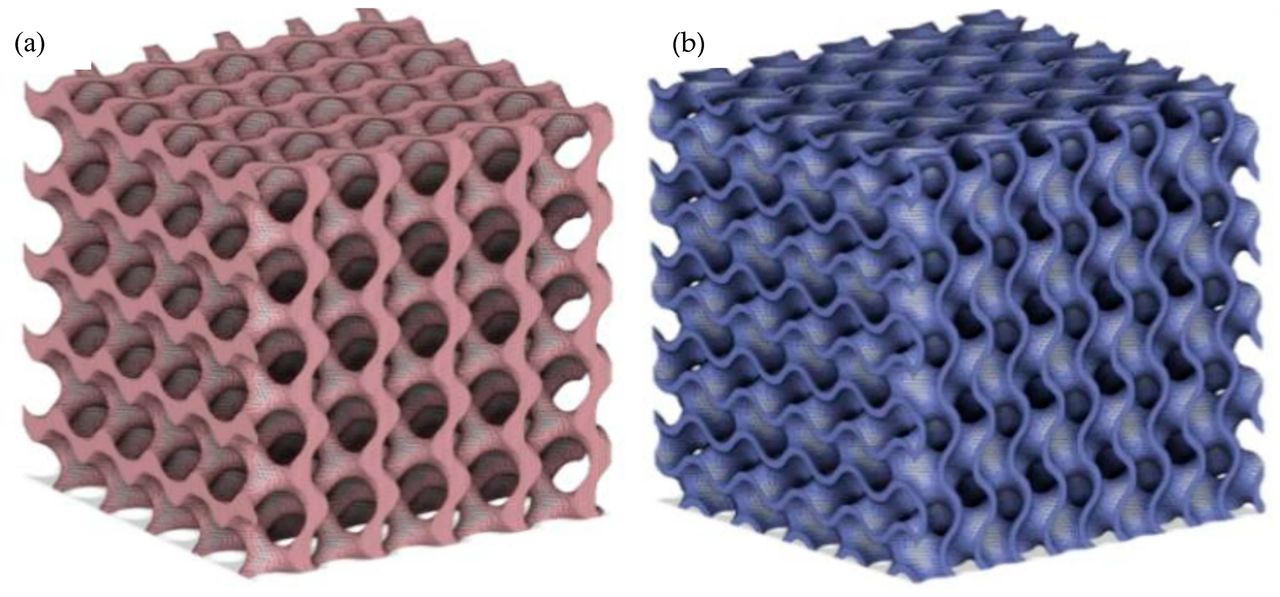
A new paper demonstrates a deep learning framework that co-optimizes Laser Powder Bed Fusion settings and titanium gyroid lattice design to boost printability and performance.
Lattice and “triply periodic minimal surface” (TPMS) structures such as gyroids are critical to lightweighting and energy absorption in aerospace, defense and medical implants. Titanium alloys, especially Ti-6Al-4V, are a natural fit for these applications in Laser Powder Bed Fusion (LPBF), but the thin walls and intricate curvature of gyroids push the envelope: too little energy yields lack-of-fusion porosity, too much drives swelling, keyholing or geometrical drift. In practice, designers optimize geometry first, then technicians nudge laser power, scan speed and hatch spacing through rounds of trial builds. That separation reduces performance and adds cost.
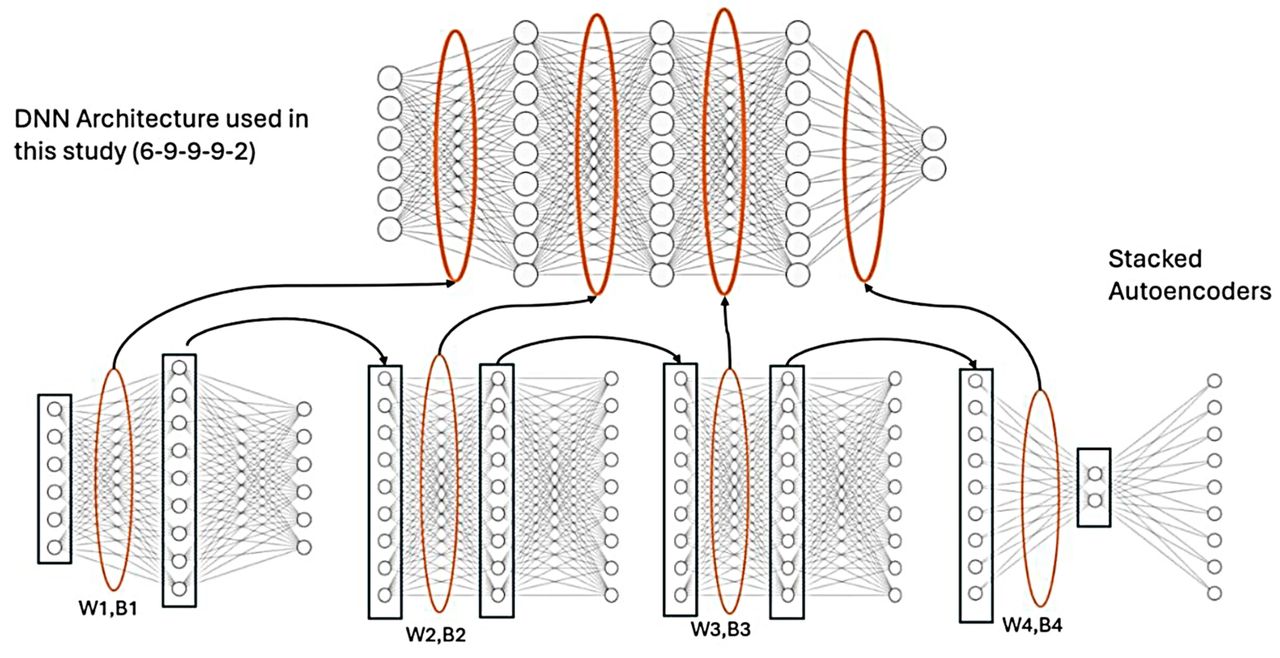
This study tackles that split. The authors build a data-driven surrogate that relates both design variables (for example, unit cell size, wall thickness, grading) and process parameters (laser power, scan speed, hatch spacing, layer thickness and scan strategy) to outcomes that matter, such as density, dimensional error, surface quality and mechanical response in compression. A deep neural network then serves as a fast predictor inside a multi-objective optimizer, enabling simultaneous search across geometry and LPBF settings for a chosen target, like maximizing stiffness-to-weight while constraining printability.
From Trial And Error To Co-Optimisation
Most AM workflows either rely on vendor parameter sets or custom recipes developed through experiments on a fixed geometry. Lattice design tools and topology optimization packages likewise assume a known process window. This research pulls those two together. By treating the part geometry and the thermal process as coupled variables, the method can, for instance, slightly thicken struts where a lower energy density is favored to avoid overheating, or adjust unit cell size to better fit a stable scan strategy — changes that are hard to intuit by hand.
The surrogate model collapses a high dimensional search into millisecond predictions, so the optimizer can evaluate thousands of candidate blends of gyroid parameters and laser settings without tying up a machine. The approach should result in fewer wasted builds, tighter dimensional control and more consistent mechanical properties, especially for functionally graded lattices where printability can vary across the build. While the paper focuses on titanium gyroids, the co-optimisation concept is applicable to other TPMS families and materials if the training data exist.
What This Could Change In Manufacturing
If validated at scale, service bureaus running titanium LPBF could compress their parameter development cycles from weeks to days, with lower powder and machine time burn. Medical implant developers might lock down a gyroid infill that meets target modulus while staying inside an auditable, repeatable process envelope, easing verification burdens. Aerospace teams chasing weight savings could expand their use of graded lattices with more confidence about build reliability and throughput.
There are some questions, though. The paper does not state dataset size, number of printed coupons, or exact performance deltas versus baseline tuning, so the magnitude of gains remains to be confirmed. Surrogates trained on one machine and powder lot may not transfer to another without adaptation, and the method’s sensitivity to recoater-induced damage, scan vector rotation, or support strategy is not clear. The work does not claim real-time closed loop control; this is offline optimization used before slicing.
Adoption will likely revolve around integration. Co-optimisation is most useful if embedded near lattice design and build prep, alongside nTop, Ansys Additive, Autodesk Netfabb or machine OEM slicers from EOS, SLM Solutions and Renishaw. A practical implementation would include a constrained slider set — part stiffness, mass, build time, and allowable roughness — while doing the heavy work under the hood. Open benchmarks on standard gyroid coupons, with cross-machine replication, would help build trust.
Design and process have always been two separate parts of additive manufacturing, but perhaps they can become a single process with this concept.
