
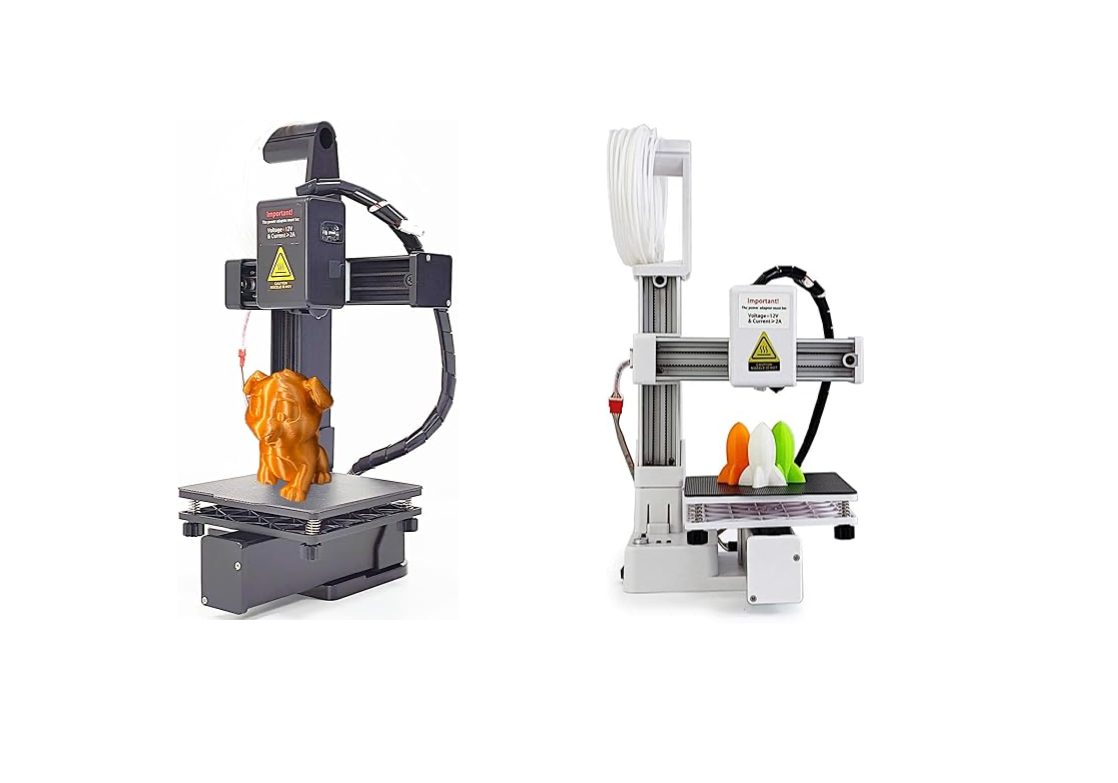
There’s a new lowest-cost desktop 3D printer that costs only US$42.
In the “race to the bottom”, the idea is that the lowest price wins. I’m not sure that’s the case here, with the “Frequency Division Multiplexing 3D Printer”, now selling online for the ridiculously low price of US$42 (marked down from US$107).
Pricing for desktop 3D printers has continually been dropping since they were introduced back in 2009. Then, a desktop machine would be priced around US$2000 — a truly enormous sum compared to today’s options.
Prices have been dropping consistently for years, and today we find that open gantry-style FFF systems typically cost in the US$200 range, while enclosed CoreXY systems are US$400 and more.
I’ve been watching the low price point for systems over the years, and the typical strategy is to strip the machine down to the bare bones to reduce costs. Recently, I’ve seen full-size open gantry systems as low as US$150.
But that record is now broken with a US$42 machine from, well, I’m not exactly sure who makes it. There is no indication of a brand on the listing.
Before we go further, I must say that this product seems entirely questionable and I would definitely not recommend buying one. However, it is interesting to see what strategies were used to bring the price so low. Let’s take a look at this curious low-cost 3D printer.
The first thing you’ll notice is that this is a very small device. In fact, its build volume is only 100 x 100 x 100 mm, tinier than even some resin systems.
The hot end can reach only 230C, which means there is no hope of printing anything other than PLA. I am not even sure that PETG would work on this machine. They do say that TPU is supported, however.
The print speed is stated as “10-40mm/s”, which is glacially slow. Today’s machines typically run at 300-600mm/s, with speedsters exceeding 1000mm/s. Even the prior generation of machines would run at 50-80mm/s, and this small system can’t even do that. Fortunately, the build volume is so small that you won’t be doing long jobs anyway.
The extremely slow speeds might suggest that TPU printing could work on this system. Slow speeds are naturally required for TPU, and this system doesn’t even need to slow down — it’s already really slow!
The slow speeds indicate that this machine does not have vibration compensation or pressure advance features. That means that print quality will not be terrific.
Does this device include automated calibration? I don’t think so, based on the instructions:
“Press the home switch to start leveling, and when the printhead touches the magnetic plate, disconnect the power and start leveling. If the printer is not leveled, the magnetic plate may be crushed by the nozzle and damaged. If the nozzle is too far away from the magnetic plate, the printed model will not stick to the magnetic plate.”
That means there is no automated levelling, which requires sensors. No sensors equals cheaper cost. However, it does appear that you must manually level the entire plate yourself by hand. In the image, you can see some knurled knobs for adjusting the four corners of the plate.
It does seem to have a removable magnetic PEI-coated print plate, however, and that’s something. They could have just used glass and saved a couple of bucks.
Another observation: there is no touchscreen. In fact, there is no control panel whatsoever. This means that the machine must be monitored remotely with the slicing software, which they recommend to be “Easyware, CURA, or Simplify3DExtruder”.
There is no mention of the controller for this device, so it is conceivable that it must be driven directly from a remote computer. This is how desktop 3D printing was done in prehistoric times: you had to have your laptop attached to the printer for the entire job. If you shut off the computer, the job would stop because no more G-codes were arriving.
Is this thing worth buying, even at the incredibly low price? Absolutely not. There have been so many convenience features removed that you will certainly spend a lot of time operating the device. Your time is worth money, and the savings here don’t justify your time.
Save your money and buy a more advanced machine that does all of this work for you automatically.
But it does come in black or white.
Via SaveNesting
