
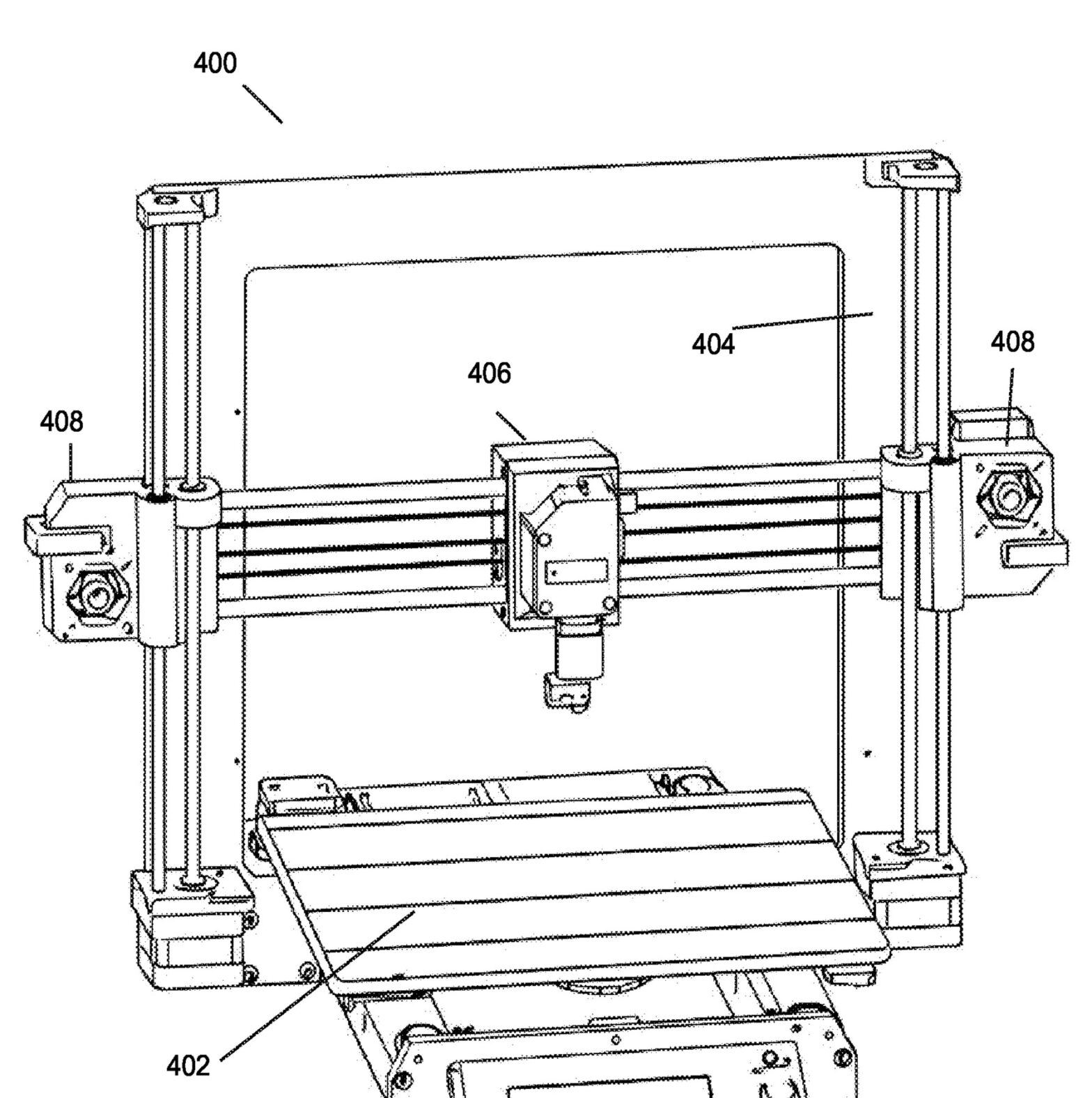
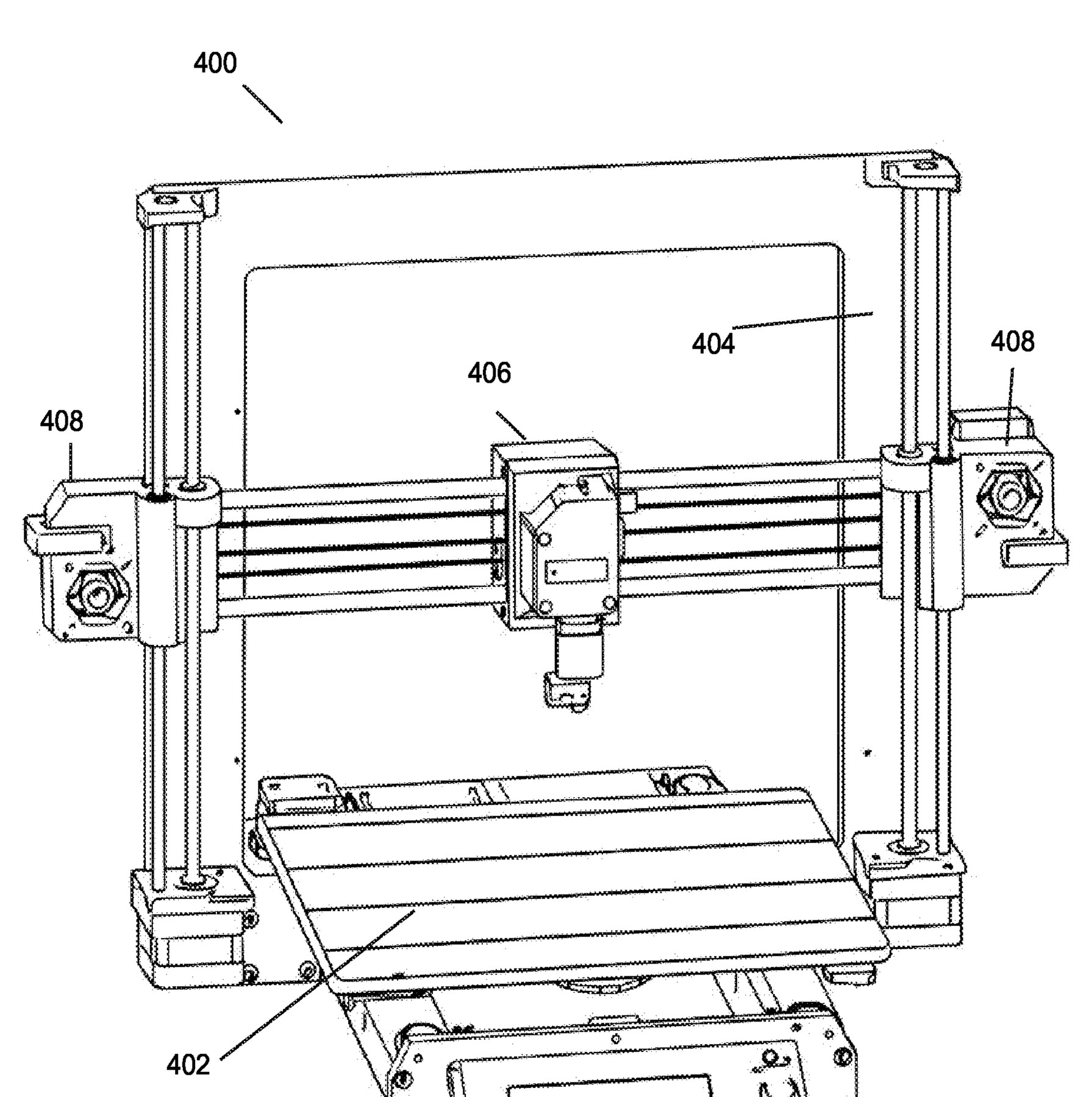
What if you moved the extruder motor off FFF printhead?
That is the crazy idea in US20260273865A1, a patent application from applicant and assignee Behnam Salemi. It describes a belt-driven extrusion system in which two motors remain mounted to the printer frame while their combined motion does two jobs: moving the printhead and driving the extruder.
The trick is differential motion. The patent’s diagrams show two motors connected through separate belts to a shared printhead assembly. The difference between the motors’ movements produces linear motion along an axis. The sum produces rotation of the extruder shaft, which pushes or retracts filament.
Imagine the motors turning by equal amounts in the same effective direction. Their opposing belt paths can cancel out the printhead movement while adding their rotation at the extruder. Reverse the relationship and the system moves the printhead with little or no extrusion. Intermediate combinations provide both at once.
That sounds like a mathematical curiosity until you consider the mass it removes. A conventional direct-drive FFF toolhead carries an extrusion motor, gears and filament sensor, often along with the hot end and cooling hardware. Every gram on that assembly has to be accelerated, stopped and redirected by the X and Y motion system.
Salemi’s arrangement leaves the motors at the frame. The printhead still receives what the patent filing describes as direct-drive responsiveness, but the moving assembly is lighter. The application says experimental results showed substantially higher achievable acceleration than conventional systems, with little degradation as extrusion loads increased.
The patent does not treat extrusion as a separate motor command bolted onto ordinary motion planning. Its control system receives both a commanded translational displacement and a commanded filament displacement, then converts those into coordinated motor values. Synchronization and feasibility checks are part of the proposed software architecture. This is wildly different from any motion system I’ve seen.
For a 3D printer operator, the possible benefit is straightforward. A lighter printhead could change direction faster, reducing the time spent on short segments, infill patterns and frequent travel moves. Higher acceleration could also let a machine maintain speed more effectively around detailed geometry.
The cost is a more complicated belt configuration. The drawings include idler pulleys, an extruder shaft and a belt tensioner. That tensioner is not decorative. Belt stretch, backlash, pulley alignment and changing tension could all affect both nozzle position and filament flow. Calibration would have to keep the two mathematical channels behaving like two clean physical channels.
I also wonder about maintenance. With a conventional toolhead, the extrusion drive is compact and easy to understand. Here, a belt failure or a small amount of slip could affect motion AND extrusion simultaneously. Diagnosing whether a defect came from the slicer, the motor coordination or the belt path might not be as simple as it is today.
Even so, this is a rather clever way to solve one of FFF’s problems: the motor that makes extrusion responsive is also weight that slows down printhead motion. Whether the added belts earn their place will depend on how well that elegant equation survives dust, wear and real production use, and whether a company decides to implement the concept.
Via Espacenet
