
After six articles and several days at McCormick Place, Charles R. Goulding reflects on the people, technologies and ideas that made IMTS 2026 a memorable manufacturing event.
This is my sixth and final article on the 2026 International Manufacturing Technology Show (IMTS) in Chicago. After several days walking through the halls of McCormick Place, looking at machine tools, robots and additive manufacturing systems, it is worth stepping back and considering the overall experience.
I attended IMTS as a guest of Robert E. Morris, the leading machine tool distributor. I was joined by three people who brought very different perspectives to the show: Mike DiMarino, President of Linda Tool, a leading Brooklyn machine shop; his daughter, Nicole DiMarino, Business Analyst at Linda Tool; and Anthony Imperato, President of Henry Repeating Arms, the large firearms manufacturer based in Wisconsin.
Having this group together made the experience particularly interesting. We were not simply walking through the show as spectators. Each of us was looking at the technology through the lens of an operating manufacturing business, making our conversations about new equipment especially practical.
Our first article, Looking Ahead to IMTS 2026: Where Machine Tools, Automation, and Additive Manufacturing Converge, was intended to tee up the show and identify some of the technologies and exhibitors we especially wanted to see.
Once we arrived in Chicago, three major categories became the focus of our coverage: 3D printing, robotics and machine tools.
“Machine tools, robots, additive manufacturing, automation and software are no longer separate stories. They are becoming parts of the same production ecosystem.”
3D Printing Takes Its Place on the Factory Floor
For our readers, additive manufacturing was naturally one of our primary interests. During our second-day coverage, we looked at several leading 3D printing exhibitors and followed that with a more detailed look at Stratasys.
What stood out to me was how naturally additive manufacturing fit into the broader manufacturing environment at IMTS. This was not a show where 3D printing existed in isolation. Instead, additive technologies were increasingly being presented alongside machining, automation, software and other production technologies.
That convergence was one of the central themes of the entire show. The question is becoming less about whether additive manufacturing belongs in a manufacturing operation and more about how it can work together with the other equipment already on the factory floor.
Robots Everywhere
Robotics is a major focus of our firm, so I was particularly interested in the large number and variety of robots throughout IMTS.
Our article, Robots Take Center Stage at IMTS 2026 – and 3D Printing Is Along for the Ride, explored many of the leading robot manufacturers we encountered.
One company that was especially interesting to me was Standard Bots, the fast-growing Long Island robotics company. Its presence at IMTS was a reminder that important robotics innovation is not limited to the traditional manufacturing giants.
Standard Bots also provided a particularly relevant connection between robotics and additive manufacturing. A robotic arm can potentially become the motion platform for a large-format 3D printer, while robots can also load, unload, inspect and move parts produced by conventional 3D printers.
That kind of integration points toward a future in which the distinction between a robot, a machine tool and a 3D printer becomes increasingly fluid.
We will have another opportunity to see Standard Bots up close when we visit its Glen Cove headquarters on October 8 for the robotics conference sponsored by Long Island Congressman Tom Suozzi.
“The distinction between a robot, a machine tool and a 3D printer is becoming increasingly fluid.”
Machine Tools Still Matter
For all the attention surrounding robotics and additive manufacturing, IMTS remains fundamentally a machine tool show.
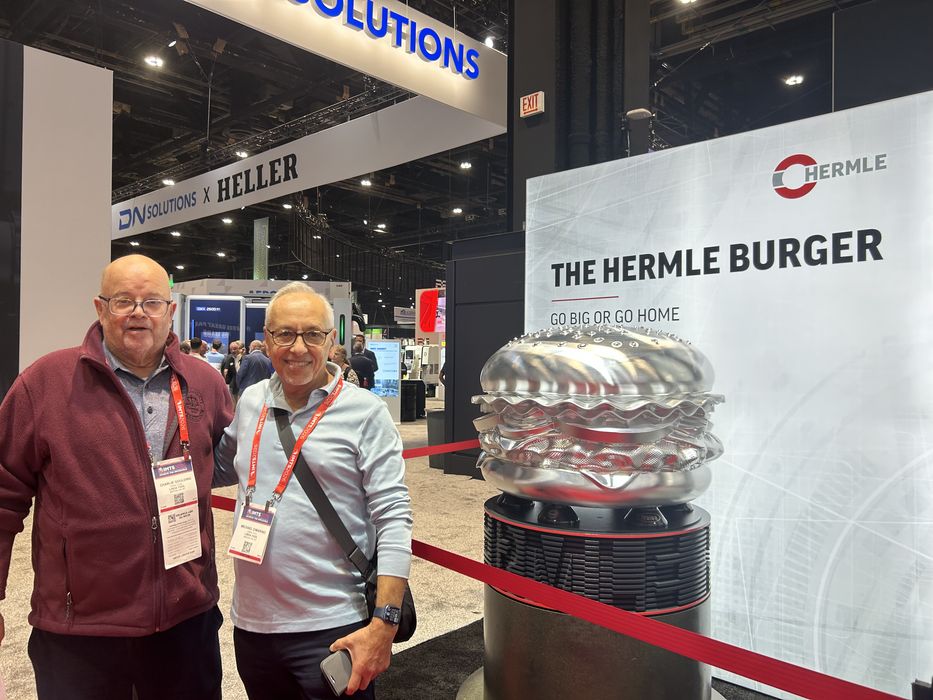
One of my favorite stops was HERMLE, particularly because Mike DiMarino is a HERMLE machine owner and has a strong appreciation for the company’s equipment. Our visit became the subject of HERMLE Goes Big at IMTS 2026 in Chicago.
HERMLE’s booth demonstrated how conventional high-precision machining is evolving alongside automation and additive manufacturing. The company showcased large five-axis machining capabilities, automation systems and its Metal Powder Application technology, which combines additive deposition with precision machining.
And there was a lighter side to the visit. HERMLE had a hamburger theme, and it was hard to resist enjoying a hamburger while watching a machine tool produce a large metal hamburger.
It was a memorable example of how a major industrial exhibition can combine serious technology with a little fun.
Breakfast With Lee Morris
One of the highlights of the entire trip for all four of us was breakfast and an open discussion with Lee Morris, Chairman of Robert E. Morris.
The company was founded and named after Lee’s father, Robert E. Morris, and Lee’s son, Bradley, now serves as President. That family history provides a remarkable connection to the American machine tool industry across generations. Lee’s core business philosophy is “grow or die.”
Lee is highly respected throughout the industry, and his knowledge of machine tools is encyclopedic. Sitting down with him provided an opportunity to talk about the show beyond individual machines and booths and to hear his perspective on where the industry is heading.
Those conversations are one of the reasons trade shows such as IMTS remain so valuable. The machines and demonstrations are important, but so are the people, relationships and experience that surround them.
“The machines and demonstrations are important, but so are the people, relationships and experience that surround them.”
The Research and Development (R&D) Tax Credit
The developments described may support IRC § 41 R&D credits where a taxpayer is not merely buying equipment, but is using experimentation to develop or improve products, manufacturing processes, automation methods, or integrated production systems. The article describes convergence among machine tools, robotics, additive manufacturing, automation, and software into a single production ecosystem, including robots used with large-format 3D printing and hybrid systems combining additive deposition with precision machining. Under IRC § 41, qualified research generally must involve domestic IRC § 174A-type expenditures, technological information, a new or improved business component, and a process of experimentation addressing technical uncertainty.
Accordingly, creditable activities could include testing alternative robotic end-effectors, print parameters, machining sequences, software controls, materials, inspection methods, or automated material-handling configurations to improve performance, reliability, throughput, precision, or manufacturability. Software embedded in or used to control a qualified production process may qualify, although internal-use software can be subject to additional requirements unless an exception applies. Activities would generally not qualify if they are limited to post-commercial-production refinement, customer-specific adaptation, duplication, surveys, routine quality control, foreign research, or funded research.
Looking Ahead
After six articles and many miles walked through McCormick Place, my biggest takeaway from IMTS 2026 is that manufacturing technologies are becoming increasingly interconnected.
Machine tools, robots, additive manufacturing, automation and software are no longer separate stories. They are becoming parts of the same production ecosystem.
That made IMTS 2026 an especially valuable experience, and I am grateful to have shared it with Mike, Nicole and Anthony.
As we leave Chicago, I am already excited to see how IMTS can improve upon what was already a stellar event next time around. If the pace of change we saw in 2026 is any indication, there should be plenty more to discover when the manufacturing community gathers again.