
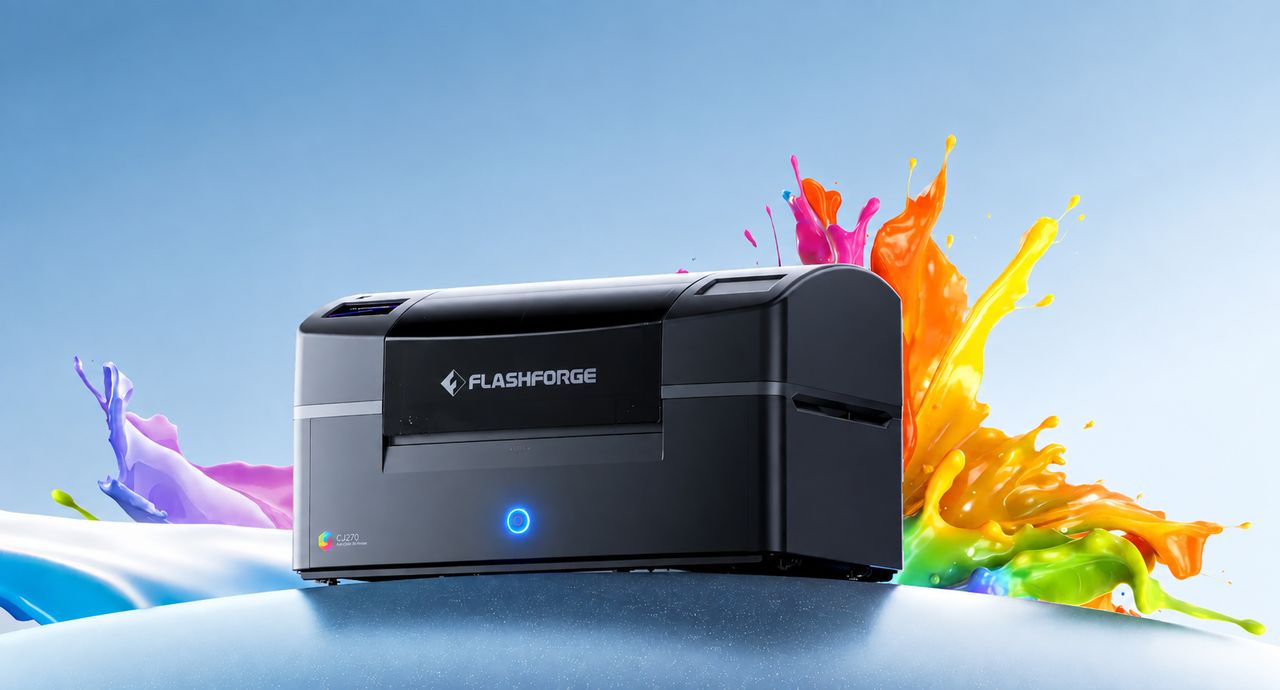
Flashforge finally shipped the elusive CJ270 full-colour 3D printer.
This device has been known for a very long time. It appeared at several trade shows, sometimes hidden at the back of the booth. Flashforge didn’t talk about it very much.
But I have been wondering when — and even if — they would release the machine.
Well, it turns out they finally did so quite recently.
They say it’s the “world’s first desktop full-colour 3D printer”, and possibly it could be, although there are a number of competitors that are about to launch similar machines.
When I say “full colour”, I don’t mean multicolour, like you’d see in many other 3D printers. A Bambu Lab system with an AMS can print, say, four colours in a job. Here the “full colour” literally means millions of colours, just like your colour laser printer. Except in 3D.
The technology has been long proven, and uses colour photopolymer resins applied with inkjet nozzles. The nozzles selectively drop the resin, and then a UV light immediately cures it. This goes on, layer after layer, until the object is finished. Full colours are achieved by mixing colours with the inkjets, just like is done with 2D paper printers.
The CJ270 prints layers quite fine: only 0.07mm high. This means that objects have exceptional resolution.
How are overhangs handled? Doesn’t the liquid simply drop to the bottom? That’s true, but one of the resins is for support material. There are no overhangs allowed, but any overhangs will have a pile of support material built underneath. After printing, the water-soluble support material is easily washed away.
The CJ270 usually operates with seven resins at once: Cyan, Magenta, Yellow, Black, White, Clear, and Support.
Flashforge designed the C270 to be relatively safe. Photopolymer resins are often toxic, so they’ve included a competent filtration system on the CJ270 to capture resin emissions before they leave the device.
Flashforge also developed new software, ColorPrint, to handle job setup for the CJ270. The software also includes an AI feature that can accept a 2D colour image and create a 3D colour representation of it that can be immediately 3D printed.
The build volume of the CJ270 is not huge: 180 x 120 x 100 mm, but that should be more than enough for most full-colour 3D prints, which will likely be figurines.
That should be the sweet spot for applications. There are a vast number of customers that are currently using standard resin MSLA 3D printers to produce high-resolution figurines, which require manual painting afterwards. With the CJ270, however, no painting is required: they are fully coloured right out of the printer.
The CJ270 is priced at US$4,499, but during the launch period it’s discounted to US$3,999. That price is quite a bit more than typical resin 3D printers, of which competent systems are about 1/4 of the CJ270 price. However, we’re printing full-colour objects here!
Also note that the current competition for this type of printer is in the industrial range: Stratasys’ PolyJet and Mimaki are the two main options, and they are both priced in six digits, far out of the reach of most people. Here, the CJ270 is actually affordable by a lot more people.
Does this mean the end of the road for the industrial systems? Absolutely not: they provide systems with far, far bigger build volumes, production-grade materials, precision colour accuracy, etc. Those will always be of interest to industrial customers.
But for hobbyists and small businesses, the CJ270 might be a great option to get into full-colour 3D printing.
Via Flashforge
