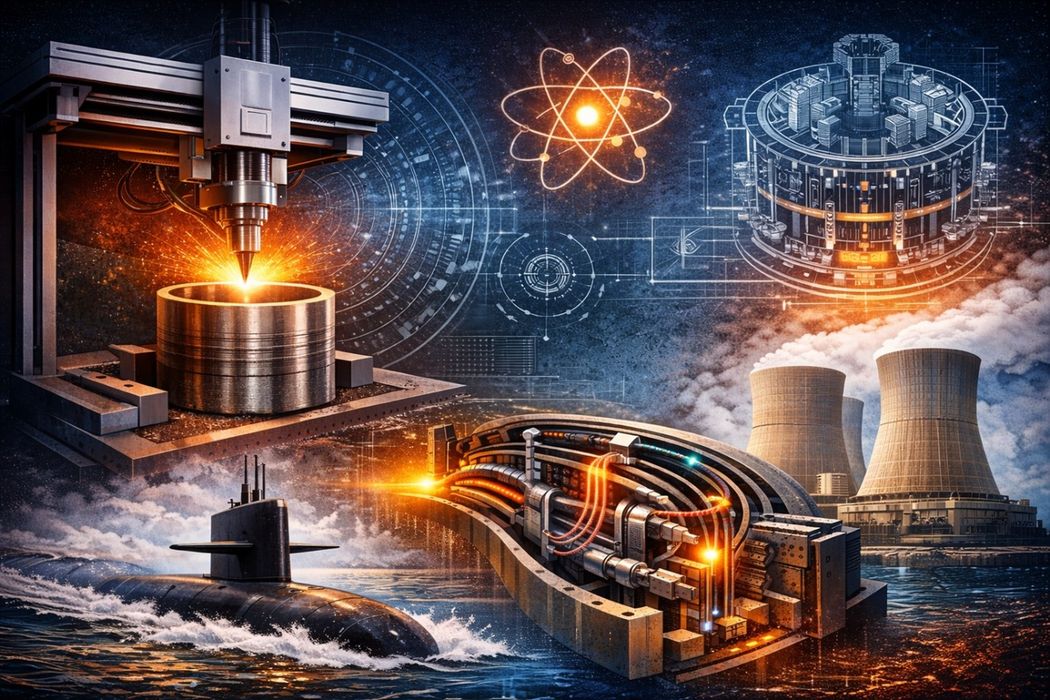
Anthony Palumbo and Charles Goulding examine how Fluor Corporation is advancing nuclear additive manufacturing through naval materials/process qualification and sensor-integrated hardware concepts, set against broader progress in 3D-printed fuel-related ceramics and nuclear construction tools.
Company Overview and Rare Earth Initiatives
Fluor Corporation is a global engineering and construction firm headquartered in Irving, Texas, with nearly 27,000 employees worldwide. The company reported 2024 revenue of US$16.3 billion and is ranked #257 on the Fortune 500, reflecting its scale in engineering, procurement, and construction services across energy, infrastructure, and major industrial projects. In parallel with its nuclear work, Fluor’s Mining & Metals organization has supported projects tied to critical mineral value chains, including rare earth-related developments.
One example is Fluor’s selection (alongside WSP Global) as engineering, procurement, and construction management (EPCM) partner for USA Rare Earth’s Round Top Rare Earth Project in Sierra Blanca, Texas, supporting the company’s Definitive Feasibility Study (DFS). USA Rare Earth has described an accelerated mine plan that leverages ongoing pilot and demonstration-plant work to advance engineering toward commercial production of heavy rare earth oxides, with associated drilling and mine-design work planned in 2026. Fluor’s role here is centered on feasibility-stage engineering and planning required to translate pilot-scale processing results into an executable development plan.
Internationally, Fluor has also served as EPCM contractor for Iluka Resources’ Eneabba Rare Earths Refinery in Western Australia, a project described as Australia’s first fully integrated rare earths refinery for separated rare earth oxides. Public reporting at the time of Iluka’s 2022 final investment decision placed the project estimate around A$1.0–1.2 billion (~US$750 million), with later reporting indicating revised higher guidance as cost pressures emerged. Fluor’s scope has been positioned around engineering and delivery management for a complex industrial processing facility. This context supports the main focus of this article: how Fluor is applying additive manufacturing to nuclear engineering challenges.
3D Printing in Naval Nuclear Applications
A significant portion of Fluor’s additive manufacturing activity is connected to its role in the U.S. Navy’s Naval Nuclear Propulsion Program. Through Fluor Marine Propulsion, LLC, Fluor manages and operates the Naval Nuclear Laboratory (NNL) under the U.S. Department of Energy’s (DOE) NNSA and Navy Naval Reactors contracts, supporting major sites including Bettis Atomic Power Laboratory and Knolls Atomic Power Laboratory. This position places Fluor close to the engineering, qualification, and sustainment challenges that define naval nuclear hardware. In this environment, advanced manufacturing must prove repeatability, traceability, and performance under stringent controls.
To accelerate the maturation of emerging technologies relevant to naval nuclear missions, Fluor helped launch the Naval Nuclear Laboratory Innovation Studio, Powered by Fluor. The program is invitation-based and is structured to surround participating teams with technical and commercial advisors, education, and access to facilities and knowledge-sharing opportunities, explicitly oriented toward shaping the future of naval nuclear propulsion. In practice, this creates a pathway for advanced manufacturing concepts (including additive manufacturing and materials) to be evaluated against real naval requirements earlier, with clearer lines of sight to stakeholders and deployment constraints.
One visible example of this additive manufacturing emphasis is Fluor Marine Propulsion’s collaboration with Rosotics, which publicly stated that it entered the fabrication and test stage of a federal contract with Fluor Marine Propulsion at Bettis Atomic Power Laboratory. Rosotics said the contract is certified for National Defense use with a high-priority E2 designation under the Defense Priorities and Allocations System (DPAS), supporting atomic energy operations and providing maintenance, repair, and operating supplies (MRO) for the U.S. Navy’s nuclear fleet. Within that scope, the stated technical objective is to demonstrate and refine deposition parameters for low-carbon, high-manganese steel alloys engineered for welding high-strength naval steels such as HY-80 and HSLA-80.
Rosotics’ technical work is positioned around an induction-derived, wire-based architecture aimed at addressing weldability and integrity challenges associated with these naval steels at larger section sizes. The near-term significance is less about declaring specific components “ready to print” and more about expanding the set of qualifiable material/process combinations for thick-section, high-strength alloys that are central to naval platforms. This is an area where microstructure control, defect avoidance, and repeatable process windows dominate development timelines.
Beyond new-build possibilities, this type of development aligns with the Navy’s broader push to move additive manufacturing from pilots into operational use for readiness and logistics resilience. NAVSEA has described additive manufacturing as transitioning into frontline fleet operations, including documented lead-time reductions and direct integration of additively manufactured parts into the supply chain. In that context, qualifying additional materials and scalable deposition approaches supports a practical sustainment goal: shortening procurement cycles for select components and tooling categories where conventional sourcing can be slow, constrained, or inflexible.
Additive Manufacturing of Nuclear Reactor Components
Fluor’s use of additive manufacturing in nuclear engineering is not limited to naval applications; it also extends to reactor component concepts that target reliability, monitoring, and maintainability. A prime example is a patented approach for steam generator conduit supports that integrate sensing hardware during fabrication. A prime example from Fluor’s broader SMR ecosystem is NuScale Power’s patented approach for steam generator conduit supports that integrate sensing hardware during fabrication. In 2024, NuScale Power was granted U.S. Patent US12062461B2, which discloses “instrumented” supports formed via an additive manufacturing process for nuclear reactor steam generator conduits.
NuScale Power was granted U.S. Patent US12062461B2 in 2024 for additively manufactured steam-generator conduit supports with integrated fiber-optic sensing. This work is also relevant to Fluor, given its long-standing strategic partnership and its historical majority ownership stake in NuScale.
In the disclosed design, the conduit support includes a carrier portion and a retainer portion that together support a helical steam conduit, with at least one portion integrally formed with a fiber optic strain sensor and a fiber optic link through additive manufacturing. By building the support additively, the method enables internal features and sensor routing that are difficult to achieve with conventional fabrication. The patent describes this as a pathway to embed sensing capability into a structural component, with additive processes serving as the enabling manufacturing mechanism. It also describes example embodiments that can incorporate sensor integration approaches without degrading the support’s structural function.
This concept is positioned to support two practical outcomes for nuclear hardware: continuous condition monitoring of a high-consequence support structure and earlier detection of abnormal loading or vibration behavior through embedded sensing. In principle, instrumented supports could provide operators with higher-resolution strain and temperature proxies at locations that are otherwise difficult to instrument, supporting maintenance planning and reliability management without changing the basic function of the steam generator assembly.
Fluor’s work on sensor-integrated reactor hardware and its naval-facing additive programs can be viewed as complementary elements of a broader manufacturing strategy. This strategy uses additive manufacturing to reduce lead times for specialized nuclear components while enabling geometries and multifunctional designs that conventional casting/forging and subtractive machining constrain. In traditional nuclear supply chains, large components (supports, heat exchanger structures, piping sections, and shielding features) often require long procurement timelines driven by specialized production capacity, inspection requirements, and documentation. Additive manufacturing can reduce schedule risk in select categories by building complex geometries from qualified digital definitions and controlled process windows. National laboratory programs, including work highlighted by Oak Ridge National Laboratory, have emphasized additive manufacturing’s role in enabling new nuclear manufacturing pathways and shortening development cycles for advanced components and construction tooling.
At the same time, additive nuclear parts must clear a high bar. Qualification for nuclear service requires rigorous validation of material properties, defect tolerance, inspection methods, and performance under operating conditions. Fluor’s long history in nuclear engineering, project delivery, and quality assurance provides relevant infrastructure for navigating that qualification landscape. This supports both component-level innovation (such as patent-backed instrumented supports) and the broader manufacturing adoption required to move additive parts from prototypes into nuclear service.
3D Printing Fuel and Structures: A New Era of Nuclear Energy
Fluor’s focus on additive manufacturing in nuclear coincides with a broader industry trend: using 3D printing to rethink how fuel, reactor hardware, and even nuclear civil structures are produced. To put Fluor’s work in context, several parallel developments highlight where additive manufacturing is already influencing nuclear deployment timelines and construction methods:
Advanced Nuclear Fuel
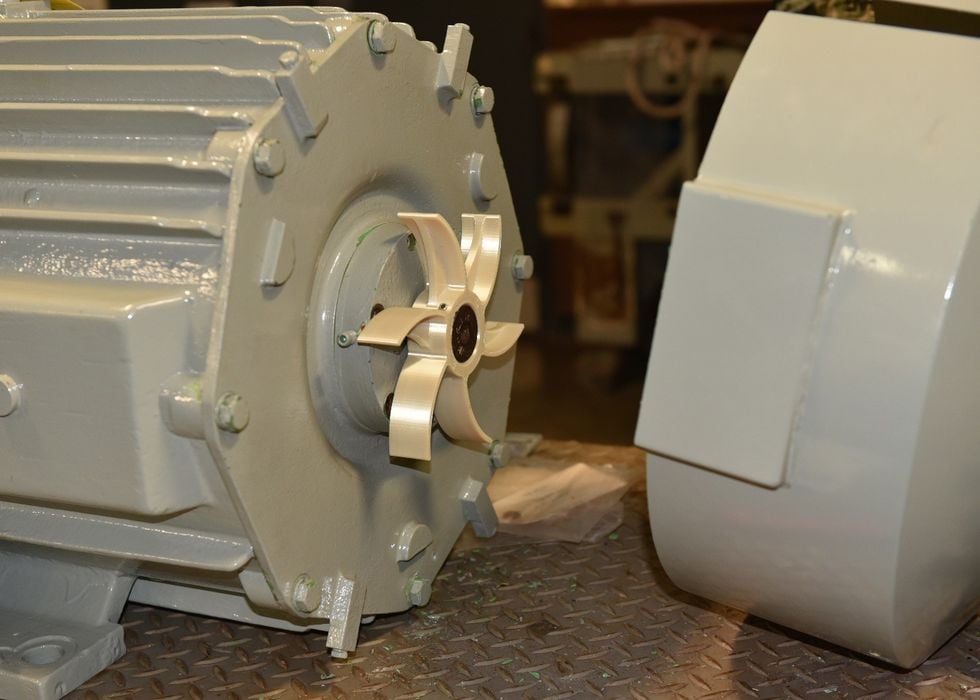
In addition to structural components, additive methods are being applied to nuclear fuel fabrication. Ultra Safe Nuclear Corporation (USNC) has adopted Desktop Metal’s X-Series binder jet systems to produce components used in its Fully Ceramic Microencapsulated (FCM) fuel approach, which incorporates TRISO particles within a ceramic matrix. Binder jetting deposits a liquid binder into a powder bed to build net-shape geometries that are later densified, reducing reliance on tooling and enabling shapes that are difficult to machine in ceramics. USNC has also licensed an Oak Ridge National Laboratory (ORNL) method combining binder jet printing with chemical vapor infiltration to manufacture highly heat-resistant ceramic components for reactor designs, underscoring how AM process chains are being tailored for nuclear-grade materials. As USNC executive vice president Kurt Terrani has stated publicly, binder jetting offers a “low-cost, high-yield, reliable” pathway for complex serial production, reflecting why these systems are being evaluated for advanced fuel and related ceramic components.
Small Modular Reactors (SMRs) and Microreactors
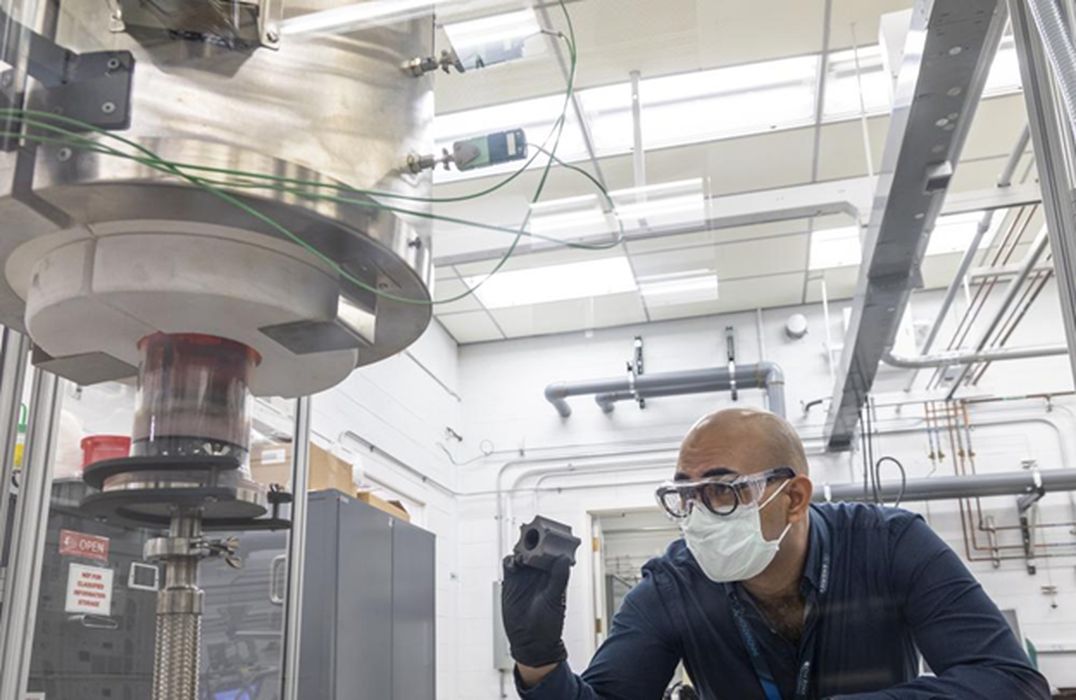
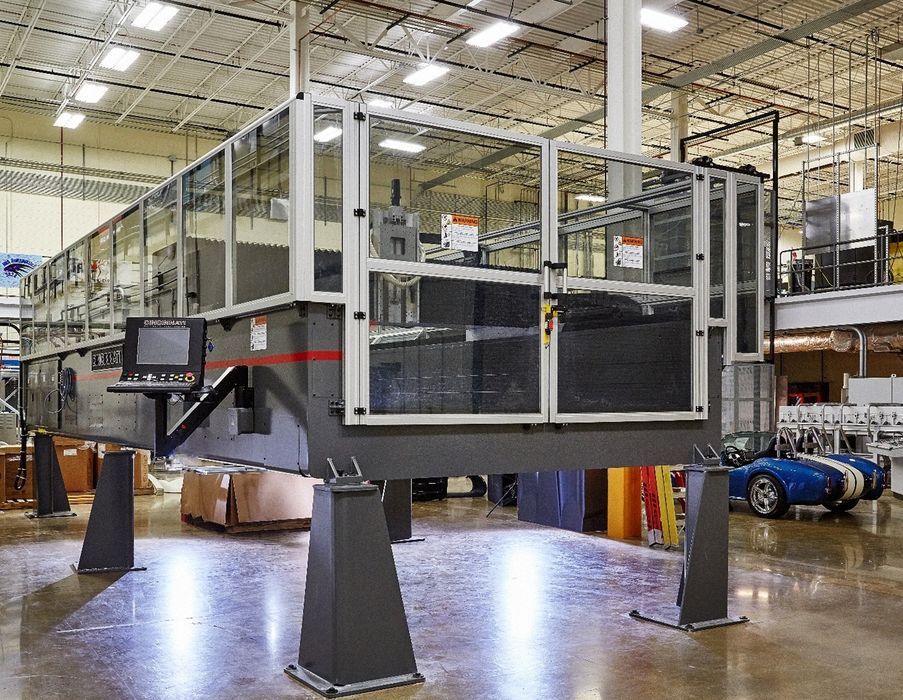
The ability to fabricate complex parts faster and with fewer supply-chain constraints is particularly relevant for emerging reactor designs such as SMRs and microreactors. ORNL’s Transformational Challenge Reactor (TCR) Program was established to apply additive manufacturing and data/AI to advanced reactor manufacturing and qualification workflows, linking design, manufacturing, and testing data to support certification of component performance. Separately, ORNL’s large-format additive work with the U.S. Navy has served as a widely cited scale demonstration. ORNL reported that a 30-foot submersible hull demonstrator was produced using Big-Area Additive Manufacturing (BAAM) in a matter of weeks, with about 90% reduced production cost compared to conventional hull fabrication. While not a reactor example, it provides a tangible benchmark for how large, complex structures can be produced on compressed schedules. This is an underlying manufacturing theme that advanced reactor developers are trying to translate into repeatable, qualifiable production pathways for nuclear hardware.
Reactor Construction and Civil Structures
Additive manufacturing is also influencing nuclear construction by changing how concrete shielding structures and formwork are produced. ORNL and partners, including Kairos Power and Barnard, have demonstrated reusable 3D printed polymer composite forms intended to support construction of radiation shielding structures for Kairos’s Hermes reactor facility. As a proof of concept, ORNL and partners reported designing, printing, and deploying molds in 14 days. ORNL describes the approach as enabling cast-in-place construction of complex geometries “in days rather than weeks”, and industry reporting has characterized the reusable molds as cutting wood usage substantially (reported as up to 75% less wood versus traditional formwork). ORNL has also portrayed these form sections as roughly 10 ft by 10 ft modules stacked to create larger column forms. This approach was aimed at reducing schedule risk for thick shielding features where conventional formwork is labor-intensive and slow to iterate.
Each of these examples, from binder-jetted ceramic fuel-related components to microreactor manufacturing programs and 3D-printed construction tooling, underscores the same theme relevant to Fluor’s nuclear strategy. Additive manufacturing can reduce lead times in select pathways, enable geometries that are impractical with conventional fabrication, and support faster iteration where construction schedules and component availability often determine project viability.
Qualification and Deployment Outlook
There are still material hurdles to widespread nuclear adoption of additively manufactured components, because each part must be qualified for service under demanding codes, documentation requirements, and operating conditions. In nuclear contexts, success depends less on printing novelty and more on repeatable process control, inspection methods, traceability, and performance validation. Fluor’s footprint in nuclear engineering and quality systems, paired with its operator role at the Naval Nuclear Laboratory and its ongoing work with external partners, positions the company to contribute to nuclear qualification pathways. These pathways can help move additive manufacturing from a prototyping tool into a deployable production method for select nuclear hardware categories.
The Research & Development Tax Credit
The now permanent Research and Development (R&D) Tax Credit is available for companies developing new or improved products, processes, and/or software. 3D printing can help boost a company’s R&D Tax Credits. Wages for technical employees creating, evaluating, and revising 3D printed prototypes are typically eligible expenses toward the R&D Tax Credit. Similarly, when used as a method of improving a process, time spent integrating 3D printing hardware and software can also be an eligible R&D expense. Lastly, when used for modeling and preproduction, the costs of filaments consumed during the development process may also be recovered.
Whether it is used for creating and testing prototypes or for final production, 3D printing is a great indicator that R&D Credit-eligible activities are taking place. Companies implementing this technology at any point should consider taking advantage of R&D Tax Credits.
Conclusion: Fluor’s Role in a Changing Industry
Fluor Corporation’s additive manufacturing work in nuclear engineering reflects a practical strategy. It is focusing advanced manufacturing on applications that can reduce lead times, enable designs constrained by conventional fabrication, and improve maintainability through embedded monitoring. Across naval nuclear propulsion initiatives and patented sensor-integrated reactor component concepts, Fluor is aligning additive manufacturing development with the core constraints of nuclear deployment: repeatability, verification, and lifecycle support.
As additive manufacturing becomes more embedded across fuel, component production, and nuclear construction tooling, Fluor’s combination of nuclear delivery experience and manufacturing integration efforts supports broader industry momentum. That momentum is oriented toward faster, more flexible, and more instrumented nuclear systems. The long-term impact will depend on qualification and adoption at scale, but Fluor’s current portfolio indicates a deliberate move toward additive manufacturing as a supporting capability for nuclear modernization rather than a standalone technology showcase.