
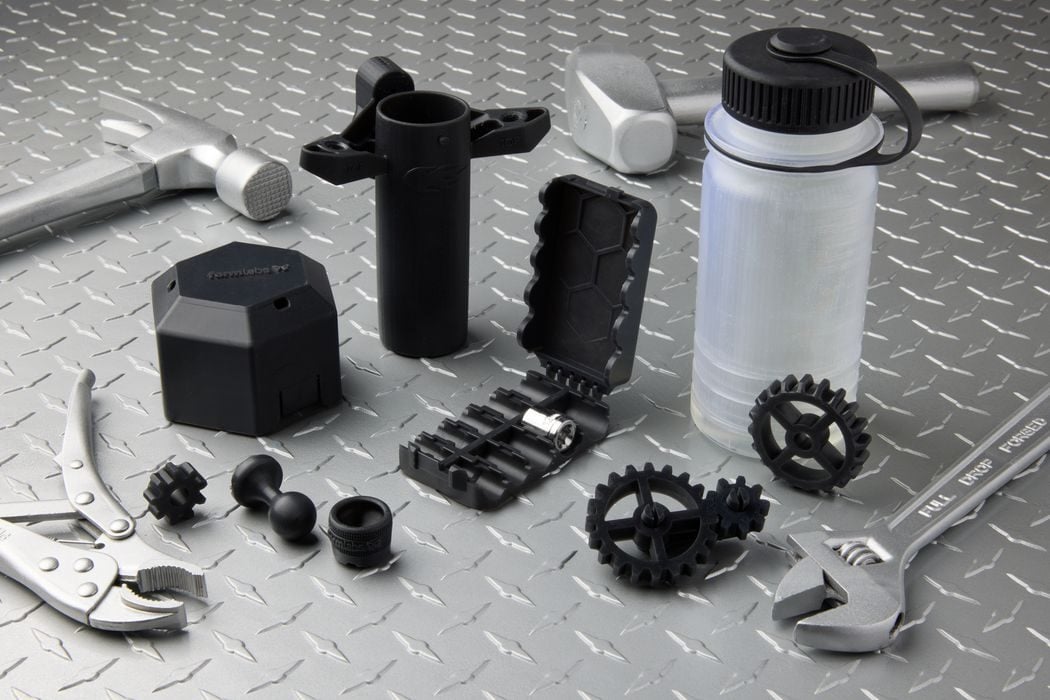
Formlabs today introduced a new family of materials designed to rival the strength and resilience of traditional thermoplastics.
This is an aggressive move that could push stereolithography technology further into the world of end-use production.
The Massachusetts-based company announced the Tough Resin Family, three engineering materials that mimic the performance of common injection-molded plastics. Each resin corresponds to a specific thermoplastic benchmark:
- Tough 1000 aims to match HDPE
- Tough 1500 mirrors polypropylene
- Tough 2000 rivals ABS
The naming convention is based on tensile modulus values, offering designers an easy way to select the right combination of ductility and stiffness for their needs.
These new formulations are compatible with the Form 4 Series of 3D printers, and deliver a dark matte finish and sharp detail.
But the larger shift being made here by Formlabs is strategic — by targeting the mechanical properties of well-known plastics, Formlabs is signaling that it wants resin not only for prototyping, but for production-grade parts.
Early adopters report that the new materials perform impressively under stress. Adam Warren, draftsman and mechanical designer at Cool Machines, noted that their end-use parts printed in Tough 1000 withstood “torture testing at freezing temperatures” and “abuse” typical of their equipment environments. Feedback like this suggests these resins can move beyond prototype use into functional applications where impact and fatigue resistance are required.
Formlabs’ new materials promise a better balance of toughness and detail, two properties not often synchronized in resin-based printing.
Faster, Simpler Post-Processing
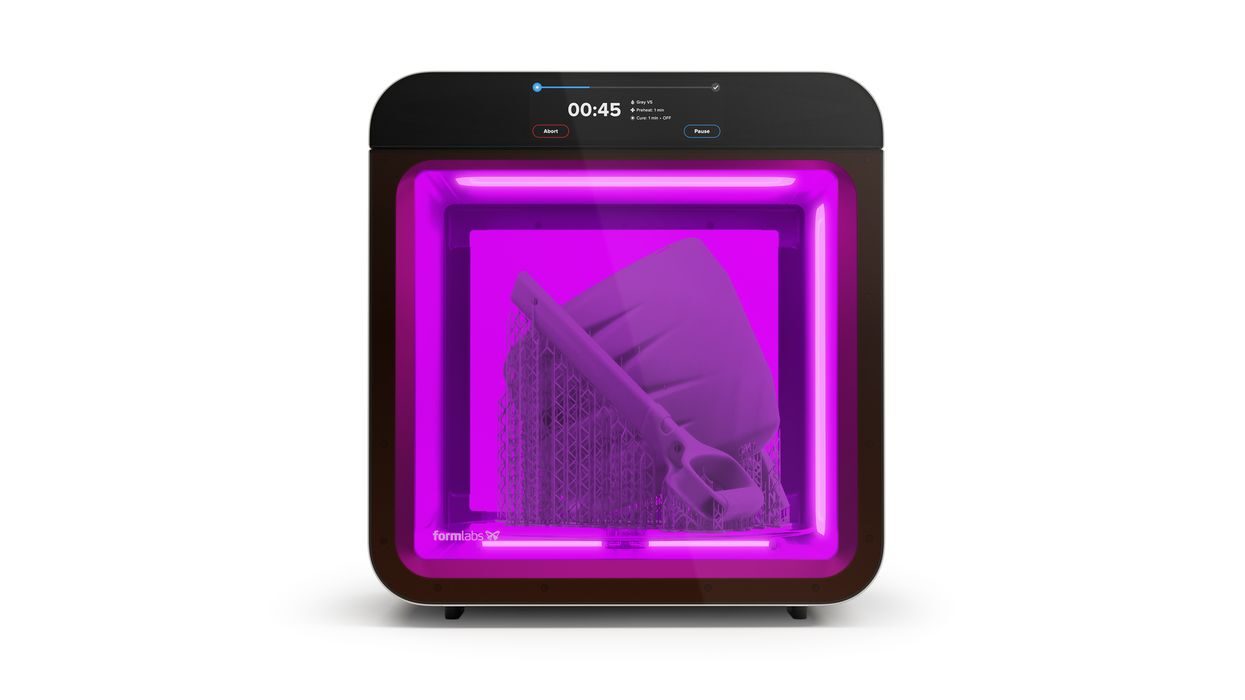
Alongside the new materials, Formlabs also revealed the Form Cure L V2, a compact post-curing unit designed for large parts, including those from the rather large Form 4L printer.
Formlabs claims it can cure most parts in under 60 seconds, drastically reducing turnaround time, which typically can be 10-20 minutes on most curing systems. This represents a major improvement in the typically slow resin workflow, where post-curing often bottlenecks production throughput.
Customers like Radio Flyer have already noticed significant productivity gains. Radio Flyer Product development engineer Agostino Lobello said they were “shocked by how fast the cure times were across all materials,” allowing engineers to receive finished parts much faster than before.
For businesses running many resin print jobs per day, that time savings translates directly into reduced labor costs and higher throughput.
Toward True Resin Manufacturing
The combined release of next-generation materials and rapid post-processing tools indicates Formlabs’ intent to make resin a more mainstream production process, not just a prototyping tool.
By emulating the performance of HDPE, polypropylene, and ABS — plastics that dominate consumer, automotive, and industrial goods — the company is taking aim squarely at short-run and bridge manufacturing. It’s possible these materials might open the door to Formlabs more directly approaching new industries, such as automotive and aerospace, which could dramatically increase their potential market.
We don’t know much yet about the long-term stability, thermal limits, and cost per part compared with fused filament or powder-bed systems. If Formlabs can demonstrate consistent performance under field conditions and maintain the price advantage of in-house printing, it may very well expand resin’s footprint for low volume manufacturing.
Formlabs’ CEO Max Lobovsky summarized the goal succinctly: delivering “any part at the push of a button.” With the new Tough Resin Family and Cure L V2, that vision just became a bit more real.
Via Formlabs
