Charles R. Goulding takes readers inside HERMLE’s exciting IMTS 2026 showcase, highlighting the company’s latest machining and additive manufacturing technologies and discovering why there’s plenty to look forward to from HERMLE.
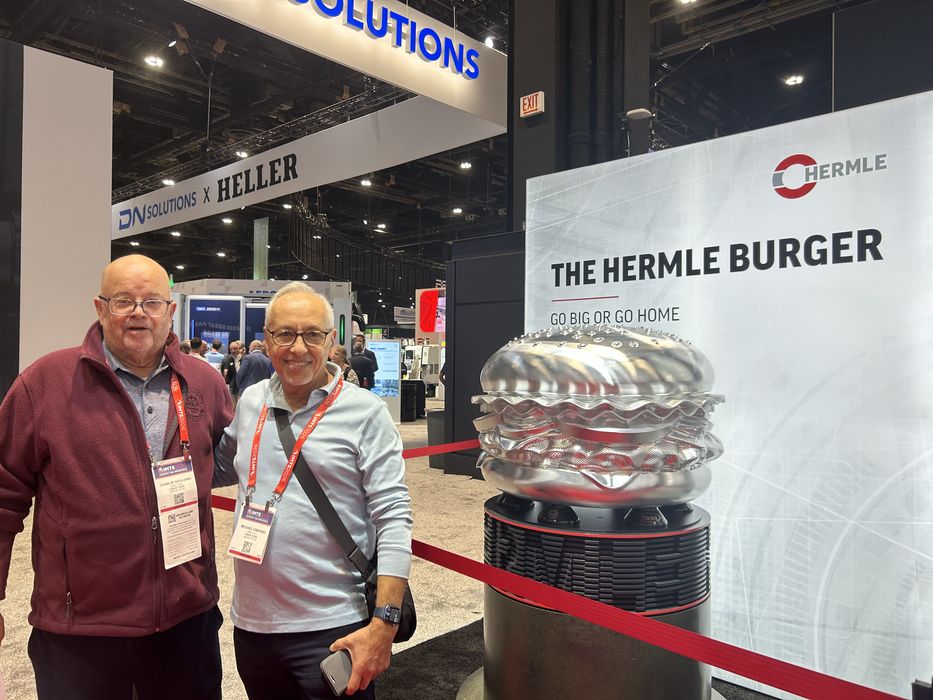
IMTS 2026 in Chicago was filled with impressive machine tools, automation systems and manufacturing technology, but one of the booths that really stood out to me was HERMLE. I attended the show with Mike DiMarino, president of Brooklyn-based Linda Tool and a HERMLE machine tool owner, and we made sure to spend time at the HERMLE booth.
It was easy to see why HERMLE was calling this its biggest North American trade show presence ever.
The company occupied booth #339121 in the South Building at McCormick Place and brought five machine models and two automation systems to Chicago. The centerpiece was the C 62 MT GEN2, HERMLE’s large-format five-axis mill-turn machine, which was being shown at a North American trade show for the first time. HERMLE also introduced its new C 22 MT GEN2 mill-turn machining center.
But the booth was about much more than simply putting large machines on display.
A “Go Big or Go Home” showcase
HERMLE’s theme for IMTS was “Go Big or Go Home,” and the company certainly followed through.
The C 62 MT GEN2 was the star attraction. HERMLE had developed an ambitious demonstration part specifically for IMTS, machining it from aluminum on the large five-axis mill-turn platform. The project involved HERMLE along with technology partners including OPEN MIND, HAIMER, FRAISA and SCHUNK.
For visitors like Mike and me, this is what makes a machine-tool trade show worthwhile. You can read specifications in a brochure, but seeing a machine actually perform complex five-axis work gives you a much better understanding of what the equipment can do.
HERMLE’s other machines included the C 12 GEN2, C 250 GEN2, C 400 GEN2 and C 22 MT GEN2. The C 12 GEN2 was paired with the RS 05-2 robot cell, while the C 250 GEN2 was demonstrated with the HS flex hybrid automation system. HERMLE described the RS 05-2 as a compact solution intended for reliable, repeatable lights-out production. The HS flex hybrid is designed to handle pallets and machine vices automatically, reducing manual intervention.
That combination of machining and automation was an important part of the story. For manufacturers dealing with labor shortages and the need for higher machine utilization, automation isn’t simply an add-on anymore. It is increasingly part of the overall production strategy.
The hamburger connection
There was also a lighter side to the HERMLE presentation.
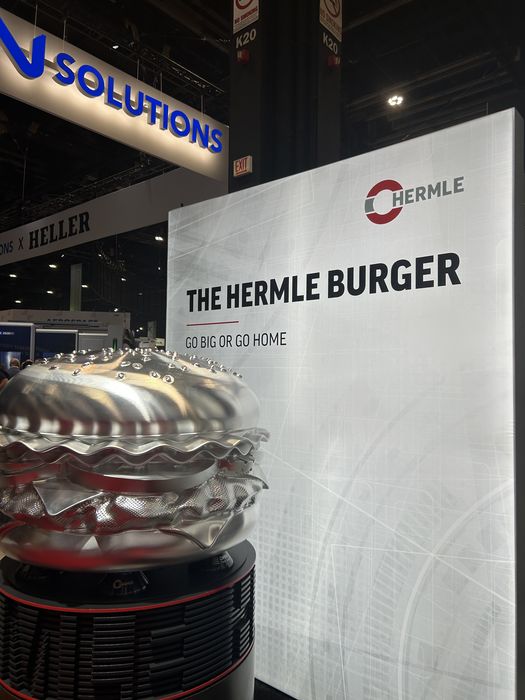
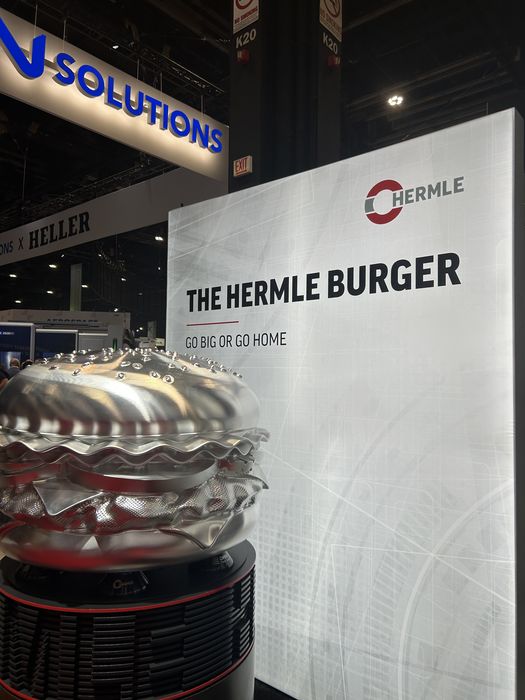
The booth had a strong hamburger theme, and HERMLE completed the theme by serving delicious hamburgers to attendees visiting the booth. That made the HERMLE area feel more like a gathering place than a conventional machine-tool exhibit.
It was a smart way to bring people in and keep them around long enough to talk with the HERMLE team, look at the machines and discuss manufacturing applications.
For me, it also added a memorable personal element to the visit. Mike DiMarino and I were there to look at manufacturing technology, but there was certainly no reason not to enjoy a good hamburger along the way.
HERMLE and 3D printing
One of the areas that deserves particular attention is HERMLE’s work in additive manufacturing.
Although HERMLE is best known for high-precision CNC machining, the company has developed its own MPA, or Metal Powder Application, technology. HERMLE describes MPA as a hybrid additive/subtractive process in which metal powder is applied layer by layer and then machined to the required geometry.
This is particularly interesting because it isn’t simply a matter of 3D printing a finished component and taking it out of the machine. HERMLE’s approach combines material deposition with precision milling.
One example is a demonstration “ball run” component. HERMLE says the component measures approximately 520 by 520 by 140 millimeters and weighs about 270 kilograms, with approximately 40 kilograms of material applied using the MPA process. The part incorporates a 3.4-meter-long internal duct and a copper insert. The manufacturing sequence involves milling a channel, filling it with a water-soluble material, applying steel and copper layers, machining the deposited materials and ultimately removing the temporary filling material.
Another particularly interesting example is HERMLE’s sailing boat project. The company produced a stainless-steel blank using MPA technology and incorporated pure copper into portions of the structure. The resulting blank was then machined on a HERMLE C 400 five-axis machining center.
These examples illustrate why hybrid manufacturing is attracting so much interest. Additive manufacturing can put material where it is needed, while five-axis machining can then provide accuracy, surface finish and final geometry.
HERMLE has also applied MPA to tooling and mold making. Its published examples include conformal cooling channels, copper cores for heat conduction and multi-material components. In injection molding, for example, HERMLE says MPA can create integrated cooling channels and combine materials such as steel and copper to improve heat dissipation and tool performance.
This is an important distinction from the way many people traditionally think about 3D printing. In HERMLE’s world, additive manufacturing isn’t necessarily replacing machining. Instead, the two technologies can work together.
Hermle 3D Printing / MPA Developments and IRC § 41 R&D Credit Support
Hermle’s Metal Powder Application (“MPA”) developments may support IRC § 41 R&D credit qualification because the article describes technical work directed at advancing additive manufacturing processes and tooling performance. Hermle’s MPA technology uses a hybrid additive/subtractive process in which metal powder is applied layer by layer and then precision machined to the required geometry. The process combines 3D metal deposition with precision milling rather than merely printing a finished part, which indicates research grounded in engineering and physical sciences.
The examples also support the “business component” and permitted-purpose requirements under IRC § 41(d), which generally require research intended to develop or improve a product, process, technique, or invention and to improve function, performance, reliability, or quality. For example, Hermle demonstrated an internal duct and copper insert using MPA, with steps including milling a channel, using a water-soluble temporary fill, applying steel and copper layers, machining the deposits, and removing the fill 4. These facts suggest technological uncertainty around material compatibility, deposition parameters, internal geometries, tolerances, and removal methods.
Further, MPA applications to conformal cooling channels, copper cores, multi-material tooling, improved heat dissipation, and tool performance align with a process of experimentation—identifying uncertainties, evaluating alternatives, and testing designs to achieve improved performance or quality.
R&D Tax Savers has been helping companies navigate the complexities of the R&D credit since it was introduced into law in 1981.
A booth built around manufacturing’s future
That combination of large-scale five-axis machining, automation, mill-turn technology and additive manufacturing made HERMLE’s IMTS presentation particularly interesting.
The company wasn’t showing just one piece of equipment or one manufacturing concept. It was demonstrating an ecosystem in which machining centers, robots, pallet handling and advanced manufacturing processes can work together.
The C 62 MT GEN2 represented the “go big” side of the presentation, while the C 12 GEN2 and RS 05-2 demonstrated how automation can be packaged into a relatively compact footprint. The C 250 GEN2 with HS flex hybrid showed another approach to automated production, while the C 400 GEN2 and C 22 MT GEN2 highlighted HERMLE’s broader range of precision machining capabilities.
For a manufacturer such as Linda Tool, these are practical considerations. The question isn’t simply which machine has the most impressive specifications. It is how a machine can fit into an existing shop, improve throughput, handle more complicated work and operate efficiently with the available workforce.
That was one of the things Mike, and I were looking at during our visit.
Looking ahead
IMTS is always an opportunity to see where manufacturing technology is heading, and HERMLE’s booth provided plenty of clues.
The company demonstrated that high-end five-axis machining remains at the center of its strategy, while automation and hybrid additive manufacturing are becoming increasingly important parts of the picture.
The hamburger theme may have provided the fun, but underneath it was a serious manufacturing message: HERMLE wants manufacturers to think more about what their production equipment can accomplish.
I had a great time visiting the HERMLE booth at IMTS 2026 with Mike DiMarino. Between the impressive machines, the advanced demonstrations, the additive manufacturing examples, the friendly HERMLE team and, of course, the hamburgers, it was a memorable stop at the show.
I came away from Chicago seeing big things for HERMLE.