
What if the heated bed were designed around its heater, instead of simply having a heater stuck underneath it?
That is the interesting idea in Shenzhen Tuozhu Technology’s US20260264331A1, a patent application for a heated bed used in a 3D printer. [Tuozhu is the parent company behind the Bambu Lab brand.] The filing proposes a rigid bed body with a separate heating unit fitted into its underside, plus a bottom case that holds everything together.
The way heat is spread through a print surface has a direct effect on whether the first layer stays attached or curls up at the corners – the dreaded warping phenomenon.
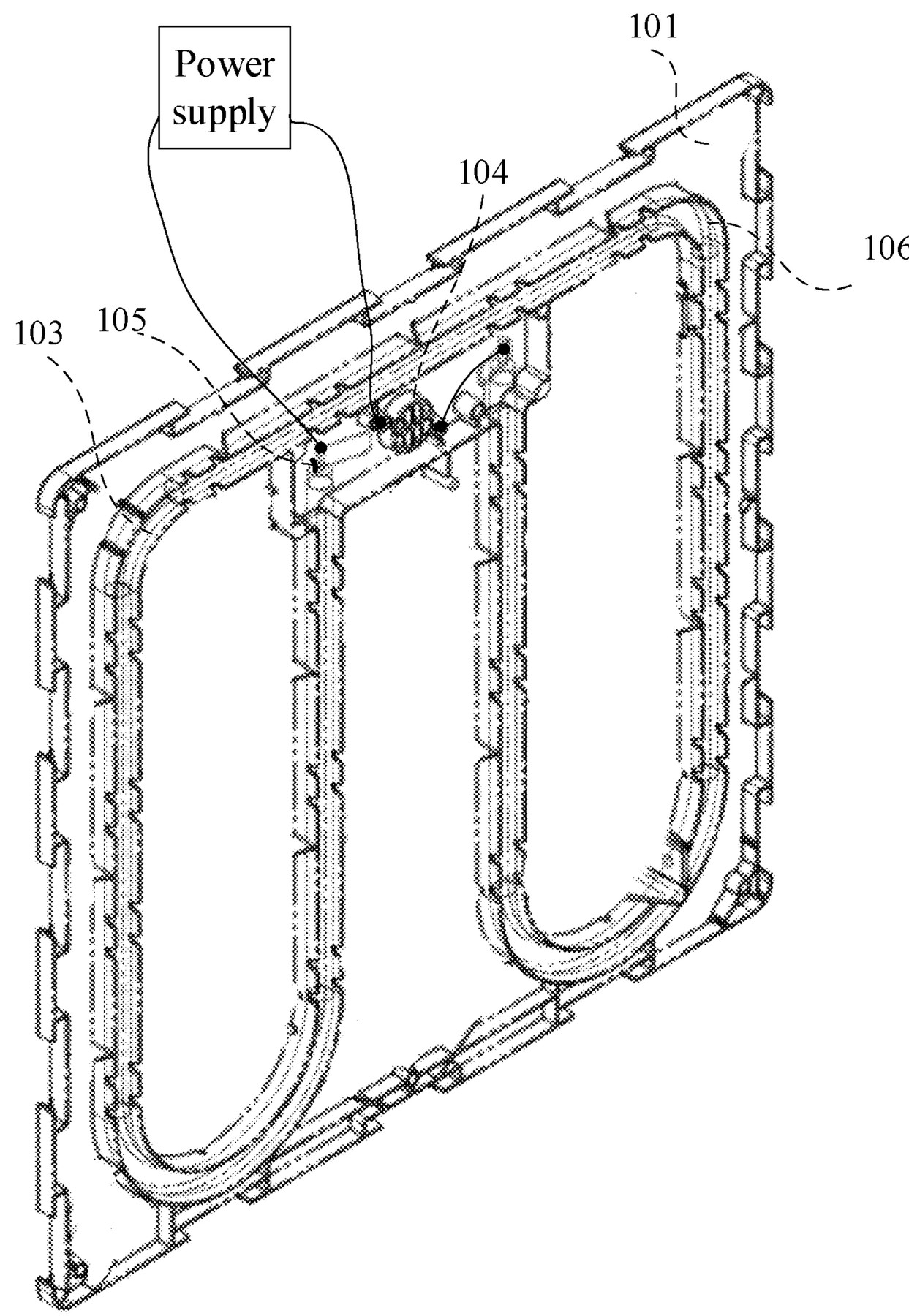
Tuozhu’s problem, as described in the patent, is that material lands on a print plate that is too cold, while thermal expansion and contraction pull at the growing object. The result can be edge warping and poor adhesion. The proposed bed in the patent places a heating tube and/or resistance wire between the heated bed body and the bottom case. The heater is attached close to the bed body, so heat reaches the upper surface by conduction.
Why not just bond a conventional heating element to an aluminum plate? The application argues that aluminum substrates can be expensive and that combining materials with different expansion rates can hurt flatness. Its bed body can instead be made as a single planar part, while the heating unit is held in a recess on the back.
The drawings show a heater line snaking around the underside of a rectangular bed. In some versions described, the recess is symmetrical or shaped like a square, while another option is S-shaped. These shapes are intended to distribute the heater across the bed so that different regions receive similar heat.
Bambu Lab also describes heat-conducting material around the tube or resistance wire. Thermal grease is one example. Better contact should reduce air gaps between the heater and the bed body, although adding grease creates another assembly step and another material that has to survive repeated heating cycles.
There are several smaller ideas wrapped around the main one. A temperature sensor can be fixed into the bed structure rather than left loose underneath it. A switch can disconnect the heater if the bed reaches a safe temperature. The bottom case may include insulation, and reinforcing ribs can stiffen the plate without making its front surface more complicated.
The application also covers magnets that hold a removable print panel against the heated bed. One version uses stronger magnets in one region and weaker ones in another, apparently reserving magnetic force for the areas where it is needed while reducing magnet cost. The print panel could be magnetically attracted to the bed, making removal easier after the print cools.
That combination is more interesting than it first may appear. A heated bed that is flat, evenly heated, and able to accept a removable panel addresses three issues: compensating for uneven heating, maintaining reliable first-layer adhesion, and prying finished parts from the machine.
The patent’s claims are broad enough to cover both moving-bed and moving-platform printer arrangements, including a bed mounted on a base or lead screw. They also cover the heating unit, sensor, safety switch, insulation, magnets, and structural features as dependent variations.
I suspect the real engineering question is whether the integrated structure stays flat after thousands of hot-and-cold cycles, and whether the heater can be replaced without discarding the entire bed.
Via Espacenet
