
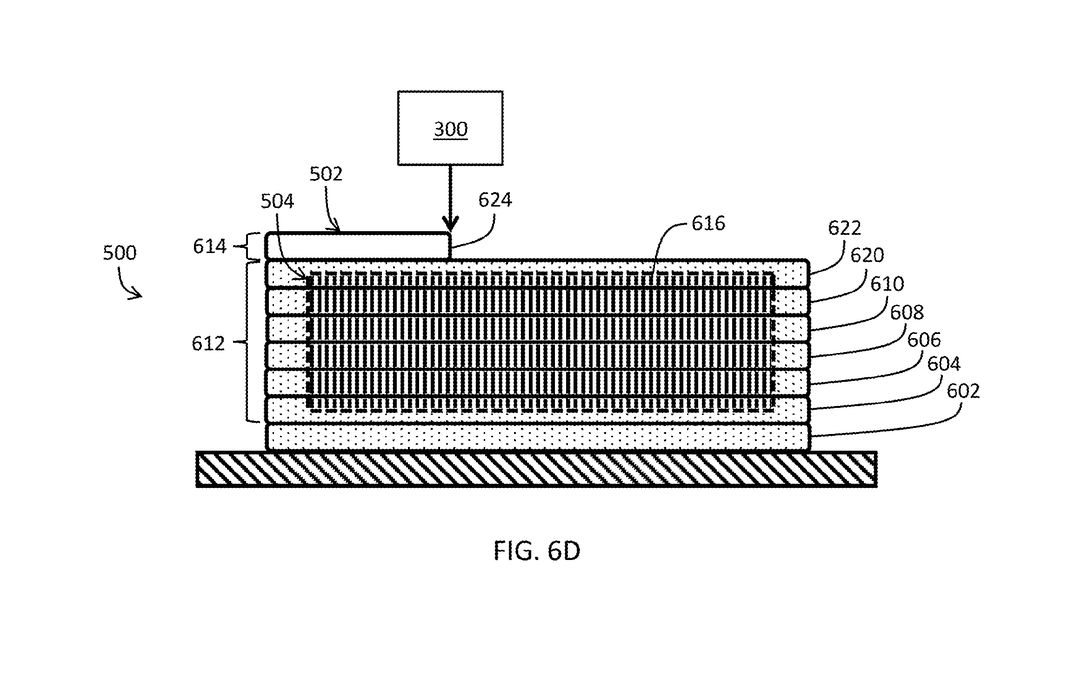
IBM is exploring a way to turn empty 3D printed cavities into engineered features instead of unused air.
Most desktop and industrial extrusion based systems treat hollows as a simple geometry problem. You either leave the space empty, bridge over it, or fill it with a patterned infill chosen during slicing. IBM’s patent points to a different approach: build the shell with a primary nozzle, then use a secondary nozzle to dispense particles into the hollow region according to a computed fill plan. In other words, this is not just about printing walls, but about programming what goes inside them while the build is underway.
That makes this more interesting than just a routine slicing tweak. The patent describes identifying a solidification pattern, generating a fill plan from that pattern, then selecting particle type, volume, and even ratios of multiple particle types before dispensing them into the cavity. The system also discusses scanning modules that monitor the process and collect thermal values during printing. That suggests IBM is thinking about a closed loop process rather than a blind dump of filler.
From Infill Geometry to Material Programming
The closest analogy is a hybrid between conventional FFF workflow and a rudimentary multi material manufacturing cell. Today, if you want different internal behavior inside a printed part, you usually change infill density, infill pattern, wall count, or switch to a different filament altogether. IBM’s concept inserts another variable: loose particles placed into selected hollow zones while the print is still being formed.
That could allow a printed object to have locally tuned properties without requiring every feature to be extruded through the main nozzle. A likely use would be weight balancing, damping, insulation, thermal behavior, or perhaps low cost reinforcement in non structural regions. The patent leaves the particle class quite open, and that is both its strength and its weakness. The idea could span simple granules, functional powders, or mixed particles, but IBM does not provide the practical material limits that would matter most in a production environment. There are many possibilities here.
The inclusion of solidification pattern analysis is also interesting. That implies the software is watching for the right moment to add particles so they stay where intended and do not interfere with later layers. Anyone who has handled powder around hot thermoplastics will immediately see the challenge. Loose particles can shift, contaminate surfaces, affect bonding of top layers, or create unpredictable thermal pockets. The patent recognizes this by adding scanning and thermal monitoring, but that is still a long way from proven throughput.
Why IBM Might Care
IBM is not a major printer OEM in the way HP, Nikon, Creality, Stratasys, Prusa, or Formlabs are, so this looks less like a near term machine launch and more like a systems level manufacturing idea. That fits IBM’s long term habit of patenting workflow, sensing, and control architecture around emerging processes. If commercialized, the company could be positioning itself around software orchestration, process control, or licensing rather than selling complete 3D printers. But it is quite surprising to see IBM appear in 3D printing, perhaps for the very first time.
If hollow fill becomes programmable at the particle level, then infill stops being only a geometry setting and becomes a materials workflow. That could create opportunities for industrial users who want custom internal behavior without stepping up to far more expensive multi process equipment. Service bureaus, research labs, and specialty manufacturers might benefit first, especially for prototypes needing tuned mass or thermal response. Education and consumer users probably would not, at least not until the particle handling system becomes cheap, clean, and reliable.
There are also obvious constraints. The patent provides no build speed data, no particle size range, no material compatibility matrix, and no proof that upper layers can be deposited consistently over a particle filled cavity. It also says nothing about post processing, recyclability, or whether the filled part remains repairable or machinable. Those are not minor details; they are the entire difference between a clever filing and a usable AM process.
The next thing to watch is whether IBM, or a partner, demonstrates actual parts with repeatable internal property control and acceptable print reliability. Until then, this is an intriguing reminder that the future of extrusion may depend less on faster nozzles and more on what happens inside the walls.
Via Patentscope
