
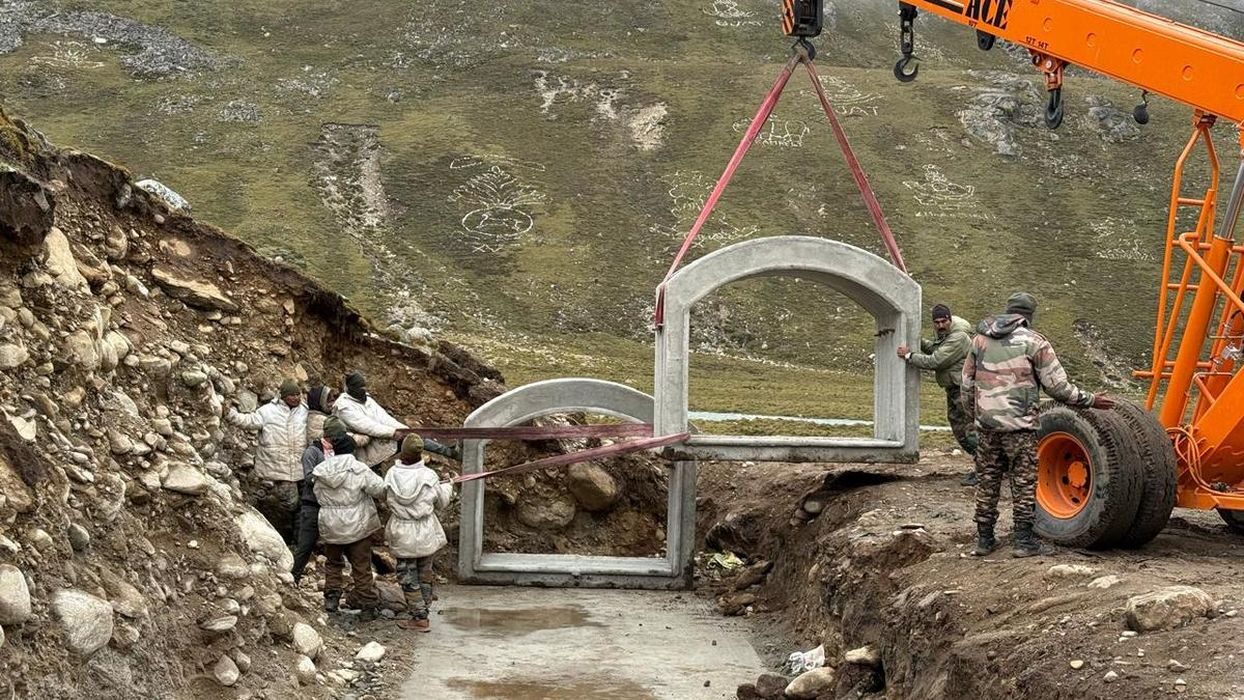
The Indian Army has been using a remote 3DCP solution to rebuild border infrastructure.
A report on Manufactur3D describes a pretty incredible system used by the Trishaki Corps to build concrete structures in situ using modern 3DCP technology. The system was developed as a partnership between the army and IIT Hyderabad in Project PARABAL.
The system involves a robotic arm, pump, materials mixer and a generator to power it all. The latter is critical, as it allows the system to operate almost anywhere without the need for connection to a power grid.
As you can see in the image at top, the concrete structures are not literally printed in their final operational position. Instead, the components are printed at the 3DCP system’s location, which presumably is nearby. The components are then lifted into final placement with cranes after they have sufficiently cured.
Printing in final position is a highly complex problem because of the positioning accuracy required. In a field setting such as this, a mobile printer would have to be aware of its offset from the desired print location, the orientation of the printer, etc. As far as I know, this problem has not yet been solved for easy and repeated prints.
If the parts are being printed and “shipped” to the installation spot, even a few meters, why not simply print them in a factory far away and ship them farther?
The answer is that the shipping costs would be greater. Shipping cement is far more compact that handling large, sparse objects like these concrete structures. In addition, the sand used might be found locally, which would also save on long distance shipping costs. In other words, you’re mostly just shipping the printer itself to the site instead of the final products.
It’s also possible that some locations might be too challenging to use conventional shipping methods. Imagine a tractor-trailer filled with these large concrete components, trying to wind its way up challenging mountain paths. It would be easier to ship a robotic 3DCP system and some supplies instead.
Project PARABAL looks like an innovation in how 3DCP is used, rather than a 3DCP technology change. This approach could very likely be exploited in a number of other scenarios elsewhere.
Via Manufactur3D
