
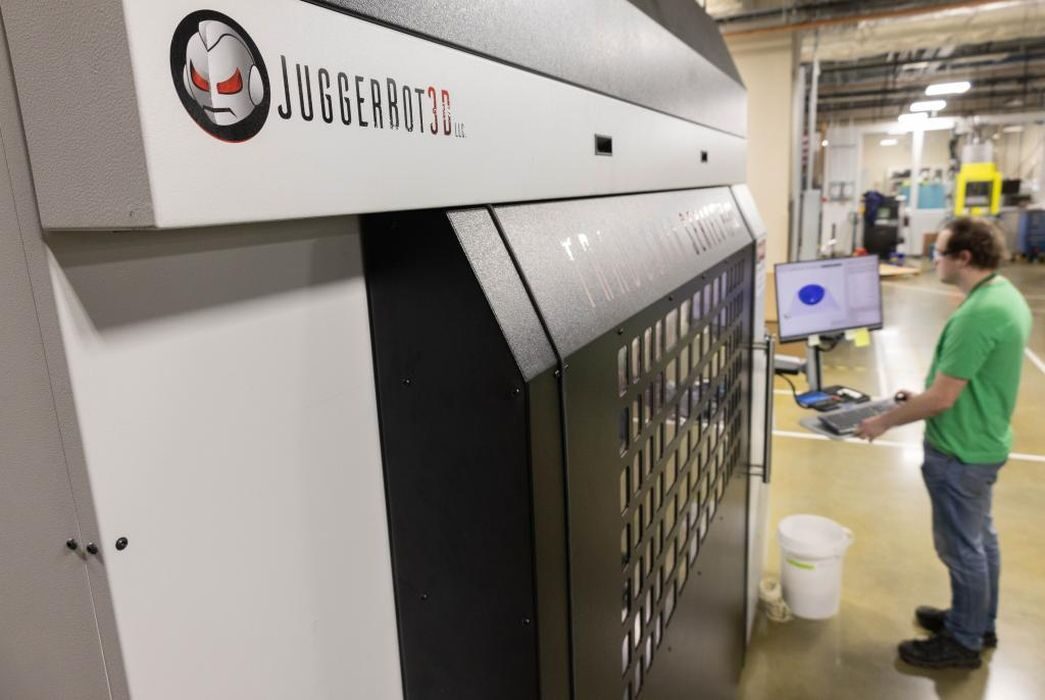
JuggerBot 3D has inked a deal with the Oak Ridge National Laboratory to develop a 3D printer that can handle both thermoplastics and thermosets.
The company has worked with ORNL in the past, specifically on pellet 3D printing. JuggerBot 3D’s systems are quite large, which is a problem for filament printing — it’s terribly expensive. They wanted to shift to the use of pellets, which can be 10X less pricey.
ORNL assisted JuggerBot 3D in developing an advanced slicer and feedback system that could enable the 3D printer to produce consistently high-quality extrusions when using pellet material.
The duo have now agreed to work on a new project. ORNL explains:
“The two organizations aim to expand the possibilities for large-format 3D printing into a new set of materials — thermoset polymers, such as epoxies, vinyl esters, and polyurethanes — and develop systems that can print both thermosets and thermoplastics. The new project will build on the production-ready technologies developed during an earlier collaboration, which ended in February.”
Why do this? It’s because the two types of plastic are very different. Thermoplastics can be softened with heat and reformed. That’s precisely what’s happening in the hot end of FFF 3D printers. Thermosets, on the other hand, are “one way”: once formed, they cannot be softened and reformed as thermoplastics can. This allows thermosets to take on interesting engineering properties, such as far higher thermal resistance.
Thermosets are almost always in liquid form, which is then solidified by a trigger, which might be an optical light source in the case of vat polymerization (resin 3D printing), or mixing a second liquid (epoxy). It sounds as if the two organizations will be working with epoxy materials on this project.
If they are successful, it is certain that JuggerBot 3D could later market a specialized 3D printer that can print both types of materials. This would be a significant advance, as there really are no systems that can do this. It would enable the 3D printing of complex multimaterial objects that would otherwise require multiple machines to produce.
Via ORNL
