
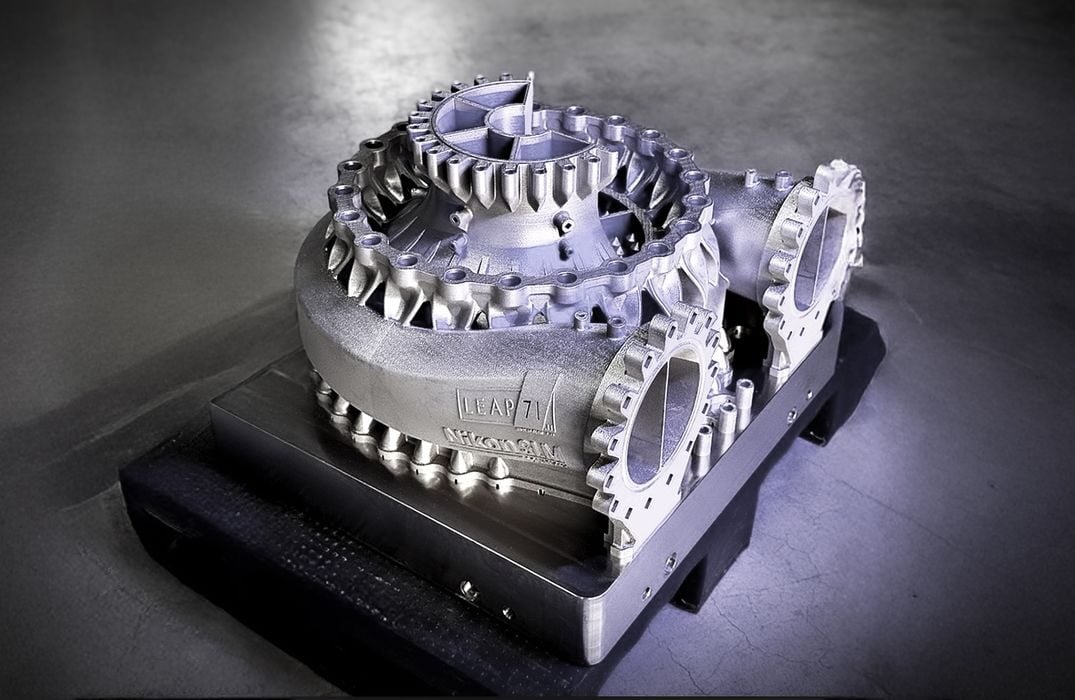
LEAP 71 and Nikon SLM Solutions have 3D printed a huge and complex rocket engine component.
The part is a 600 mm diameter Inconel 718 injector head for a two meganewton, full flow staged combustion methane oxygen engine, combining an AI generated design with the high throughput NXG 600E — a combination that could meaningfully accelerate development cycles in rocket propulsion.
Rocket makers have leaned on metal powder bed fusion (LPBF) for years to combine complex cooling and flow features, but most printed injectors remain assemblies of multiple pieces or are smaller than this diameter.
Here, LEAP 71 says its XRB 2E6 injector was produced as a single monolithic part directly from Noyron, the company’s “large computational engineering model” that outputs machine ready geometry without manual modeling. Nikon SLM Solutions handled fabrication in IN718 using its production tuned parameter set.
Full flow staged combustion (FFSC) is the goal for rocket engineers due to its efficiency, but it’s punishing on hardware since both fuel rich and oxygen rich preburned gases pass through dense manifolding before main combustion.
Printing that labyrinth as one piece is enormously attractive: fewer joints to leak, tighter thermal control, and less touch time.
Nikon SLM reports the build completed in under four days on their massive 12 laser NXG 600E, consistent with the platform’s focus on multi laser parallelization and large format parts.
AI meets LPBF at scale
Mechanically, this looks like a straightforward but audacious marriage of generative computational engineering and industrial LPBF. Noyron accepts abstract performance targets and known manufacturing constraints, then emits a functionally integrated injector design.
Nikon SLM’s team says they co tuned those constraints inside Noyron and across the downstream chain so the geometry would slice, support, and print repeatably with the company’s IN718 PROD parameters.
The headline is not just the large part diameter; it is print time under four days for a structure that would traditionally mean hundreds of precision machined components and many sealing operations, and the ability to do so repeatedly.
There could still be some challenges, however. IN718 injectors of this scale will still require extensive support removal, machining of critical interfaces, and non destructive evaluation — especially computed tomography to confirm channel fidelity and porosity. After all, this part is literally designed to push the envelope on mechanical and thermal stress.
Testing will be key, and LEAP 71 targets practical engine testing in late 2027, which means today’s news is a manufacturing milestone, not an engine qualification, yet.
On economics and throughput, the claim of “record time” matters because FFSC hardware lives or dies on iteration speed. If a lights out, sub week build on a 12 laser system becomes routine, teams can close feedback loops faster: print, machine, test, repeat.
That is particularly aligned with LEAP 71’s philosophy of frequent physical testing to refine Noyron’s models. The beneficiaries are space propulsion programs that value rapid design churn over single part unit cost, though service bureaus with NXG class capacity could also see demand for similar monolithic heat exchangers or manifolds.
Proof now shifts to data. Show density and defect maps pre and post HIP, CT of the deepest channels, burst and pressure cycle results, and a cost per injector that includes powder reuse ratio and post processing labor.
When the XRB 2E6 hot fires, timing of refurbishment between tests will tell us whether monolithic LPBF brings reliability or traps defects that assemblies could isolate.
If AI wrote the injector and a dozen lasers signed it, the next chapter is whether a test stand will endorse the authorship.
Via LEAP 71 and Nikon SLM Solutions
