
MechStyle blends generative AI stylization with mechanical simulation so your “make it brick” prompt does not accidentally create a fragile print.
When Pretty Meshes Meet Physics
Text driven 3D stylization has been improving fast, with tools that can push a mesh toward a look like “terracotta,” “stone,” or “crochet” by changing color and nudging surface geometry. That is great for renders, but it is risky for fabrication because those nudges often land exactly where prints already struggle: thin walls, bridges, clips, and stressed joints.
The MechStyle team (MIT CSAIL, MIT Center for Bits and Atoms, University of Washington, plus collaborators from Google Research and Stability AI) frames this as a classic mismatch between digital goals and physical reality. A model that looks fine on screen can become a break point generator once you actually drop it, squeeze it, or load it the way real objects get used.
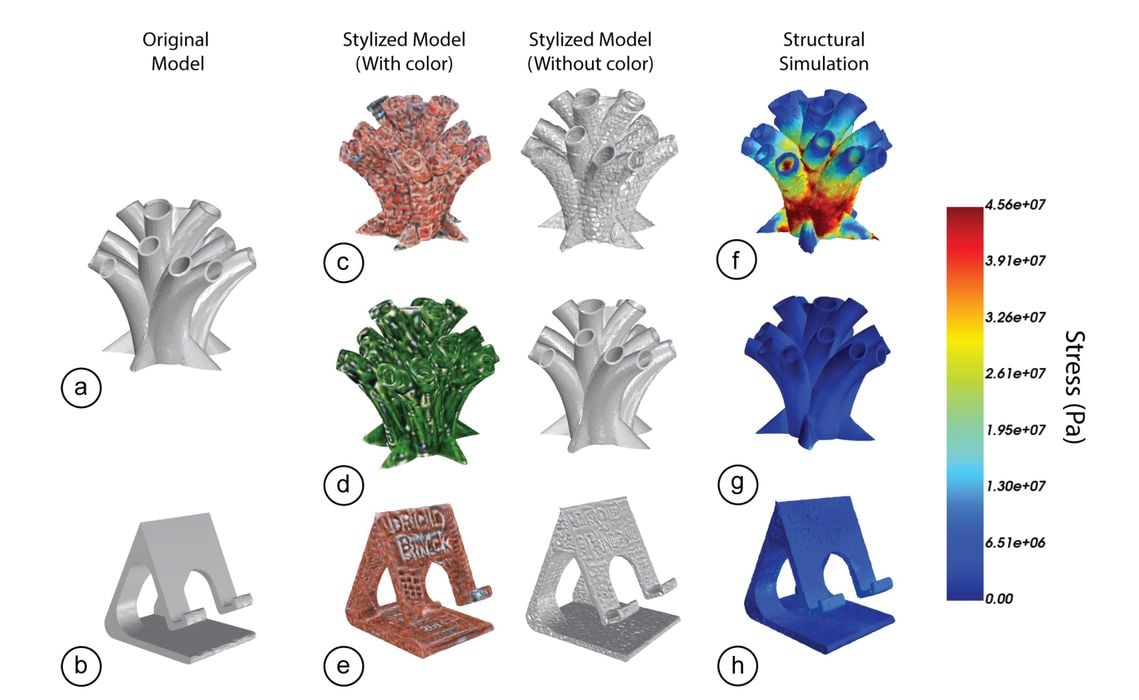
This is not a minor corner case. In their formative study, the researchers stylized 30 popular Thingiverse models using six common prompt styles (brick, stone, cactus, realistic, crochet, green). After running a simulated drop test and checking material failure, only 25.55% of the stylized results stayed structurally viable. In other words, roughly three out of four “successfully stylized” meshes were likely to break when treated like an everyday object.
Simulation Feedback Inside The Stylization Loop
MechStyle’s core idea is to stop treating structural repair as an afterthought. Rather than stylize first and then try to thicken or brace weakened areas (which can wreck the intended look), the system feeds structural stress information back into the stylization process while the AI is still iterating.
Under the hood, the stylization uses an iterative per vertex displacement approach based on X Mesh, running for 200 steps as it gradually pushes geometry and color toward the text prompt. MechStyle periodically converts those intermediate surface meshes into volumetric tetrahedral (TET) meshes (using fTetWild), then runs a Finite Element Analysis (FEA) simulation using NVIDIA Warp to estimate stress under a standardized “drop test” scenario: a 1.5 meter fall onto a hard surface.
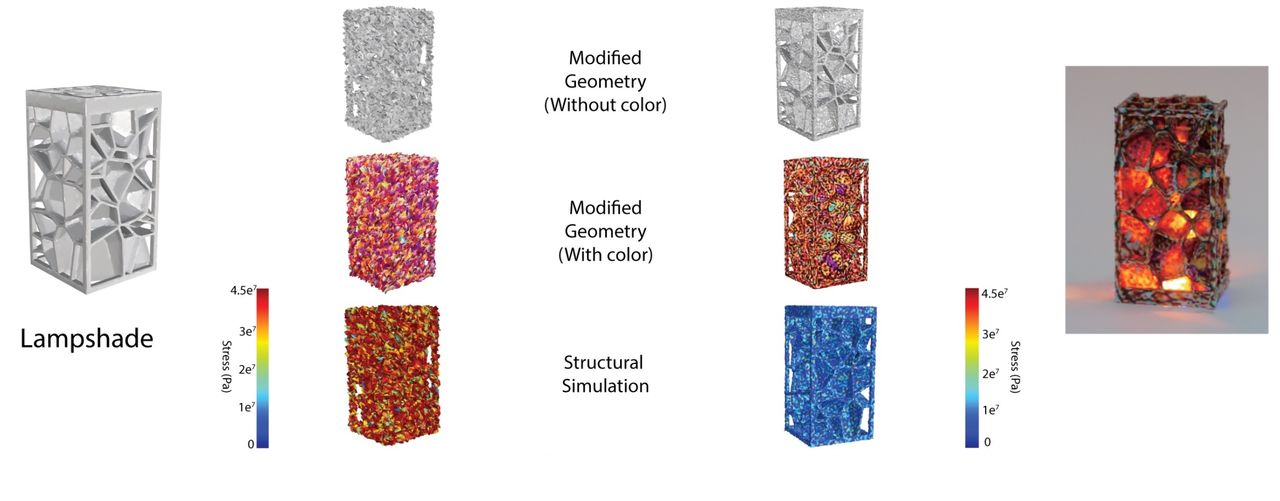
The simulation output becomes a mask that modulates future stylization. High stress zones get less geometric displacement, while lower stress zones can still receive aggressive texturing. The paper explores three control strategies: linear reduction, exponential reduction, and selective freezing (where stylization stops completely past a stress threshold).
Why Scheduling Matters More Than You Think
FEA is not cheap, even with GPU acceleration. The team measured stylization iterations at about 2.67 seconds on average, while a single simulation averaged 4.61 minutes. If you simulated every iteration, a run would balloon to roughly 15.5 hours, which is dead on arrival for a creative workflow.
So MechStyle also tackles “when to simulate” with adaptive scheduling. They tested time based schedules (including non linear schedules that simulate more often early, when geometry changes are bigger) and two trigger based approaches: geometry based (simulate when cumulative displacement exceeds a fraction of local thickness) and stress based (prioritize areas that were already structurally weak in the original model).
Across 2,160 configurations (30 models × six styles × three control strategies × four scheduling strategies), MechStyle dramatically improved the odds of printable results. Depending on settings, 80.2% to 100% of outputs remained structurally viable after stylization. The best overall trade off came from stress based scheduling paired with either exponentially weighted masking or selectively frozen masking, maintaining structural viability without a statistically significant hit to style quality.
What This Could Mean For Real Printing Workflows
For consumer and prosumer printing, the biggest value is time saved on failed prints that “look fine” until they snap in your hand. The demos are grounded in everyday objects: eyeglass frames with fragile bridges, pill boxes with sharp lid geometry, assistive utensil grips that must survive drops, and lampshades with intricate panels that are easy to weaken with heavy surface relief.
It is also a hint at where generative CAD is heading: toward multi objective optimization that treats strength, stiffness, and safety as first class constraints, not post processing hacks.
The researchers implemented MechStyle as a Blender plugin, and they report it can run on CUDA GPUs with only 8GB of memory (they ran experiments on an NVIDIA L4). They also note material parameters can be swapped in, and they printed examples on a Stratasys J55 using Vero after updating the simulation properties.
Reality Is Messier Than A Drop Test
MechStyle assumes the starting model is already structurally valid, and it uses simulated stress as a proxy for real world performance. It also leans on a single drop test scenario as a general approximation of everyday forces. Those are reasonable constraints for a research prototype, but adoption will hinge on whether future versions can model more use specific loads: bending, torsion, clips, press fits, and fatigue.
Still, the result is a good step forward because it makes an important point: generative stylization is currently very good at making meshes prettier, and very bad at keeping them robust. MechStyle is a step toward fixing that, and it suggests the next generation of “AI for makers” will need to stop guessing and start simulating.
Via ACM
