
New research suggests laser melting metal parts in a CO2 atmosphere could be “good enough” for Mars, and maybe cheaper on Earth too.
Metal additive manufacturing for space has always had an awkward dependency: most laser powder bed fusion relies on argon. On Earth, argon, or another inert gas, is typically used to ensure no oxygen reaches the material. Oxygen reacts with metals to reduce part strength.
Using argon gas is easy on Earth, but it is a logistics nightmare on Mars, where shipping any consumable is extraordinarily expensive because there isn’t much argon on the Red Planet.
Researchers at the University of Arkansas decided to test an interesting theory: what happens if you swap argon for carbon dioxide, the dominant gas on Mars? There’s plenty of it in the Martian atmosphere, although at a lower pressure.
They investigated the use of Selective Laser Melting (SLM), using 316L stainless steel powder, because it is a common LPBF alloy with known characteristics. They built a small, sealed chamber with a quartz window and gas inlet and outlet ports, letting them run tests in argon, CO2, and ambient air.
Turning “Inert Gas” Into “Local Gas”
In SLM, the shielding gas does more than prevent oxidation. It influences melt pool stability, wetting behavior, spatter transport, and how well nearby laser scan tracks fuse. Argon is popular because it is inert and predictable.
CO2 is not inert, and that is where this gets interesting. Mars has a CO2-rich atmosphere, and if CO2 can act as a workable processing medium, you can imagine metal AM that needs far less imported gas infrastructure.
The study hints at another possibility: if CO2 works as a partial substitute in a Mars environment, some terrestrial workshops might reduce argon consumption and cost, especially for early-stage prototyping, where perfection is less important.
Printing and Measuring CO2
The researchers ran both single-track scans and small two-dimensional specimens, using 316L powder with particle sizes reported between 22 and 28 microns.
Their lab-scale SLM setup used a 1064nm fiber laser with up to 80W power, and the test matrix explored power, scan speed, and laser frequency across wide ranges. For the 2D samples, they targeted 5 × 5 mm squares and compared how much of the intended area solidified into a cohesive plate.
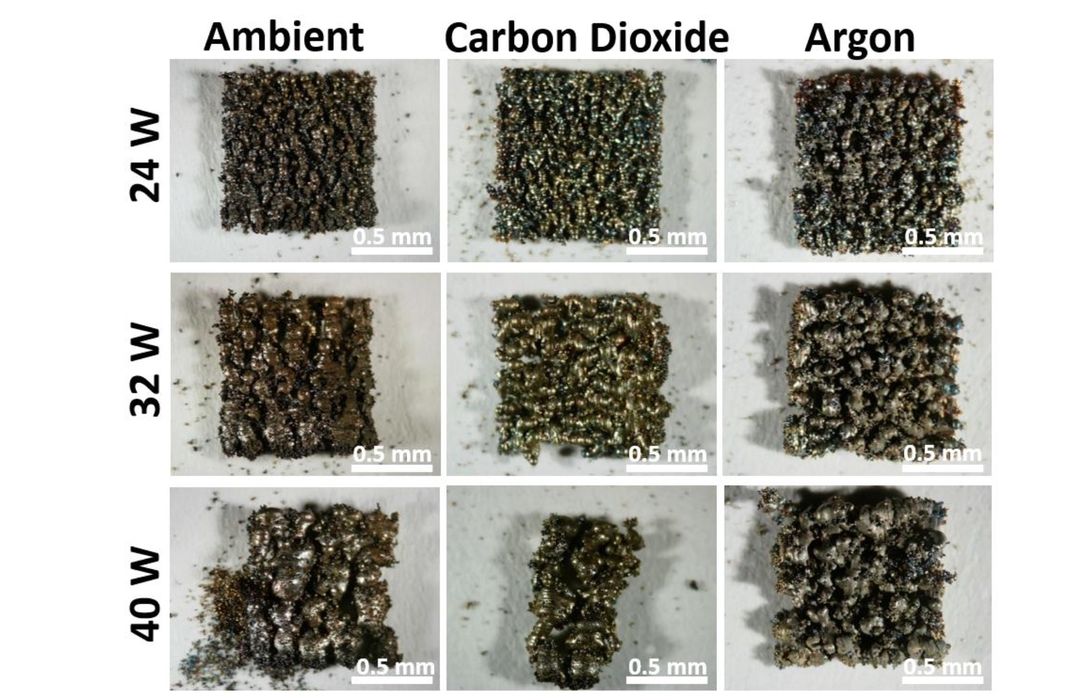
Even at this small scale, the photos show classic LPBF results: too little energy gives weak fusion and discontinuous tracks, while too much energy pushes the process into balling, cracking, and rough surface textures. The discovery is that the atmosphere shifts the size of the “safe” process window rather than changing the physics entirely.
CO2 Was Worse Than Argon, Better Than Air
For single tracks, increasing laser power generally widened the melt line in all atmospheres, but higher power also increased balling and discontinuity. The CO2 environment tended to produce narrower tracks than argon and ambient air at the same settings, which the authors suggest could relate to interfacial energy changes between molten steel and the surrounding gas.
In the 2D sample prints, argon delivered the most consistent cohesion and shape retention across a wider range of scan speeds and spacings. CO2 parts were rougher and showed more defects than argon, but still outperformed ambient air, where oxidation aggressively disrupted wetting and bonding. When parameters pushed toward overheating, ambient air and CO2 samples showed cracking and degraded cohesion sooner than the argon equivalents.
Oxygen content on the surface was highest in ambient air, lower in CO2, and lowest in argon. The reported atomic oxygen percentages were about 54% in ambient, 45% in CO2, and 28% in argon, neatly matching what you would expect from the visible surface quality differences.
Metal Printing on Mars — And Earth
This is not a “print a rocket bracket on Mars tomorrow” result. The team mostly demonstrated that CO2 shielding can produce noticeably more stable melting than open air, but still does not match argon for oxidation control and smooth fusion. The work is also limited to single tracks and thin 2D plates, not full-density 3D components with bulk mechanical testing.
Even with these imperfect results, there are some interesting implications. If a Mars mission can tolerate somewhat rougher surface finish and a narrower processing window, CO2-based SLM might be viable for non-critical hardware, fixtures, tooling, or spare parts for repairs. A likely adoption path would be hybrid: run in CO2 for rough fabrication or emergency manufacturing, then reserve precious argon for high-performance builds when required.
Another question is whether use of CO2 for Earth-based LPBF activities would be useful. Are there applications that would accept weaker parts with poorer surface quality? Would a CO2-based LPBF configuration be less expensive than current argon setups?
The next step is straightforward but certainly non-trivial: print true 3D geometries, quantify density and tensile performance, and see whether oxidation-driven defects become catastrophic with thicker sections. It would also help to test other alloys, because stainless steel is only one of several potential Martian materials.
This research is less about Mars hype and more about a pragmatic question: how much “inert” do we really need for usable metal LPBF, and when is “good enough” actually good enough?
Via ArXiv
