
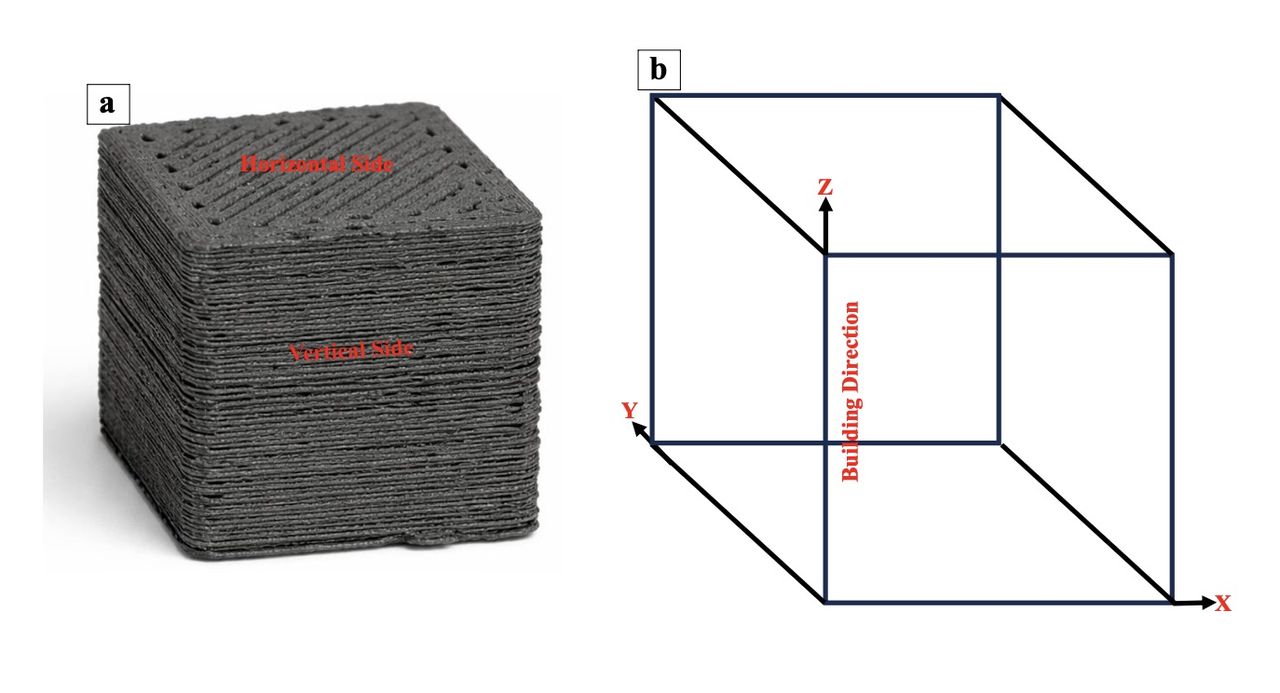
Printing a metal part with FFF is only the beginning of the making process.
That is the finding from a study of fused filament fabrication (FFF) with 316L stainless steel. The researchers printed small cubes from a filament containing stainless-steel powder and polymer binder, then watched what happened when the binder was removed and the remaining metal powder was sintered.
The result is a reminder that in metal FFF the final properties of the part were strongly controlled by what happened in the sintering furnace after the print.
The team printed 12mm cubes on a Creality machine using commercial 316L filament from Virtual Foundry. The filament was about one-fifth polymer binder by weight (80% metal). Printing used a 230C nozzle, a 0.6mm nozzle diameter, and 0.2mm layers. Each cube took about 52 minutes to print.
At that point, the cubes were still “green” parts: metal powder held together by plastic. The researchers first heated them through a thermal debinding cycle to remove roughly 20% of the mass. They compared several holding times at 427C and selected a two-hour hold for the rest of the work.
The brown parts were then sintered in argon at 1300C for one, two, or three hours.
Sintering is where the metal particles begin to behave like a component instead of a packed bed of powder. At the interfaces between particles, small connections grow during sintering. Atoms diffuse across those contacts, grain boundaries move, and pores gradually change from large and interconnected to smaller, rounder, and more isolated.
The differences were substantial. Bulk density rose from 3.84 g/cm3 after one hour to 4.20 g/cm3 after two hours and 4.84 g/cm3 after three hours. That is an increase of about 26% from the shortest to the longest hold, although the three-hour parts were still well below the paper’s 8 g/cm3 reference for monolithic 316L.
Hardness followed the same direction. On the vertical measurement plane, the average increased from 114 HV after one hour to 205.5 HV after two hours and 249.7 HV after three hours. The horizontal plane was softer at every stage, reaching 200.9 HV after three hours.
The microstructure explains why. After one hour, the researchers found weak particle interfaces and enough porosity to prevent reliable EBSD analysis. After three hours, the interfaces were much better fused, particle-boundary strain had fallen, and the grains had coarsened into a more strongly textured structure.
There is a cost to that improvement. The longer furnace cycle consumes time, and grain coarsening and texture are not automatically desirable for every application. The parts also shrank by roughly 10–15% in length and breadth, with as much as 20–22% shrinkage in the build direction. Note, however, that a true production workflow would require reliable, geometry-aware shrinkage compensation instead of a single universal scale factor.
Metal FFF can use relatively inexpensive printing equipment and avoids the laser and powder-bed environment used with some other metal AM processes. But the low-cost printer does not eliminate the difficult manufacturing steps. It moves them into thermal processing, atmosphere control, debinding, shrinkage prediction, and inspection.
Metal FFF lowers the cost of making a green part, but you still need to handle all the normal metallurgy steps.
Via Springer