
I’m looking at Metal Powder Works’ energy-efficient method of producing metal powder for AM.
The Pittsburgh-based company has been around since 2018 and has developed an unusual method of producing AM materials they call “DirectPowder”.
Metal powder is typically used in LBPF systems that use powerful lasers to fuse the loose powder. To achieve the best quality, the particles should be of uniform size and shape, which ensures consistent results throughout the print.
DirectPowder is quite different from the typical approaches to producing metal powder. Normally, the production process involves a significant amount of heat. Here’s how it normally works:
- Metal bars or scrap are placed in a high-temperature furnace.
- The heat first melts the metal, and then further transforms it into a gas.
- The gas is channeled through a cooling mechanism.
- Gas condenses into droplets, like raindrops, which then solidify.
- The result is spherical particles of the metal.
While that traditional approach works, it suffers from several key issues. First, there is a huge amount of energy required. The metal must be heated not only to its melting point but also to its boiling point. In some cases, this is done by burning fossil fuels, which produce quite an amount of CO2.
The second problem is yield. Remember those droplets? We need the particles to be of uniform size, and droplets can form in various diameters. This is normally handled by simply sorting the particles by size after the process completes and selecting those with the correct diameter.
This generates a large amount of waste, as there are lots of particles that don’t meet the diameter requirements. That metal then goes back into the process, where it is heated up again. In other words, the metal in a particle might have been heated up several times before it became proper for AM.
DirectPowder uses an entirely different process that is quite interesting. It doesn’t involve any heat at all!
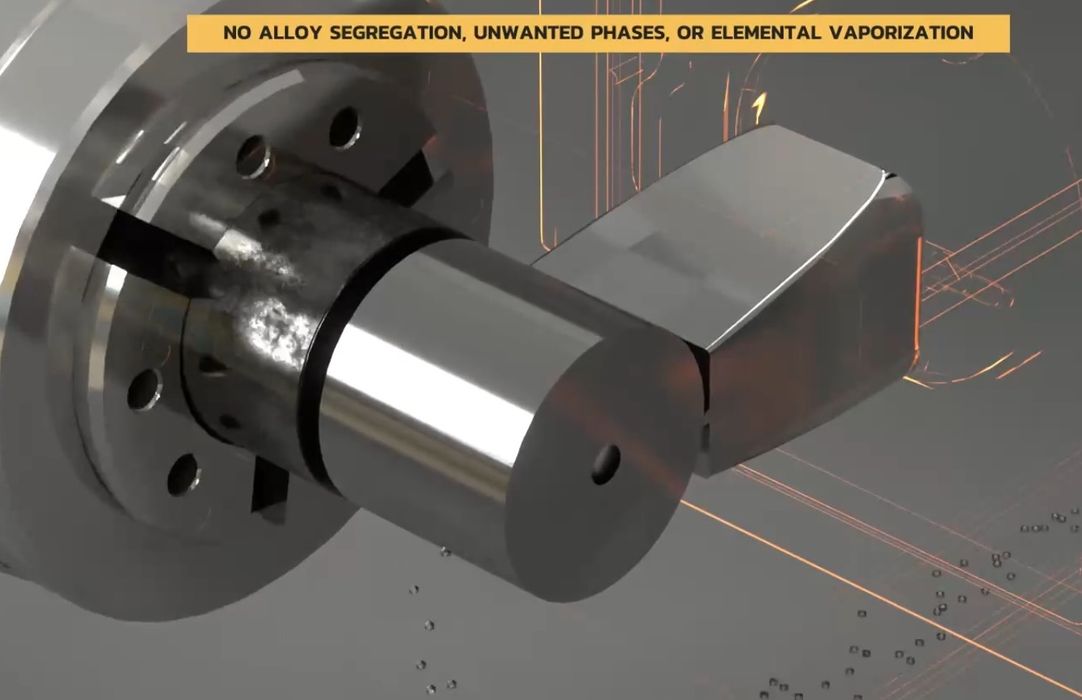
In the company’s video of the process, you can see the operator sliding in a standard bar of quality metal into their system. The machine uses rotational motion to push the bar against a specialized toolhead. The toolhead somehow grinds off particles of uniform size. No heat is involved.
They say this approach is effective because 95% of the input material is successfully made into AM powder, so the yield is very high. They also state there is a 90% reduction in energy costs to produce powder in this way, which should lead to considerable CO2 savings. As the cost of energy rises, this should give Metal Powder Works a financial advantage.
Since there is no heat involved in the process, the microstructure of the input material persists and is found in the resulting powder. However, the LPBF process will melt the metal, and that microstructure will be re-formed during the printing process.
DirectPowder is an example of how an ingenious approach can deliver the same results with far less energy.
