
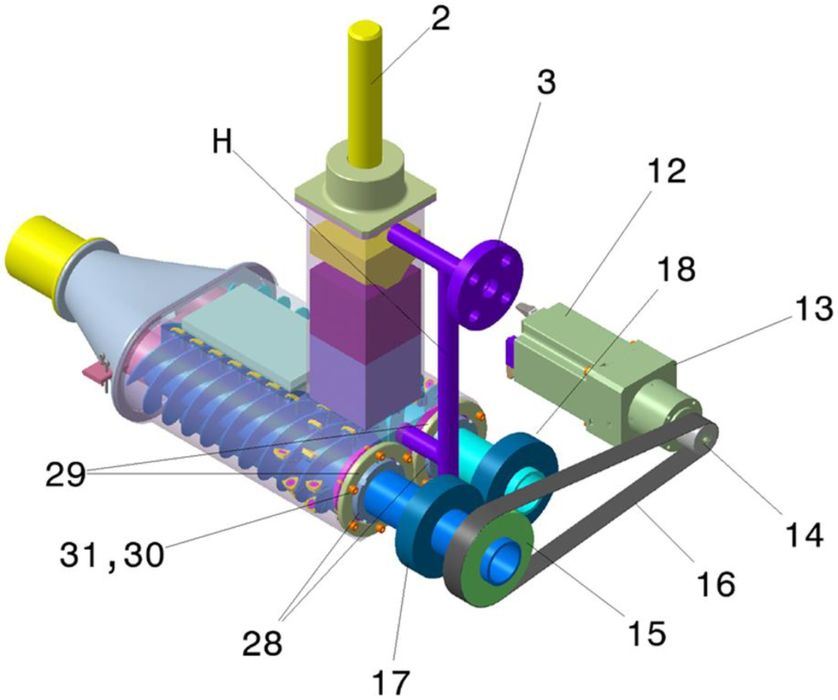
A new research paper describes a closed-loop installation to recycle SLA resin and support injection casting in microgravity.
The concept tries to overcome a rather difficult problem in the weightless environment of space: 3D printing with photopolymer resins. Most space manufacturing demonstrations to date have favored thermoplastics via FFF because printed parts can be reheated and reprocessed. SLA brings fine feature capability and smooth surfaces, but it depends completely on the presence of gravity. But there’s no gravity when in orbit. Resin 3D printing is difficult enough to deal with on Earth, never mind in a spacecraft where crew time, power, available space, and ventilation are tightly constrained.
Like on Earth, orbital SLA printing will require special handling for the liquid resins and solvents used in the process. On Earth these are handled with difficulty, requiring special ventilation, personal protective equipment and carefully followed procedures. But how would you even attempt to deal with toxic liquids in space?
The researchers propose an integrated “recycling installation” that collects, stabilizes and reconditions liquid photopolymer streams, while also enabling an injection casting method for simple parts. The goal is circularity in a closed space habitat: fewer liters of fresh resin need to be launched, less hazardous waste is stored, and more functional parts produced per kilogram of shipped materials.
Managing Fluids In Zero G
On Earth, resin managment largely depends on gravity settling, and filtration. In microgravity, those don’t work. The researchers developed capillary-driven fluid management, membrane separation, peristaltic pumping. Inline sensors could monitor viscosity, refractive index and temperature to keep the formulation inside process windows before returning it to a printer vat or metering it into a mold.
Solid waste streams are more challenging to deal with. Cured SLA parts form crosslinked networks that cannot be re-melted like thermoplastics. The paper recognizes this and focuses the circular loop on reclaiming unreacted resin and wash liquids, while suggesting that failed or end-of-life parts may be ground up into inert powder fillers for casting compounds. That is an ingenious idea to handle resin 3D printer waste, and something that should be considered on the ground, too.
The injection casting capability is an interesting addition for microgravity. Instead of only relying on curing via 3D printing, a reconditioned resin or compatible thermoset blend could be injected into reusable molds to make simple brackets, spacers or housings. This could complement an SLA 3D printer making high-precision parts, followed by casting for simpler geometries. The printer might even print the molds, too.
If this is actually implemented, it might make photopolymer use a lot more feasible in a weightless environment. Simultaneously, it also adds casting capabilities, which could increase part throughput in some scenarios.
However, the paper does not provide end-to-end mass balances, or how resin properties drift over multiple recycling loops.
Operationally, spaceflight readiness will depend on safety and automation factors. Photopolymers and their solvents are often quite toxic and even flammable. Crew procedures, containment, fume scrubbing and failure modes must be addressed alongside print quality. We also don’t know how radiation affects stored resin.
While this is an interesting development, it’s pretty clear NASA is not going to allow this to proceed until all the safety ticky boxes are ticked.
Via Inventions
