
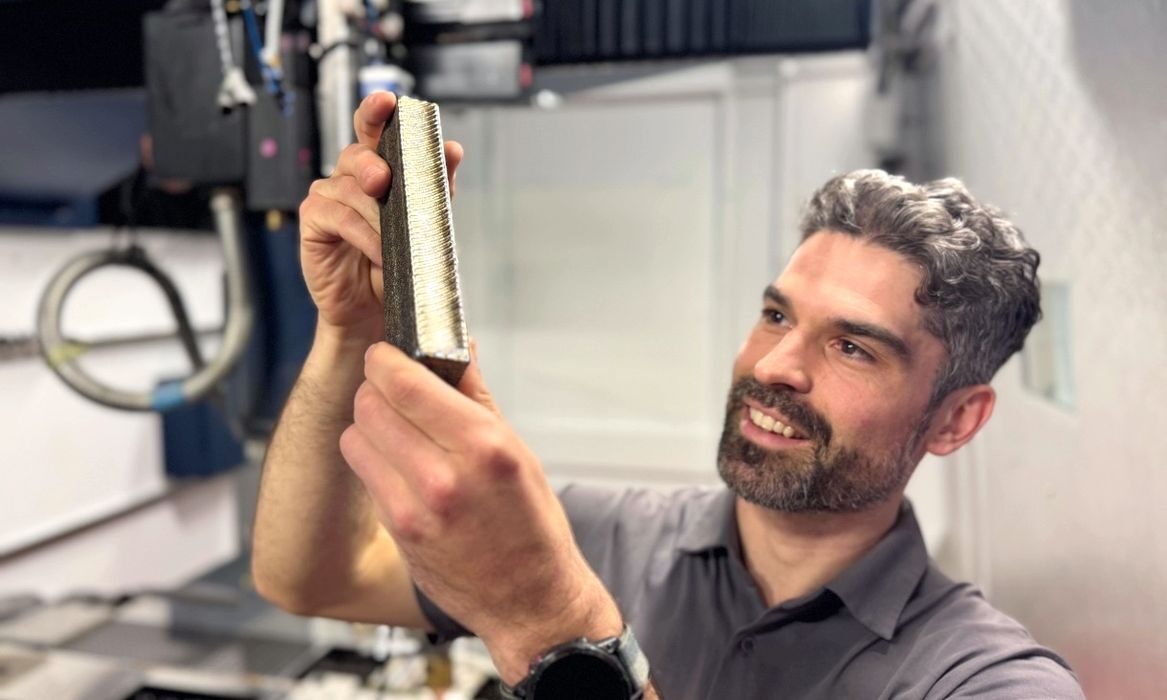
Researchers have developed a new titanium alloy and accompanying 3D print process that is quite a bit less expensive.
Titanium is one of the wonder materials for 3D printing: it’s strong and very light, ideal for aerospace applications. However, it doesn’t print very well in its natural state. For this reason, the alloy Ti6Al-4V is used.
In the formula, the “V” is the element vanadium, which is used in the alloy to promote stabilization during microstructure formation.
The catch is that vanadium is becoming more difficult to obtain. The current sources of the rare metal are China (by far the largest provider), Russia, South Africa, and Brazil. The major sources are subject to geopolitical forces that make it harder to obtain vanadium, and therefore raising the price of Ti6AlV.
The MIT researchers had a brilliant idea. They had performed some prior work that determined the factors that influence microstructure development in additive manufacturing. Typically, these alloys crystallize in columnar grains, which leads to anisotropy.
Their research revealed that constitutional supercooling is the determining factor in avoiding the columnar grains. Their idea was to remove the expensive vanadium from the 3D printable material and replace it with another less expensive substance, which isn’t stated publicly, as this is all under patent protection.
But how do you avoid the columnar grains? They leverage the print parameters discovered in the prior work to print the new, cheaper alloy with minimized columnar grains. This makes the parts strong but without the expense.
How much cheaper is this material? They say it is 29% less expensive than the typical titanium alloys, which should be a huge benefit to aerospace manufacturing. Parts could be made with the same strength, but for less expense.
Note that the parts themselves won’t be 29% cheaper, because a large portion of the cost of producing a part is all the other operational elements: printer, labour, software, electricity, facility, etc.
But it’s all a step in the right direction.
Via MIT
