
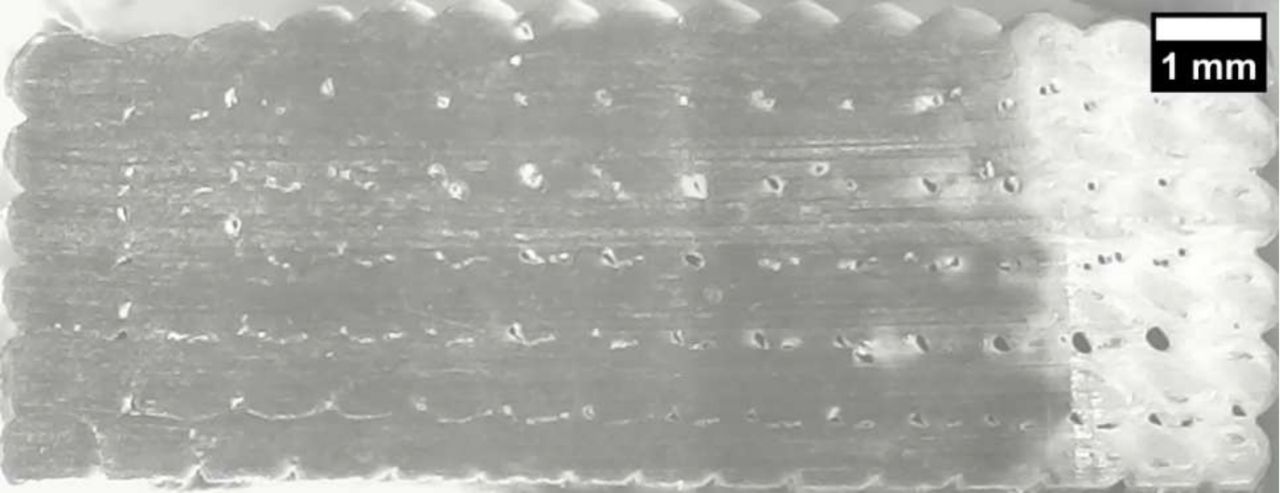
A research team has proposed an uncertainty aware method to improve the weakest link in FFF: bonding between neighboring layers.
The work, by Berkcan Kapusuzoglu, Matthew Sato, Sankaran Mahadevan, and Paul Witherell, is a computational study backed by physical experiments. The team focused on selecting process parameters that maximize interfilament bond quality while accounting for the fact that real FFF processes are variable.
FFF parts often look acceptable but do not have dependable mechanical properties. The nozzle may lay down a clean extrusion, but strength depends on what happens immediately afterward: does cooling limit the amount of adhesion between layers?
3D printer operators can tune temperature, speed, layer height, extrusion flow, chamber conditions, and toolpath strategy. But a setting that looks ideal may be lousy when material properties, ambient conditions, or the model itself differ from assumptions.
Putting Uncertainty Into The Optimization
The researchers linked a transient heat transfer analysis with a sintering neck growth model. The thermal model estimates the temperature history of deposited filaments, and the neck growth calculation uses that history to estimate bonding at the interfaces.
In other words, the framework asks which settings remain useful after considering uncertain inputs and the possibility that the physics model does not perfectly represent the actual printing process.
The study separates uncertainty into aleatory and epistemic sources. Aleatory uncertainty describes inherent variation, while epistemic uncertainty comes from incomplete knowledge, assumptions, or approximations. A manufacturer might reduce some variation through better process control, but it cannot solve an imperfect model only by tuning the settings.
The team used variance based sensitivity analysis with Sobol indices to identify which uncertainty sources contribute most strongly to uncertainty in predicted bond quality. It also builds a Gaussian process surrogate model to represent model discrepancy during optimization. Gaussian processes are often useful here because they can provide an approximation without requiring an expensive physics simulation for every possible parameter combination.
A More Practical Quality Target
The big claim here is that actual physical experiments calibrated and validated the physics model, and also validated the optimized solution. They report high bond quality between adjoining FFF filaments using the proposed optimization under uncertainty.
If sensitivity analysis shows that a few variables dominate bond quality, 3D printer manufacturers might consider prioritizing sensors and controls around those variables. That could mean better monitoring of extrusion temperature or environmental conditions, rather than collecting large volumes of data with no clear connection to part performance.
A good workflow must be fast enough for engineering teams and sufficiently connected to slicer settings, material data, and machine controls.
Treating uncertainty as part of FFF optimization instead of an unknown is the right direction, because that is reality. Stronger parts may ultimately come from knowing how much confidence to place in every setting.
Via arXiv
