
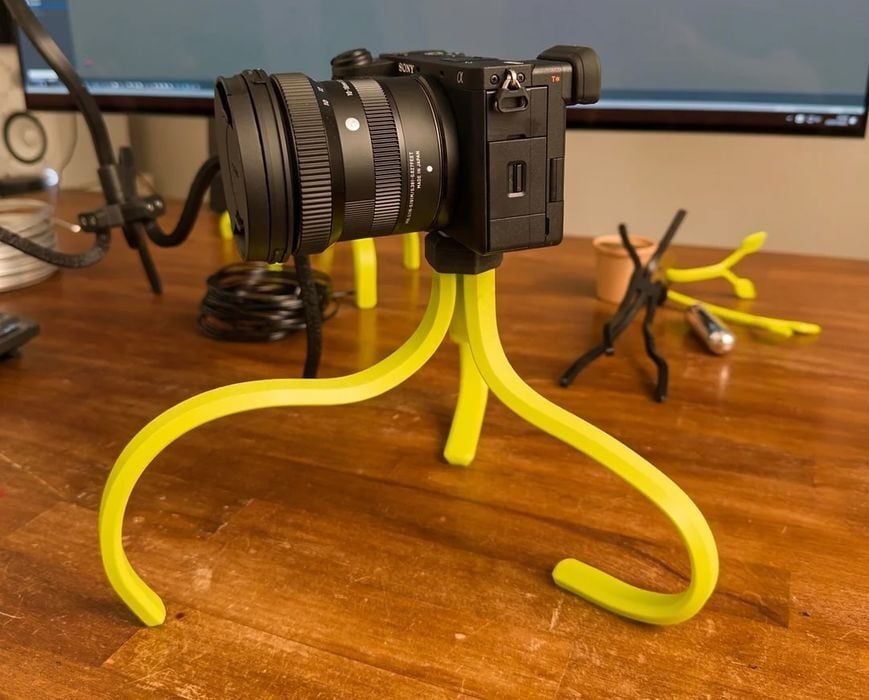
A very interesting 3D printing technique using aluminum wire can be used by any 3D printer operator.
Reddit contributor CanYouEvenPhoto posted the method recently, which involves embedding aluminum wire in a TPU 3D print. Why do this? You can make adjustable “arms”, as shown in the top image.
This is vastly simpler than 3D printing complex articulated structures. Here you have a wire surrounded by flexible TPU, and that’s about it.
But how do you actually make these with a 3D printer? CanYouEvenPhoto suggests using round aluminum wire with at least a 4mm diameter. This type of wire can often be found at local craft stores, where it’s used for home projects.
CanYouEvenPhoto experimented with flat aluminum wire, but found that it was nowhere near as strong as the round versions, even when stacked together.
Here you can see aluminum wire laid down during a TPU print job. The idea is to pause the print at the appropriate moment, and then insert the aluminum wire into a void. Resuming the print job will cover over the void and wire, completing the bendable arm.
I wondered about this part of the process myself, as wire is notoriously not straight. How can you ensure the shape of the wire fits precisely into the void? CanYouEvenPhoto explains:
”For short runs of thicker wire I use a vise, for longer runs I used two vises across my desk to tension the wire which straightens it quite well.”

I’m skeptical that this would work well, and it seemed that other Reddit readers thought the same. CanYouEvenPhoto wrote:
“Initially I tried stopping the print and putting it in mid print which gives very nice seamless results, but it’s a bit fiddly, so I’ve been focusing on designs that have one end open so I can slide the wire in.”
This seems to be a much more usable approach: creating a void for the wire and making a hole for insertion after printing.
What item needs legs? They’re easy to make with this technique.
Via Reddit
