
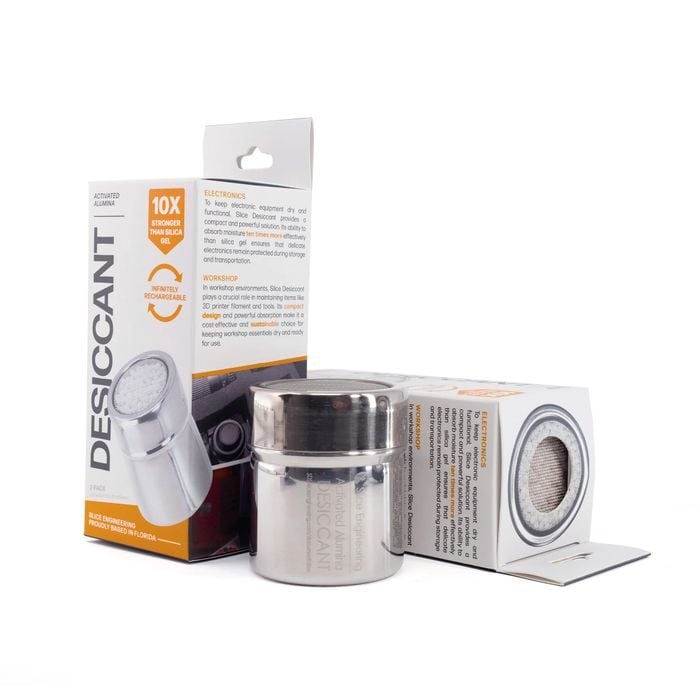
Slice Engineering has developed a new desiccant product that is far more powerful than common desiccants.
Desiccants are materials that absorb moisture from the air. They are typically placed with 3D printer filament during shipment to ensure the product remains dry until opened. Desiccants are also used to dry wet filament: place a spool in a sealed chamber with a bag of desiccant and the desiccant will gradually absorb some of the moisture. That is — only if the desiccant has previously been dried. If it’s already soaked it won’t absorb any more moisture.
Moisture is the bane of FFF 3D printing. If a filament absorbs moisture (and most do, with some much more than others), then that moisture will boil as it comes out of the nozzle. Those bubbles will wreck the surface quality and drastically compromise the strength of the part. You want dry filament, and desiccants are a frequent solution.
If you’re a 3D printer operator you no doubt have countless little bags of desiccant. If you open them up you would discover they are most likely filled with granules of silica gel, made from silicon dioxide. This material is very good at absorbing moisture, as water molecules stick to the surface.
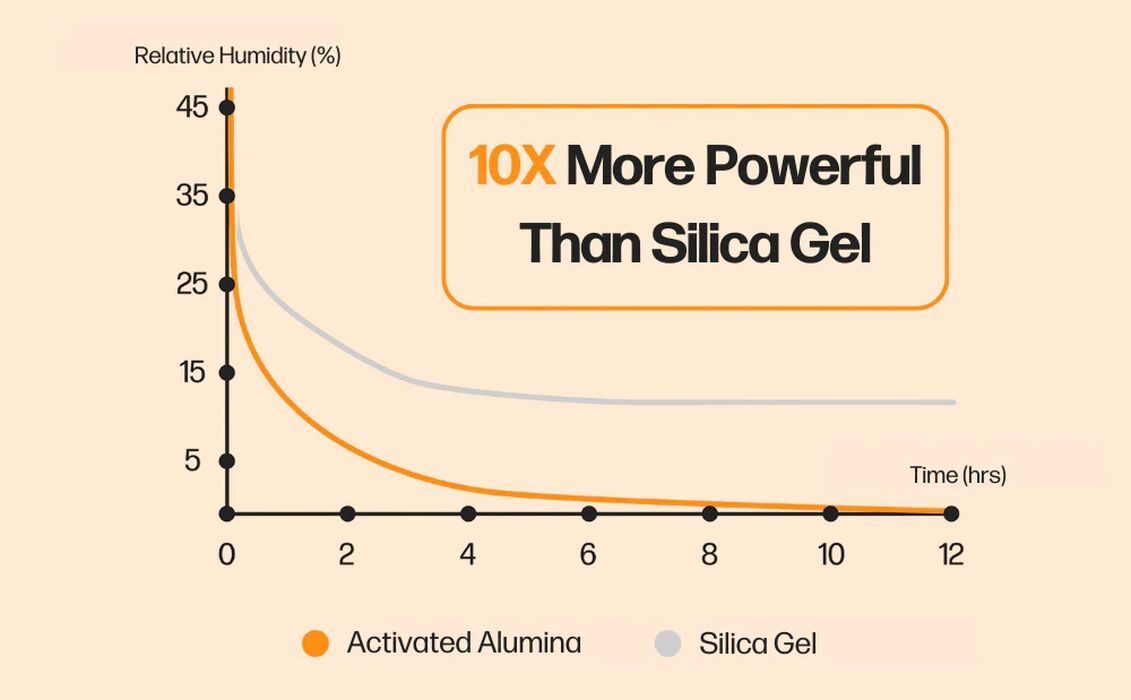
Slice Engineering did an analysis of the performance of silica gel, and found an alternative material that is up to 10X more effective: activated alumina. Here you can see their chart showing how well it performs.
They’ve packaged up this material into a highly functional system that works with many spools. The idea is to put the cylindrical activated alumina package into the empty hub of a spool. That spool can then be placed into a non-drying filament switching system like the Bambu Lab AMS, and the filament will dry automatically.
This is a brilliant idea that should improve print quality by drying filament more effectively.
However, like any desiccant, activated alumina will eventually become saturated with moisture, and it must be dried. The good news is that activated alumina’s moisture capacity is so much greater than silica gel that it will last much longer before drying is required.
Slice Engineering is selling activated alumina canisters under their brand name “Filament Drying Desiccant” in 2, 4, or 6 packs. Pricing is about US$10-12, depending on how many you buy. If you bought four, you’d be able to outfit your Bambu Lab AMS forever.
If you’re printing with an AMS and are having drying issues, this might be a great solution.
