
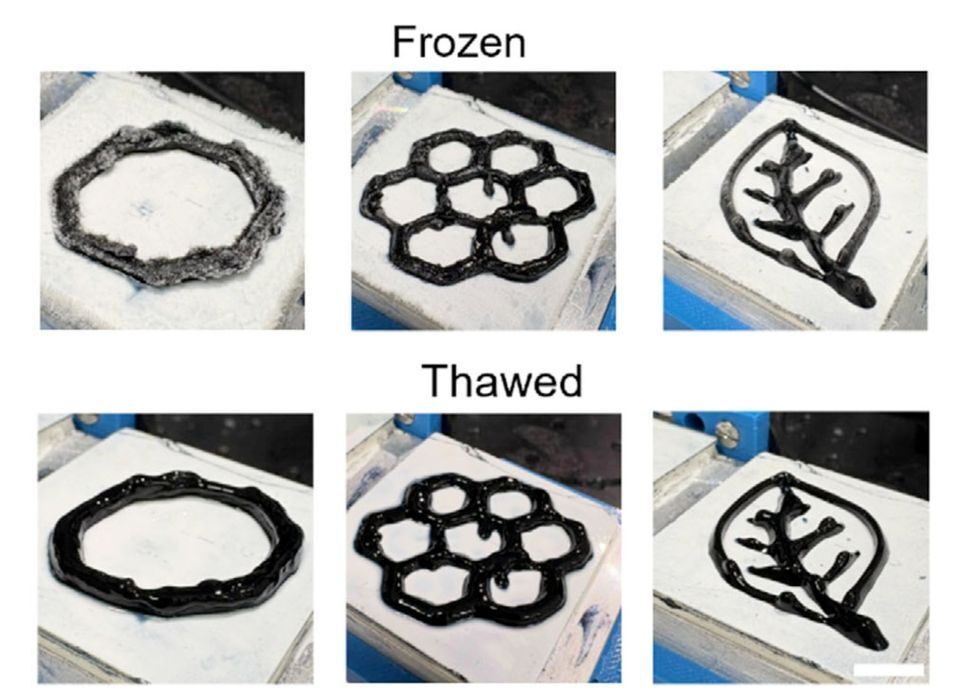
Researchers have found a way to 3D print a biocompatible conductive material.
The material is PEDOT:PSS, a commonly used conductive plastic. The polymer that conducts the electricity is PEDOT, and the PSS is a helper polymer that makes PEDOT dissolve in water and easier to process. This material conducts electricity similar to metal, but is soft and flexible, even bendy and stretchy. It’s water-based and biocompatible, too.
Typically, it would be used in skin sensors, wearable electronics, brain implants, touchscreens, and some other applications.
This sounds like the ideal material to add to a 3D printer: you could print circuits during an ongoing print job. That could mean you’d end up with a “wired” printed object.
However, there’s a big problem: PEDOT:PSS is VERY watery, and therefore it’s nearly impossible to 3D print using conventional approaches.
Here, the researchers developed a process that does allow for 3D printing of PEDOT:PSS, and it’s relatively simple: they froze the PEDOT:PSS as it was being printed.
They added another chemical, DMSO, to the PEDOT:PSS to make it more viscous, and added a cold plate to the printing system. By the way, DMSO is a safe chemical, meaning printed PEDOT:PSS retains its biocompatibility.
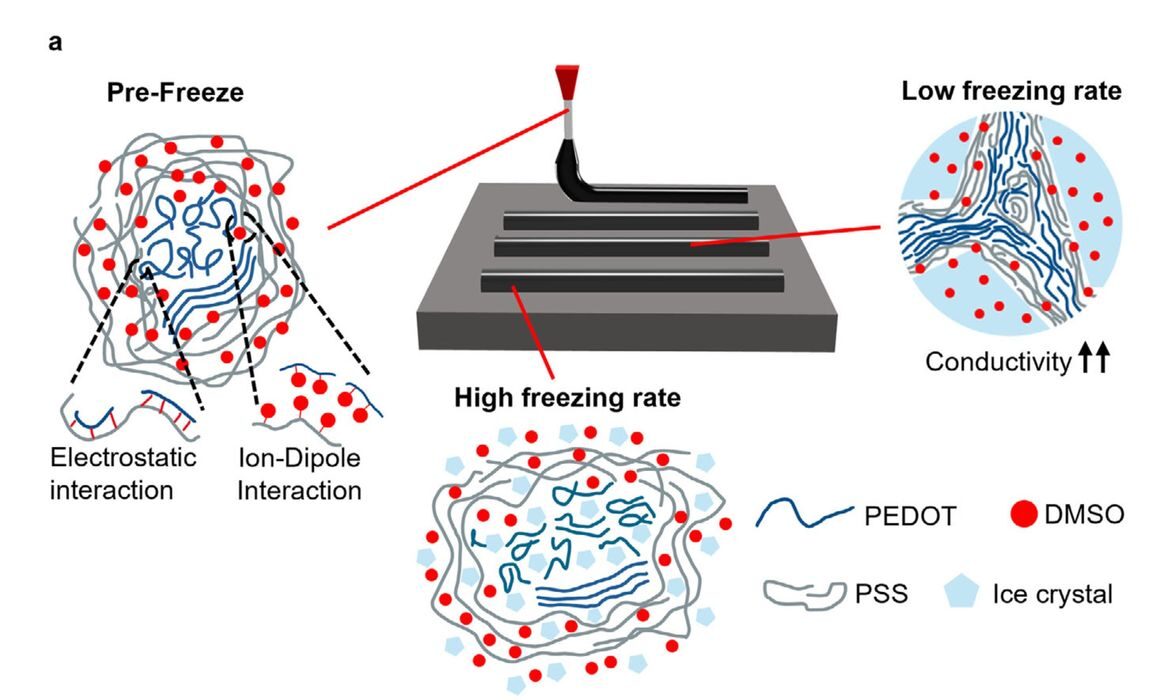
When printing, the DMSO/PEDOT:PSS hit the cold plate and immediately froze, preventing it from collapsing. The watery material then dries, leaving a proper electrical trace.
This provides far better conductivity, said to be 3-4X that of other approaches, and does not require any harsh chemicals or high thermals. It can even print on soft materials like hydrogels.
Could this technique be integrated into existing FFF 3D printers? It might be possible by adding a way to rapidly cool the conductive mix. The cold plate approach would not work, as you’d be printing normal thermoplastics at the same time.
Imagine something like this: a normal FFF 3D printer, but with an independent toolhead. The second toolhead would deposit the DMSO/PEDOT:PSS and would have a nozzle that instead of being hot would instead be cold. That would solidify the conductive plastic as it was extruded. A fan system might be able to quickly dry the deposit as well.
A system of that type would theoretically be able to print a plastic object with embedded electrical traces, making functional electronic prints possible.
However, that is a long way off, as several investigatory steps would have to be taken first.
But that’s how new technologies appear: experiments.
