
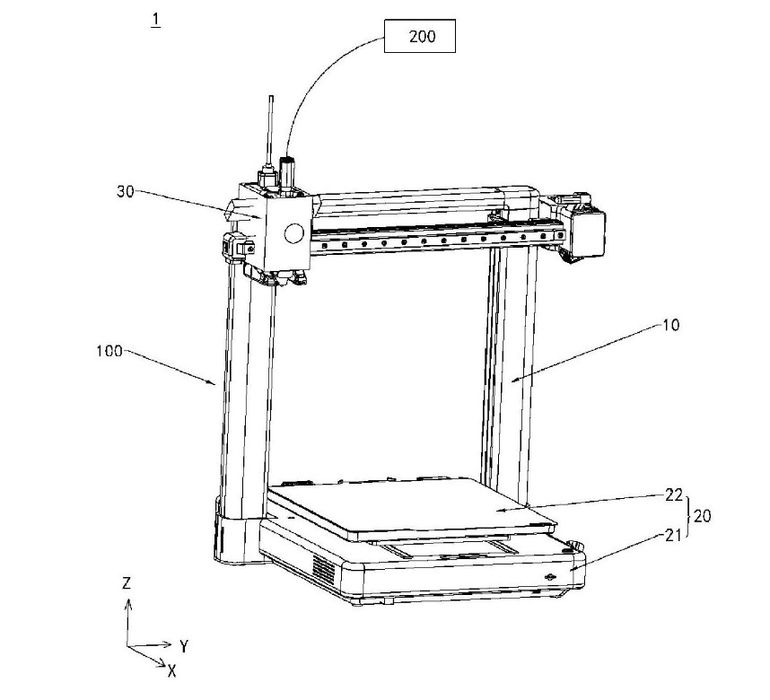
A newly patent application from Shenzhen Tuozhu Technology, the company behind Bambu Lab, focuses on assembling the machine itself.
The application, CN122422127A, describes a 3D printer and 3D printing system built around two vertical columns, a mounting seat, a base, and a print platform that slides into connection with the rear side of that base.
This sounds quite straightforward, but it could be incredibly important to Bambu Lab: simplifying the assembly could result in lowered shipping costs, which could save the company huge amounts of money. And it might make life easier for operators, too.
The patent drawing shows a enclosed or semi enclosed Cartesian FFF machine setup. Two upright members support an upper gantry, while the base contains the lower structure and print platform. The mounting seat spans between the uprights, and the print platform appears designed to slide into place from the rear.
In other words, the patent is about how the printer arrives in the box and how the operator builds the components into a working machine.
Desktop 3D printer assembly has become incredibly competitive. Many machines still arrive as kits or require significant setup, while some models have increasingly moved toward preassembled systems that can be unpacked, calibrated, and put online quickly. Bambu Lab has been one of the companies pushing that, particularly for buyers who are often newbies that are not going to welcome the notion of building a 3D printer.
A sliding print platform connection could simplify the final assembly sequence. Instead of asking a customer to attach more components beneath or inside the machine, the manufacturer could potentially ship a more complete base and have the platform engage through a precision mechanical interface.
There could also be manufacturing advantages. A modular platform and base arrangement may make final factory assembly easier, reduce packaging complexity, or allow a common chassis to support different printer configurations. That is now a possible future for Bambu Lab equipment. A design that decreases assembly time at the factory and operator setup time after delivery can improve both cost and first use experience.
The patent does not confirm that Bambu Lab will actually release a machine using this exact arrangement. Companies file patents for possible product directions, defensive coverage, and manufacturing ideas that may never become visible in a shipping system.
As faster print speeds become more widely available, the other parts of 3D printer operation become more important: unpacking, setup, maintenance, reliability, and replacement of components. Customers could remember a machine that is awkward to assemble or difficult to service when making their next buying decision.
Let’s wait and see whether this proposed architecture appears in a future Bambu Lab machine, and whether it genuinely makes setup simpler.
Via Espacenet
