
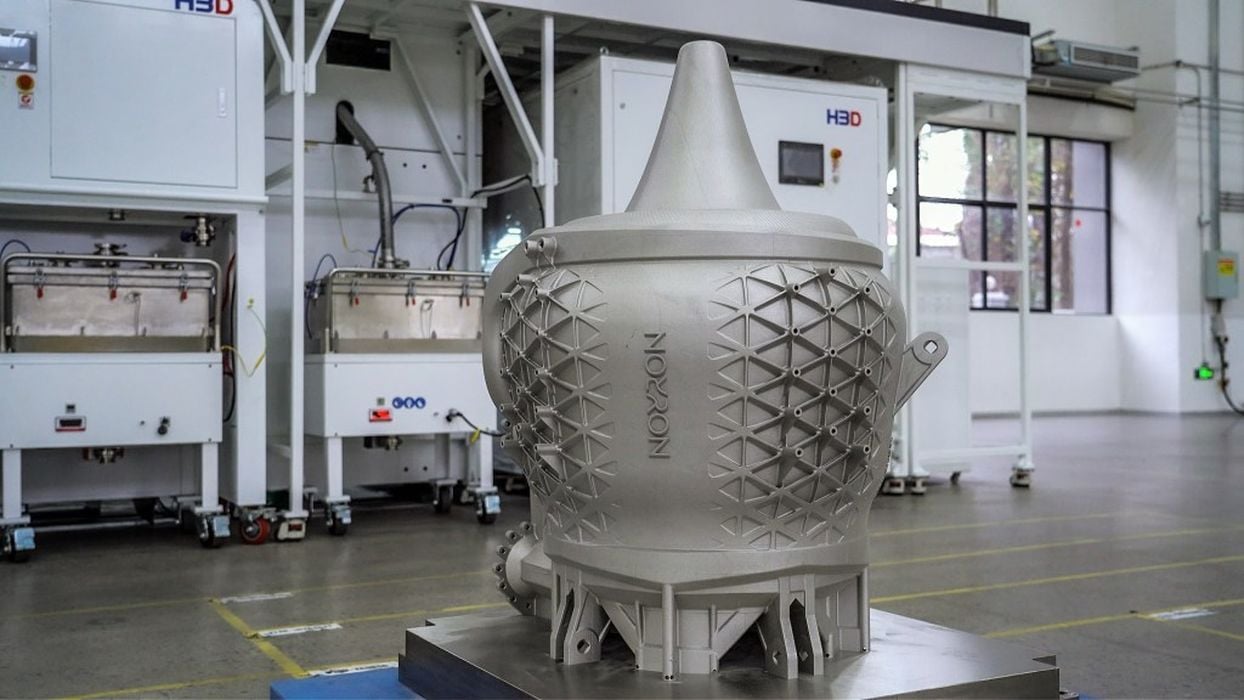
LEAP71 continues to break records, this time with the world’s largest 3D-printed aerospike rocket engine.
There’s quite a story behind this feat. Aerospike engines are very different from conventional rocket engines that use a “bell” to corral the explosive forces and push them backwards. But they suffer from pressure issues: a given engine bell works efficiently only at a certain air pressure. This is why you see “sea level” or “vacuum” versions of some rocket engines.
An aerospike engine is different. Instead of a bell, it uses a “spike”, and the explosion takes place outside, pushing a force on the carefully designed spike. This approach works efficiently regardless of the air pressure.
The problem is that making one of these magic rocket engines is extraordinarily complex. The geometries have to be just right to capture the maximum energy from the burning fuel, and the fuel and oxidizer must be efficiently delivered to the firing area, even at supersonic speeds. All of that has to occur while the engine itself is cooled via intricate embedded cooling channels.
Designing such a beast is so complex that it hasn’t had a chance of succeeding in the years since the idea was conceived. However, LEAP71 recently solved the problem with their generative design tool, Noyron. They use a computational engineering approach, in which “functions” automatically generate geometry in a voxel field. If you’d like to learn more about Computational Engineering, LEAP71’s Lin Kayser wrote a six-part series for us a couple of years ago.
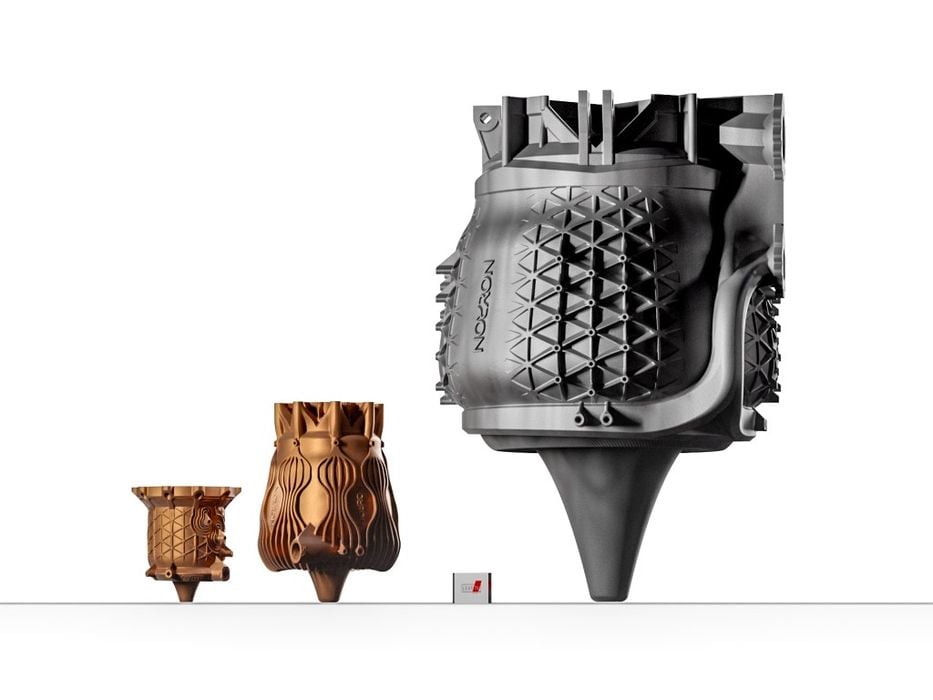
The news this week is that after a successful firing of their first aerospike engine, they have now scaled up the system and produced what is certainly the largest aerospike engine ever 3D-printed in metal, the XRA-2E5.
How big is this engine? They haven’t stated its weight, but obviously it’s quite large at one metre tall, and made from Inconel 718, a nickel superalloy. However, they did say that when fired, it is capable of producing 20 tonnes of force, which is significant.
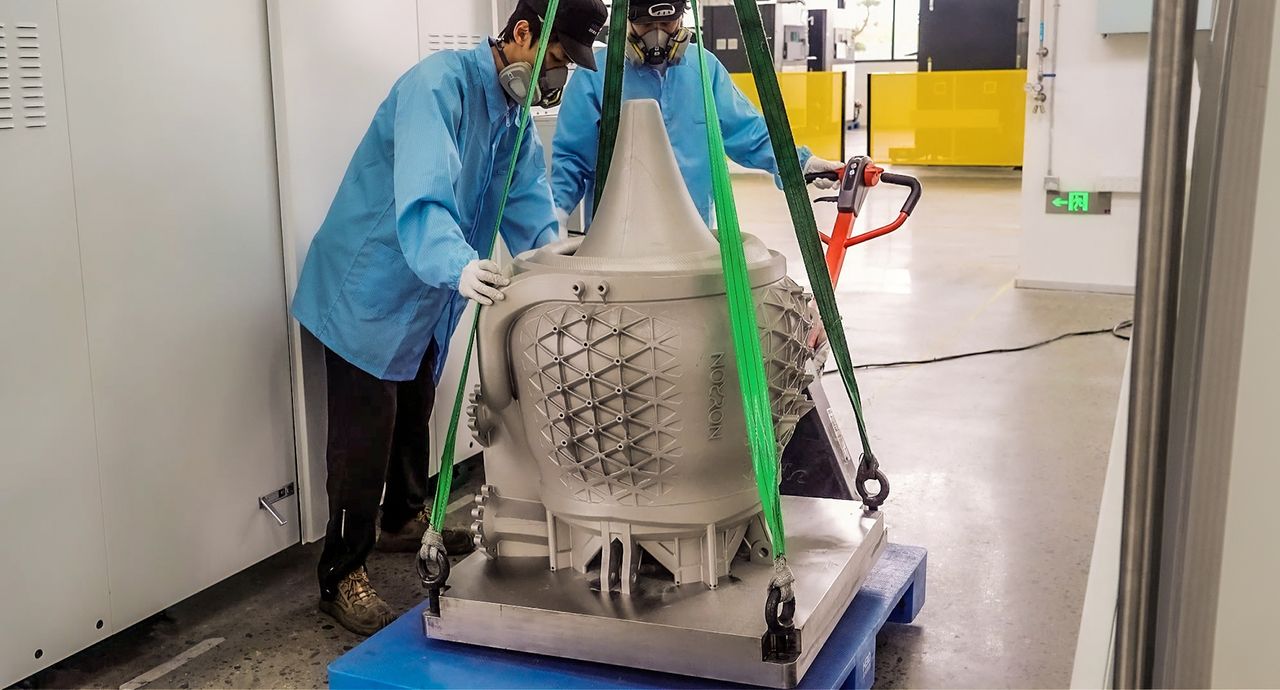
The XRA-2E5 was printed on a ten-laser HBD 800 metal 3D printer, and the job took 289 hours (12 days) to complete.
The next step will likely be a live firing of the XRA-2E5, which should be quite interesting. If it works, the Noyron technology just may have opened up a whole new rocket engine market.
Via LEAP71
