
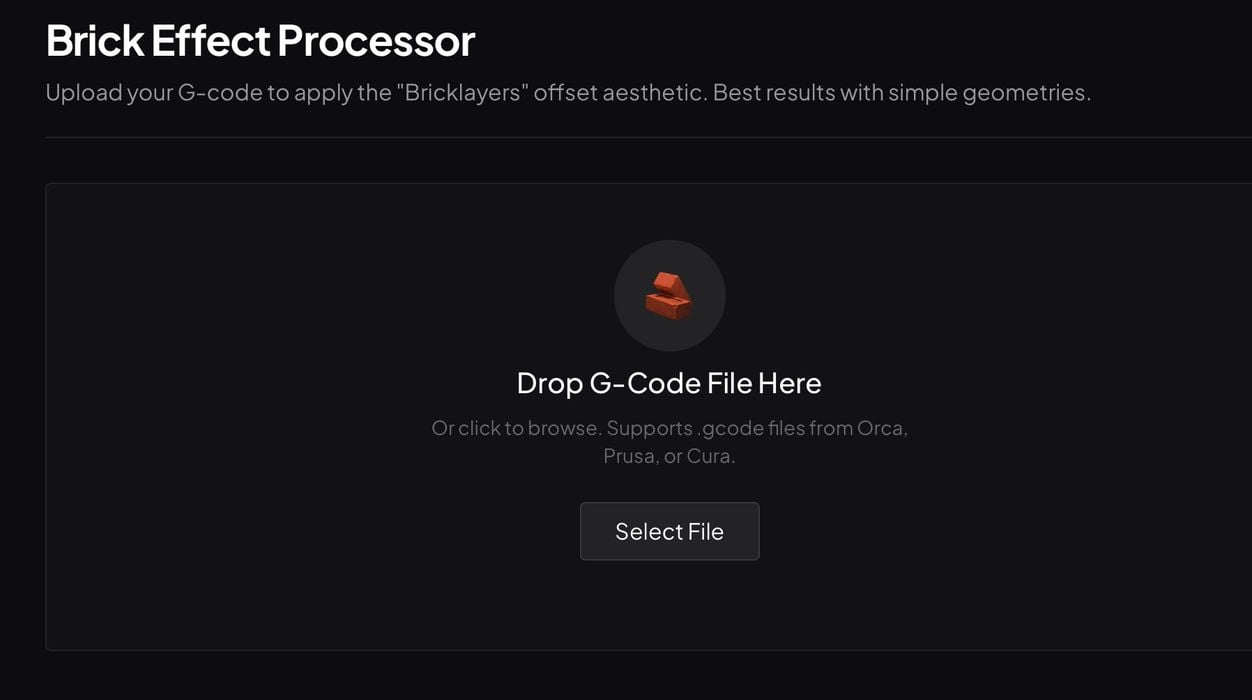
Using the Bricklayers approach to 3D printing has never been easier with the new Brick Effect Processor.
Hold on, what’s “Bricklayers”? It is a new concept for aligning extrusions in FFF 3D printing. Normally, extrusion lines are simply piled on top of each other. This means that the relatively small area where the two extrusions meet (top and bottom of the round extrusion line) is the only thing holding them together. That’s why FFF prints tend to be weakest along layer lines.
The Bricklayers approach is different. Instead of the normal layering approach, the extrusions are offset in height, resulting in a brick-like pattern as you can see below. This means there is more material touching each extrusion line, and therefore far more strength. In other words, print stronger parts on the same machine with only a software change.
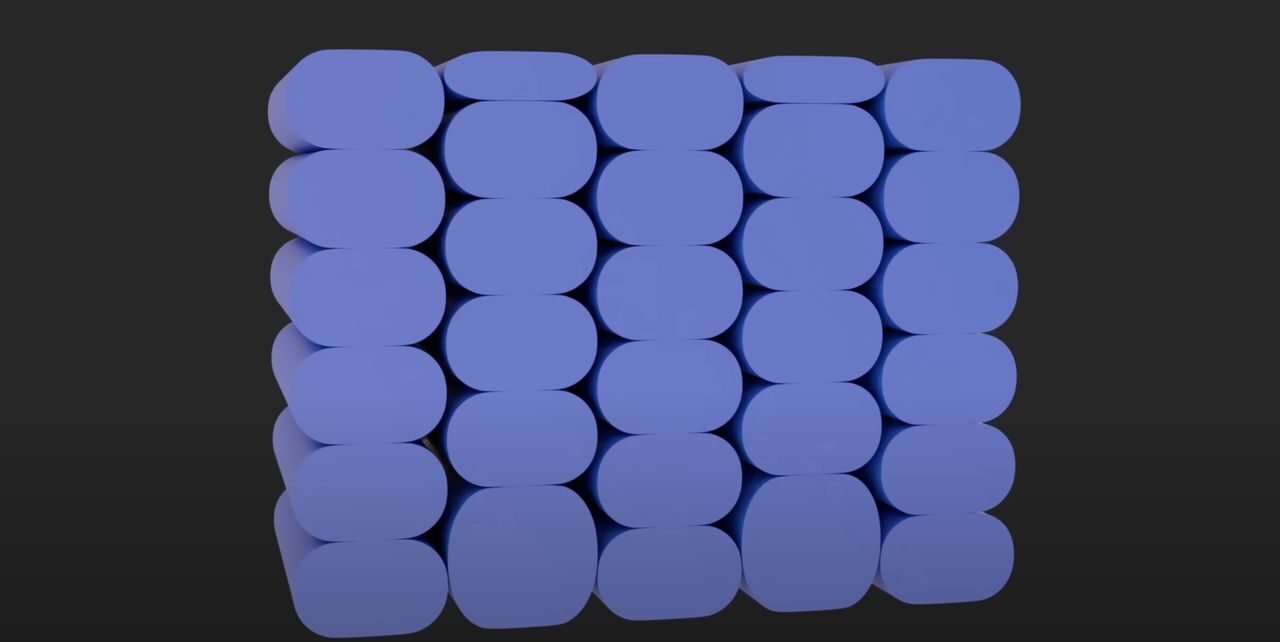
But then there’s that software change. How do you get the slicing software to prepare jobs in this way?
It turns out that this approach for extrusion has been patented in the US by ADDMAN years ago, and they’ve partnered with Create It REAL to implement the technology in a special slicing software tool.
Some are not interested in purchasing expensive slicing tools, as most 3D printers these days use free, open-source slicing tools. This led to some developing workarounds to generate Bricklayer-style toolpaths using their own software.
However, the method remained lightly used because it was challenging for many to implement. The rudimentary tools built by the community required installing Python, running scripts, and other command-line stuff that would baffle many 3D printer operators.
This scenario is now changed utterly with the introduction of Brick Effect Process online service by Minimal 3DP. Minimal 3DP offers a series of handy 3D print utilities, and the Brick Effect Process is a new one to their list.
They’ve taken all the tricky software development work and bundled it into this easy-to-use web page. How easy is it to use? There are only a few steps:
- Slice your job in the usual fashion with your favourite slicing tool.
- Drop the resulting G-code file into the Brick Effect Processor.
- Download the newly modified G-code.
- Print.
That’s it. It cannot get any simpler than this, unless the Bricklayers function is directly integrated into your slicing software.
While the process works quite smoothly, there is one possible issue: that patent, US11331848. The Bricklayers approach is indeed patented — but only in the US. If you were in the US and used this tool, the Brick Effect Processor would effectively be infringing on that patent and could be subject to a lawsuit. Users of the service are unlikely to be affected, as patent owners tend to pursue the creators of infringing services, not the users.
